
Animatiefilm ParaNorman baanbrekend door 3D-printtechniek. De nieuwe stop-motion animatiefilm ParaNorman is mede mogelijk gemaakt door een full color 3D-printer.

Via rapid prototyping konden de makers ruim 31.000 onderdelen printen. Stop-motion is de tijdrovende, maar zeer nostalgisch aandoende, animatietechniek waarbij echte poppetjes van klei of kunststof tot leven worden gewekt. Dit wordt gedaan door een personage in steeds een iets andere houding te fotograferen. Als de foto&39;s snel achter elkaar worden vertoond komt een personage tot leven. Vooral gezichten zijn lastig in dit soort films, omdat veel van de emotie van een minieme oogbeweging of een subtiele gezichtsuitdrukking afkomstig is. Maar liefst 31.000 afzonderlijke onderdelen voor de gezichten van de personages uit ParaNorman zijn afkomstig van een full color 3D-printer (van 3D Systems). 'Om de personages de gezichtsuitdrukkingen en emotionele ... Print je eigen schoenen. Stel je voor.

Je hebt de ideale jurk gevonden voor een avondje uit en staat klaar om te vertrekken. Maar pas dan besef je dat geen enkel paar schoenen echt bij je kleedje past. Binnenkort is er een eenvoudige oplossing voor zulke frustrerende situaties: je gaat even online, zoekt het design voor een droompaar uit en duwt op print. De 3D-print zorgt voor de rest. Volgens trendwatcher Jan Monnington Boddy is dat zelfs geen verre toekomstmuziek meer. Op dit moment zijn er zelfs als Bèta-versies van de technologie beschikbaar via online shops zoals desktopfactory.com.
3D manufacturing: Print me a phone. Xerox - On 3D Printing. Editor’s Note: This guest post is written by Chris Waldo, who is a technology enthusiast and copywriter with a focus in 3D printing.

He is currently working as the Content Manager for the 3D printing network, Kraftwurx. Follow him on Facebook or Twitter. We previously covered Chris’ work about renewable energy. Xerox has recently developed a new type of silver “ink” which has a few qualities to it that are truly unique. This silver has been engineered to melt at a temperature lower than plastic, film, and various fabrics.
“With the development of a new silver ink, Xerox scientists have paved the way for commercialization and low-cost manufacturing of printable electronics. Assuming that this silver can be melted onto various surfaces without melting them, we can approach the possibility of 3D printing circuits onto fabrics, plastics, and film. If a circuit can be placed on a surface, an electrical current can flow through it.
(photo credit: Solarinsolation) Bericht: Aston Martin DB5. 3D-printers. Collaborative manufacturing: All together now. NEW YORK CITY was once the capital of manufacturing in America, with more than 1m people working in the sector in 1950.
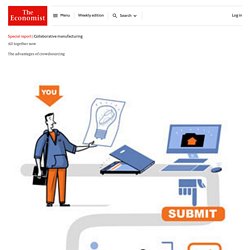
Today that number has shrunk to a mere 80,000, and they are employed largely by specialist producers in areas such as furnishing, food processing and the cluster that makes up Manhattan's vibrant garment district. Yet nourished by the city's entrepreneurial spirit, a new industry is emerging. It might be called social manufacturing. One of the firms involved is Quirky, which is as trendy as its name suggests.
Its new design studio in a converted warehouse near the Hudson river includes a small factory complete with a couple of 3D printers, a laser cutter, milling machines, a spray-painting booth and other bits of equipment. With the help of a growing online community, Quirky comes up with two new consumer products a week. Quirky's most successful product so far is called Pivot Power. Can you imagine? There are plenty of surprises in what people come up with. Koppen - 3D-printing. Een laserprinter die in 3D objecten print, laagje boven laagje.

In chocolade, titanium, plastic, suiker, noem maar op. De technologie is baanbrekend, want in theorie kunnen op die manier zelfs huizen worden ‘geprint’. In beton. De firma’s Melotte en Layerwise printen vooral objecten in metaal, Materialise uit Leuven werkt met kunststof. Layer by layer. Additive manufacturing: Solid print. INSIDE A LOW-RISE building in a business park at Rock Hill, South Carolina, is a vision of the factory of the future.
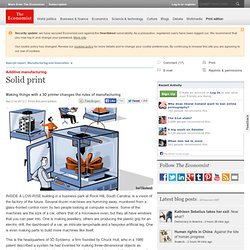
Several dozen machines are humming away, monitored from a glass-fronted control room by two people looking at computer screens. Some of the machines are the size of a car, others that of a microwave oven, but they all have windows that you can peer into. One is making jewellery, others are producing the plastic grip for an electric drill, the dashboard of a car, an intricate lampshade and a bespoke artificial leg. One is even making parts to build more machines like itself. This is the headquarters of 3D Systems, a firm founded by Chuck Hull, who in a 1986 patent described a system he had invented for making three-dimensional objects as “stereolithography”. 3D printing was originally conceived as a way to make one-off prototypes, but as the technology is getting better more things are being printed as finished goods (a process known as additive manufacturing).