
Deb Ness
National Spinal Cord Injury Association — a program of United Spinal Association. School of Health Sciences. Hands-on experienceMayo School of Health Sciences educates health professionals who are vital to delivering quality patient care.
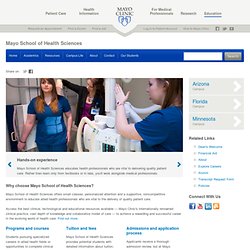
Rather than learn only from textbooks or in labs, you'll work alongside medical professionals. Preparing you for successAt Mayo School of Health Sciences, you'll find exceptional academic instruction in a supportive learning environment. Our students perform strongly on board exams and are highly sought after upon graduation. Faculty and mentorsOur faculty include Mayo Clinic physicians, researchers and allied health staff — professionals with real-world perspectives. You'll begin hands-on experience with patients and researchers early in your education. World-class resourcesBeing a student at Mayo School of Health Sciences means learning within one of the world's largest, most advanced medical centers.
Why choose Mayo School of Health Sciences? Programs and courses.
Tamaravosdraper. Colleagues. Medical Mission Trips, International Missions, Medical Volunteer. Lutheran Humanitarian Relief Organization in Tanzania. Global Health Ministries. Health Volunteers Overseas. Operation Blessing International. Internet Stroke Center at UT Southwestern Medical Center. Family/patient resources. The Rehabilitation Research and Training Center (RRTC) on Developing Strategies to Foster Community Integration and Participation (CIP) for Individuals with Traumatic Brain Injury - Resources and Publications. Patients & Families. Caregiver.com - For caregivers, about caregivers, by caregivers. School of Continuous Professional Development. The Diabetes Intensive Training online didactic is a comprehensive web based graduate credit level professional enhancement course.

Diabetes Intensive Training is an online self-paced 12 week course through Blackboard Learn. The course is offered on a quarterly basis. Neurorehabilitation Summit. The Diabetes Intensive Training online didactic is a comprehensive web based graduate credit level professional enhancement course.

Diabetes Intensive Training is an online self-paced 12 week course through Blackboard Learn. The course is offered on a quarterly basis. The curriculum includes a pretest, 16 modules for study, a post-test requiring an 80% passing score for continuing education credit, and a required survey evaluation of the course at completion. The 16 modules each take an average of two hours to complete and include self-assessments and case studies. Learn more. 19th Annual Brain Injury Conference. The Diabetes Intensive Training online didactic is a comprehensive web based graduate credit level professional enhancement course.

Diabetes Intensive Training is an online self-paced 12 week course through Blackboard Learn. The course is offered on a quarterly basis. The curriculum includes a pretest, 16 modules for study, a post-test requiring an 80% passing score for continuing education credit, and a required survey evaluation of the course at completion. The 16 modules each take an average of two hours to complete and include self-assessments and case studies. Learn more. Brain injury research. What is Traumatic Brain Injury?

Traumatic brain injury (TBI), a form of acquired brain injury, occurs when a sudden trauma causes damage to the brain. TBI can result when the head suddenly and violently hits an object, or when an object pierces the skull and enters brain tissue. Symptoms of a TBI can be mild, moderate, or severe, depending on the extent of the damage to the brain. A person with a mild TBI may remain conscious or may experience a loss of consciousness for a few seconds or minutes. Other symptoms of mild TBI include headache, confusion, lightheadedness, dizziness, blurred vision or tired eyes, ringing in the ears, bad taste in the mouth, fatigue or lethargy, a change in sleep patterns, behavioral or mood changes, and trouble with memory, concentration, attention, or thinking. Is there any treatment? Anyone with signs of moderate or severe TBI should receive medical attention as soon as possible.
What is the prognosis? What research is being done? Clinical Trials at Mayo Clinic. Model Systems Knowledge Translation Center. Stroke Research Network. The Rehabilitation Research and Training Center (RRTC) on Developing Strategies to Foster Community Integration and Participation (CIP) for Individuals with Traumatic Brain Injury - Resources and Publications. Outcome measures. COMBI-Featured Scales. Materials available for featured instruments often include contact information, background information, scale syllabi, administration and scoring guidelines, training and testing materials, information on scale properties, references, scale forums, and frequently asked questions.

Rating forms for nonproprietary instruments are usually available for download. In cases of proprietary instruments, you will find background and contact information. Advocacy Activity Scale (AAS) A 14-item instrument used to provide a measure of involvement in a range of activities representing advocacy for people with acquired brain injury. Agitated Behavior Scale (ABS) A 14-item instrument used for serial assessment of agitation by clinician raters. Apathy Evaluation Scale (AES) An 18-item instrument used for evaluation of apathy. Awareness Questionnaire (AQ) An 18-item measure of self-awareness. Cognitive Log (Cog-Log) A 10-item measure used for serial measurement of cognition by clinician raters.
Professional organizations. Search engines.