
Hello parents, teachers, and blog readers! We’ve. Hello parents, teachers, and blog readers!
We’ve received so much interest in The Kid Should See This and for the educational videos featured here — especially for the science vids — that we’d love to focus that attention on the teachers who are bringing science education to life for kids every day. If you’ve liked watching videos on this ad-free blog, want to let the co-curator and I know that the research and work put into this site has meant something to you, and above all want to directly help students in need, then please consider giving this site a small tip in our tip jar by supporting one of the science-focused projects that we’ve picked on DonorsChoose.org.
It works like this: 1. Donate money to a classroom project that you like 2. 3. Write in the Middle: A Workshop for Middle School Teachers. Official: 10 states to get education waiver. Ten states got the green light Thursday to pursue school reforms without being tethered to the requirements of the federal No Child Left Behind law.
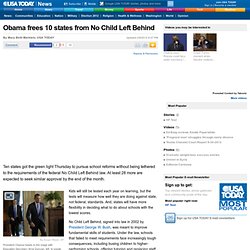
At least 28 more are expected to seek similar approval by the end of the month. Kids will still be tested each year on learning, but the tests will measure how well they are doing against state, not federal, standards. And, states will have more flexibility in deciding what to do about schools with the lowest scores. No Child Left Behind, signed into law in 2002 by President George W. Bush, was meant to improve fundamental skills of students. STORY: Obama hopes housing, education moves deflect controversies President Obama said Thursday the law is too punitive and driving the wrong behaviors.
SPED. FlexBooks. How to Learn Without Memorizing. Photo by Edwin Stemp Rote memorization is an inefficient way to learn.
Teacher Tools. Kids. KidzTimez - Todays News for Kids, by Kids. K-12 Rubrics and Assessment. Technology. Home. NCEE - National Centre for Entrepreneurship in Education. Six Questions for Entrepreneurial Leadership and Innovation in Distance Education. Six Questions for Entrepreneurial Leadership and Innovation in Distance Education by Connie Reimers-Hild, Ph.D., University of Nebraska-Lincoln, and James W.
King, Ed.D., University of Nebraska-LincolnWinter 2009, Online Journal of Distance Learning Administration Introduction Entrepreneurial individuals and continuous innovation are vital components of successful organizations. Therefore, the public and private sectors must develop the entrepreneurial characteristics and actions of individuals with a focus on innovation.
Research has shown that entrepreneurial individuals (Krueger, 2000), learners (Reimers-Hild, 2005), educational institutions (King & Cornell, 1992) and leaders (Gupta, MacMillan & Surie, 2004) are needed to address the complex global issues associated with the continuously evolving knowledge economy. Distance education administrators can become entrepreneurial leaders by recognizing that leadership and innovation are critical throughout every level of the organization. Language Arts Websites.
3-6 Student Interactives - Language Arts. Language. Reading. Interesting reading. Activities. EDUCATION. Education Resources. Critical thinking. Blooms. «Free digital tools in Blooms. This list is distinctive as the resources are a) free and b) almost exclusively browser based.

The list is also sorted by Blooms, meaning you are able to more easily consider your student outcomes FIRST. There are a few exceptions. A number of resources listed offer ‘pro’ services, but are still particularly useful using the free services they offer. There are a couple of software downloads included. Notably, Jing and Audacity, which are free and powerful products in the classroom and I felt compelled to include them. Have a favourite that’s missing? Creating (Higher order thinking): Designing, constructing, planning, producing, inventing, devising, making) Applications: Bloom's Apps - 21nnovate. Testmoz - The Test Generator. Shmoop: Homework Help, Teacher Resources, Test Prep.
The Best Videos For Educators In 2011. This is always one of my favorite year-end lists to do…..
You might also be interested in: Part Two Of The Best Videos For Educators — 2010 The Ten Best Videos For Educators — 2010 And you might also want to see The Best Funny Videos Showing The Importance Of Being Bilingual — Part One and The Best Videos Illustrating Qualities Of A Successful Language Learner. 100 Incredibly Useful YouTube Channels for Teachers. YouTube has earned a reputation for featuring brain cell-slaughtering fare such as the truly abysmal Fred and playing host to the some of the most depressingly stupid comments this side of Yahoo!
News. It’s said that there’s nothing new under the sun, Evernote for Education. Android App: I use the desktop version at home and the office, the Android app on my HTC One smartphone, my tablets, web version on my Chromebook.
Common Core. Professional Learrning. Apps for Professional Development. Twitter App (free) Twitter is one of the most active and beneficial social networks on the web.
All educators would be wise to join the conversation. If you haven’t used Twitter yet, I would recommend that you read these excellent blog posts: Google Voice (free) Text and call for free! The Oxford Institute for Environmental Education. Webinars – Google Apps for Education. General Learn about all of the features and benefits of Google Apps Education Edition.
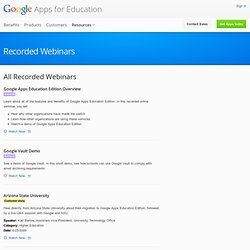
In this recorded online seminar, you will: Hear why other organizations have made the switch Learn how other organizations are using these services Watch a demo of Google Apps Education Edition. 200 Free Online Classes to Learn Anything. Written by: Thomas Broderick Universities, colleges, and private organizations offer free online college courses to help students acquire new knowledge and skills. These courses cover a variety of traditional academic topics and other subjects that can lead to career advancement and personal enrichment.
Pgrteach. Graphic Organizers.