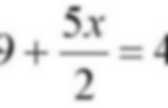
Quadratic form. In mathematics, a quadratic form is a homogeneous polynomial of degree two in a number of variables.

For example, is a quadratic form in the variables x and y. Introduction[edit] Quadratic forms are homogeneous quadratic polynomials in n variables. In the cases of one, two, and three variables they are called unary, binary, and ternary and have the following explicit form: where a, ..., f are the coefficients.[1] Note that quadratic functions, such as ax2 + bx + c in the one variable case, are not quadratic forms, as they are typically not homogeneous (unless b and c are both 0). Orthogonal complement. In the mathematical fields of linear algebra and functional analysis, the orthogonal complement of a subspace W of a vector space V equipped with a bilinear form B is the set W⊥ of all vectors in V that are orthogonal to every vector in W.

Informally, it is called the perp, short for perpendicular complement. It is a subspace of V. General bilinear forms[edit] Let V be a vector space over a field F equipped with a bilinear form B. We define u to be left-orthogonal to v, and v to be right-orthogonal to u, when B(u,v) = 0. There is a corresponding definition of right orthogonal complement. Properties[edit] An orthogonal complement is a subspace of V;If X ⊆ Y then X⊥ ⊇ Y⊥;The radical V⊥ of V is a subspace of every orthogonal complement;W⊥⊥ ⊇ W;If B is non-degenerate and V is finite-dimensional, then dim W + dim W⊥ = dim V. Example[edit] In special relativity the orthogonal complement is used to determine the simultaneous hyperplane at a point of a world line.
Inner product spaces[edit] Quaternionic projective space. In mathematics, quaternionic projective space is an extension of the ideas of real projective space and complex projective space, to the case where coordinates lie in the ring of quaternions H.

Quaternionic projective space of dimension n is usually denoted by and is a closed manifold of (real) dimension 4n. It is a homogeneous space for a Lie group action, in more than one way. In coordinates[edit] Its direct construction is as a special case of the projective space over a division algebra. Where the are quaternions, not all zero. In the language of group actions, is the orbit space of by the action of , the multiplicative group of non-zero quaternions. One may also regard. Homogeneous coordinates. Rational Bézier curve – polynomial curve defined in homogeneous coordinates (blue) and its projection on plane – rational curve (red) In mathematics, homogeneous coordinates or projective coordinates, introduced by August Ferdinand Möbius in his 1827 work Der barycentrische Calcül,[1][2] are a system of coordinates used in projective geometry, as Cartesian coordinates are used in Euclidean geometry.

They have the advantage that the coordinates of points, including points at infinity, can be represented using finite coordinates. Formulas involving homogeneous coordinates are often simpler and more symmetric than their Cartesian counterparts. Homogeneous coordinates have a range of applications, including computer graphics and 3D computer vision, where they allow affine transformations and, in general, projective transformations to be easily represented by a matrix.
Introduction[edit] To summarize: Homogeneous polynomial. Split-complex number. A portion of the split-complex number plane showing subsets with modulus zero (red), one (blue), and minus one (green).

In abstract algebra, the split-complex numbers (or hyperbolic numbers, also perplex numbers) are a two-dimensional commutative algebra over the real numbers different from the complex numbers. Every split-complex number has the form x + y j, where x and y are real numbers. The number j is similar to the imaginary unit i, except that j2 = +1. As an algebra over the reals, the split-complex numbers are the same as the direct sum of algebras R ⊕ R (under the isomorphism sending x + y j to (x + y, x − y)).
In interval analysis, a split complex number x + y j represents an interval with midpoint x and radius y. Split-complex numbers have many other names; see the synonyms section below. Definition[edit]