
Shape of the Universe. The shape of the universe is the local and global geometry of the universe, in terms of both curvature and topology (though, strictly speaking, it goes beyond both).
When physicsist describe the universe as being flat or nearly flat, they're talking geometry: how space and time are warped according to general relativity. When they talk about whether it open or closed, they're referring to its topology.[1] Although the shape of the universe is still a matter of debate in physical cosmology, based on the recent Wilkinson Microwave Anisotropy Probe (WMAP) measurements "We now know that the universe is flat with only a 0.4% margin of error", according to NASA scientists. [2] Theorists have been trying to construct a formal mathematical model of the shape of the universe. In formal terms, this is a 3-manifold model corresponding to the spatial section (in comoving coordinates) of the 4-dimensional space-time of the universe. Two aspects of shape[edit] Local geometry (spatial curvature)[edit] Quintessence (physics)
In physics, quintessence is a hypothetical form of dark energy postulated as an explanation of the observation of an accelerating rate of expansion of the Universe announced in 1998.
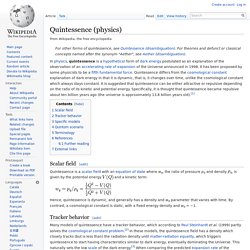
It has been proposed by some physicists to be a fifth fundamental force. Quintessence differs from the cosmological constant explanation of dark energy in that it is dynamic, that is, it changes over time, unlike the cosmological constant which always stays constant. It is suggested that quintessence can be either attractive or repulsive depending on the ratio of its kinetic and potential energy. Specifically, it is thought that quintessence became repulsive about ten billion years ago (the universe is approximately 13.8 billion years old).[1] q, is given by the potential energy and a kinetic term: Hence, quintessence is dynamic, and generally has a density and wq parameter that varies with time. Jump up ^ Christopher Wanjek; "Quintessence, accelerating the Universe? " Ostriker JP, Steinhardt P (January 2001).
Diffeomorphism. The image of a rectangular grid on a square under a diffeomorphism from the square onto itself.
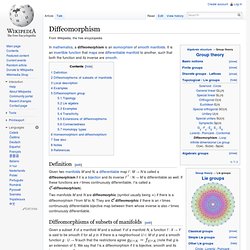
Definition[edit] Given two manifolds M and N, a differentiable map f : M → N is called a diffeomorphism if it is a bijection and its inverse f−1 : N → M is differentiable as well. If these functions are r times continuously differentiable, f is called a Cr-diffeomorphism). Two manifolds M and N are diffeomorphic (symbol usually being ≃) if there is a diffeomorphism f from M to N. They are Cr diffeomorphic if there is an r times continuously differentiable bijective map between them whose inverse is also r times continuously differentiable. Diffeomorphisms of subsets of manifolds[edit] Given a subset X of a manifold M and a subset Y of a manifold N, a function f : X → Y is said to be smooth if for all p in X there is a neighborhood U ⊂ M of p and a smooth function g : U → N such that the restrictions agree (note that g is an extension of f).
Local description[edit] Remark 1. Remark 2. Remark 3. Let. Ekpyrotic universe. The ekpyrotic universe, or ekpyrotic scenario, is a cosmological model of the origin and shape of the universe.

The name comes from a Stoic term ekpyrosis (Ancient Greek ἐκπύρωσις ekpurōsis) meaning conflagration or in Stoic usage "conversion into fire".[1] The ekpyrotic model of the universe is an alternative to the standard cosmic inflation model for the very early universe; both models accommodate the standard Big Bang Lambda-CDM model of our universe.[2][3] The ekpyrotic model is a precursor to, and part of, some cyclic models.
The ekpyrotic model came out of work by Neil Turok and Paul Steinhardt and maintains that the universe did not start in a singularity, but came about from the collision of two branes. This collision avoids the primordial singularity and superluminal expansion of spacetime while preserving nearly scale-free density fluctuations and other features of the observed universe. See also[edit] Notes and references[edit] Further reading[edit] P.