
What is Digital Curation? The digital curation lifecycle Digital curation and data preservation are ongoing processes, requiring considerable thought and the investment of adequate time and resources.
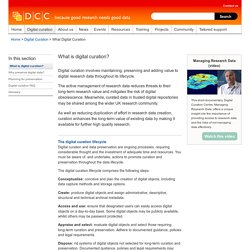
You must be aware of, and undertake, actions to promote curation and preservation throughout the data lifecycle. The digital curation lifecycle comprises the following steps: Conceptualise: conceive and plan the creation of digital objects, including data capture methods and storage options. Create: produce digital objects and assign administrative, descriptive, structural and technical archival metadata. Access and use: ensure that designated users can easily access digital objects on a day-to-day basis. Appraise and select: evaluate digital objects and select those requiring long-term curation and preservation. Dispose: rid systems of digital objects not selected for long-term curation and preservation. Reappraise: return digital objects that fail validation procedures for further appraisal and reselection. Digital curation. The term curation in the past commonly referred to museum and library professionals.
It has since been applied to interaction with social media including compiling digital images, web links and movie files. Approaches to digital curation[edit] The Digital Curation Centre is a "world leading centre of expertise in digital information curation"[5] that assists higher education research institutions. The DCC is based in the UK and began operations in early 2004. The following is a general outline of their approach to digital curation: Conceptualize: Consider what digital material you will be creating and develop storage options. Sheer curation[edit] Sheer curation is an approach to digital curation where curation activities are quietly integrated into the normal work flow of those creating and managing data and other digital assets. A similar idea is curation at source used in the context of Laboratory Information Management Systems LIMS.
Channelisation[edit] See also[edit] References[edit] 22 Web App Tools For Editors & Writers. Writing is an interesting career that carries with it a sense of instant gratification.
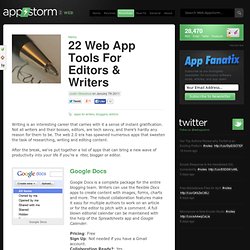
Not all writers and their bosses, editors, are tech savvy, and there’s hardly any reason for them to be. The web 2.0 era has spawned numerous apps that sweeten the task of researching, writing and editing content. After the break, we’ve put together a list of apps that can bring a new wave of productivity into your life if you’re a riter, blogger or editor. Google Docs Google Docs Google Docs is a complete package for the entire blogging team. Pricing: Free Sign Up: Not needed if you have a Gmail account. Springpad Springpad I have been using Springpad for the past month for all bookmarking and scrap booking needs and is one of the best apps I have discovered so far. Pricing: FreeSign Up: Required.Collaboration Ready? Wridea Wridea Wridea is a web app that helps bloggers avoid ideas from being forgotten, then to organize and improve those ideas. LooseStitch LooseStitch Writeboard Writeboard AutoCrit AutoCrit Jing.
Curating Information as Content Strategy. Content, which is anything that informs, educates, or entertain online, is your business digital body language.

The Internet changed how people find and read content. While it was helpful to have a strategy for publishing information about your business before the Web, people didn't necessarily track if what you gave them as brochures and papers was integrated with everything else. Online, it's easier to see all of the different outputs of an organization side by side -- and to notice whether they connect the dots, or if they seem to come from separate businesses. It is more attractive to buy from a business that has its act together. You find out through search. Why content is important On the Web, people trade attention for good, useful content.
There are still companies that struggle with the idea of becoming content producers, and thus have not yet formulated a content strategy. Some organizations are affected by the sprawling issue when it comes to content.