
Transmission Control Protocol. Web browsers use TCP when they connect to servers on the World Wide Web, and it is used to deliver email and transfer files from one location to another.
HTTP, HTTPS, SMTP, POP3, IMAP, SSH, FTP, Telnet and a variety of other protocols are typically encapsulated in TCP. Historical origin[edit] In May 1974 the Institute of Electrical and Electronic Engineers (IEEE) published a paper titled "A Protocol for Packet Network Intercommunication. "[1] The paper's authors, Vint Cerf and Bob Kahn, described an internetworking protocol for sharing resources using packet-switching among the nodes. Network function[edit] The protocol corresponds to the transport layer of TCP/IP suite. TCP is utilized extensively by many of the Internet's most popular applications, including the World Wide Web (WWW), E-mail, File Transfer Protocol, Secure Shell, peer-to-peer file sharing, and some streaming media applications.
TCP segment structure[edit] A TCP segment consists of a segment header and a data section. Anonymous dupes users into joining Megaupload attack. News January 20, 2012 02:29 PM ET Computerworld - The Anonymous hacking group recruited unwitting accomplices in Thursday's attacks against U.S. government sites, a security researcher said today.
The distributed denial-of-service (DDoS) attacks began Thursday just hours after the U.S. Department of Justice announced arrests of four men associated with the popular Megaupload "cyberlocker" site on charges of copyright infringement, money laundering and racketeering. Federal authorities shuttered Megaupload.com and other sites, and seized assets belonging to the company, including hundreds of servers. Almost immediately, Anonymous retaliated with DDoS attacks against Justice's website, and those operated by Universal Music, the Recording Industry Association of America (RIAA), the Motion Picture Association of America (MPAA), and others.
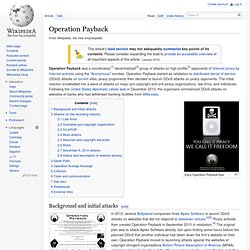
But some of the 5,600 who participated may have done so unwittingly, said Graham Cluley, a senior technology consultant with U.K. . Operation Payback. Early Operation Payback flyer Background and initial attacks[edit] Media detailing the attack on Gallant Macmillian Attacks on the recording industry[edit] Law firms[edit] On 21 September 2010, the website of ACS:Law was subjected to a DDoS attack as part of Operation Payback.
When the site came back online, a 350MB file which was a backup of the site was visible to anyone for a short period of time.[13] The backup, which included copies of emails sent by the firm, was downloaded and made available onto various peer-to-peer networks and websites including The Pirate Bay.[13][14][15] Some of the emails contained unencrypted Excel spreadsheets, listing the names and addresses of people that ACS:Law had accused of illegally sharing media. On 30 September, the Leesburg, VA office of Dunlap, Grubb & Weaver law firm – also doing business as the "U.S. Australian pro-copyright organization[edit] ACAPOR[edit] More attacks[edit] Musician and copyright advocate[edit] RIAA[edit] Sarah Palin[edit]