
35 Amazing Uses For Old Pallets. Matei Apostolescu - Work (higher resolution images) Aromas-Wheel.jpg (JPEG Imagen, 1024x1365 píxeles) - Escalado (66%) Sky Series Selected Works. 14 Punctuation Marks That You Never Knew Existed. Recent posts. 73% uploaded. Science. MIT discovers the location of memories: Individual neurons. Update 12/2/15: We’ve now followed up on this story: The more we learn about memory, the weirder it gets.

The original continues below. MIT researchers have shown, for the first time ever, that memories are stored in specific brain cells. By triggering a small cluster of neurons, the researchers were able to force the subject to recall a specific memory. By removing these neurons, the subject would lose that memory. As you can imagine, the trick here is activating individual neurons, which are incredibly small and not really the kind of thing you can attach electrodes to. Now, just to temper your excitement, we should note that MIT’s subjects in this case are mice — but it’s very, very likely that the human brain functions in the same way.
In the experiment, MIT gave mice an electric shock to create a fear memory in the hippocampus region of the brain (pictured above) — and then later, using laser light, activated the neurons where the memory was stored. University Archive for the History of Economic Thought. How to Disagree. March 2008 The web is turning writing into a conversation.
Twenty years ago, writers wrote and readers read. The web lets readers respond, and increasingly they do—in comment threads, on forums, and in their own blog posts. Many who respond to something disagree with it. That's to be expected. The result is there's a lot more disagreeing going on, especially measured by the word. If we're all going to be disagreeing more, we should be careful to do it well. DH0. This is the lowest form of disagreement, and probably also the most common. U r a fag!!!!!!!!!! Ideas, issues, knowledge, data - visualized! Diffraction Limited Photography: Pixel Size, Aperture and Airy Disks. Diffraction is an optical effect which limits the total resolution of your photography — no matter how many megapixels your camera may have.
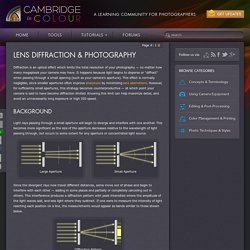
It happens because light begins to disperse or "diffract" when passing through a small opening (such as your camera's aperture). This effect is normally negligible, since smaller apertures often improve sharpness by minimizing lens aberrations. However, for sufficiently small apertures, this strategy becomes counterproductive — at which point your camera is said to have become diffraction limited. Knowing this limit can help maximize detail, and avoid an unnecessarily long exposure or high ISO speed. Light rays passing through a small aperture will begin to diverge and interfere with one another. Large Aperture Small Aperture Since the divergent rays now travel different distances, some move out of phase and begin to interfere with each other — adding in some places and partially or completely canceling out in others.
Economagic: Economic Time Series Page. High Intensity Interval Training: Sprint Interval Workout. This sprint interval workout is a type high intensity interval training (HIIT) that helps build endurance, increase your anaerobic threshold and burn more calories and fat both during and after your workout.

For this workout, you'll have a longer warm up (10 minutes) before going into 4 all-out sprints at a Level 9 on this perceived exertion chart for 30 seconds each. Between each sprint, you'll recover at an easy pace for 4.5 minutes, giving you plenty of time to get ready for the next sprint. Keep in mind that all-out effort is very challenging, so modify the sprint intervals as needed to fit your fitness level and goals. You can do this workout on any cardio machine (set to manual mode) or with any outdoor activity such as walking, running or cycling.
This workout is best for intermediate or advanced exercisers. How Can I Set Up a Home Recording Studio on the Cheap? Also, keep in mind that not everyone needs an audio interface. if you are only recording one track at a time or are recording more than one track but are fine with mixing it as you record you can use a much cheaper and oodles simpler analog mixing board/mixer. i struggled for over a year with a USB audio interface box i bought for home recording and it was ALWAYS a hassle - either really high latency, dropped sections, or it would take 15-20 minutes of fiddling with system prefs and settings in software to get it to work right. i finally went to my local music store and picked up a behringer analog mixer for $49 which has 8-Inputs (2 mic, 2 stereo, 1 stereo tape/CD), builtin EQ, effects send/receive, and the mic jacks have phantom power and the line inputs work great for electric instruments, a headphone out and I use an RCA-to-mini-1/8th-stereo plug to connect directly into the mic jack on my mac mini.

It's simple, always works, and has real knobs and buttons.
Getting started.