
Researchers Develop Lithium Ion Battery That Can Charge an Electric Car for 27-Years. The problem with electric cars these days is that their lithium-ion batteries need to be replaced every few years, with some costing in the upwards of $10,000+.

Researchers at the Center for Solar Energy and Hydrogen Research Baden-Wurttemburg (ZSW) have developed one of the most efficient lithium-ion batteries yet, and in an electric vehicle they’re expected to retain 85% of their capacity after being charged every day for “about 27.4 years.” According to Inhabitat: “After 10,000 complete charging and discharging cycles, with a complete charge and discharge cycle per hour, these lithium-ion batteries still retain more than 85% of the initial capacity. This means that an electric car with those batteries could be fully charged every day for about 27.4 years and still be going strong. The power density of these batteries, which measures the available power per unit of weight, is also very high at 1,100 watts per kilogram. Source: Super-powered battery breakthrough claimed by US team. 17 April 2013Last updated at 14:23 ET By Leo Kelion Technology reporter Researchers claim their technology could shrink the size of batteries by 10 times while offering the same power A new type of battery has been developed that, its creators say, could revolutionise the way we power consumer electronics and vehicles.
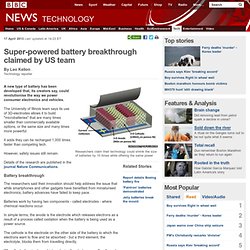
The University of Illinois team says its use of 3D-electrodes allows it to build "microbatteries" that are many times smaller than commercially available options, or the same size and many times more powerful.
Graphene Super Capacitor. High Surface Area Batteries. Silicon Nanotube Batteries. Sulfer Batteries. Fuel Cells. Other Battery Ideas. Inexpensive material boosts battery capacity. Next-generation lithium-ion batteries made with iron oxide nanoparticles could extend the driving distance of electric cars.

Battery-powered cars offer many environmental benefits, but a car with a full tank of gasoline can travel further. By improving the energy capacity of lithium-ion batteries, a new electrode made from iron oxide nanoparticles could help electric vehicles to cover greater distances. Developed by Zhaolin Liu of the A*STAR Institute of Materials Research and Engineering, Singapore, and Aishui Yu of Fudan University, China, and co-workers, the electrode material is inexpensive, suitable for large-scale manufacturing and can store higher charge densities than the conventional electrodes used in lithium-ion batteries1.