
Wp-content/uploads/2011/05/Anthology-Teachers-Guide.pdf. G-ecx.images-amazon.com/images/G/01/books/harper/pdf/everythingonit_booklet5._V167701331_.pdf. The Sound of Music Cast Today - Charmian Carr. The Persuaders. All Games - Micrsoft Office Game Templates by Dr. Jeff Ertzberger UNC Wilmington. Big Board Facts Similar to Jeopardy.
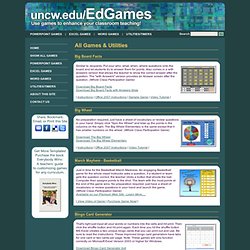
Put your who, what, when, where questions onto the board and let students try to answer them for points. Also comes in a with answers version that allows the teacher to show the correct answer after the question. The "with Answers" version provides an Answer screen after the question. (Whole Class Participation Game) Download Big Board Facts Download Big Board Facts with Answers Slide | Instructions | Office 2007 Instructions | Sample Game | Video Tutorial | Big Wheel No preparation required, just have a sheet of vocabulary or review questions in your hand. Download The Big Wheel Download The Big Wheel Elementary | Instructions | Office 2007 Instructions | Video Tutorial | /elements.htm. Infographic: Write It Down. Khan Academy - StumbleUpon.
Education. Teaching Debate: debate class. Many teachers believe that debating is something you do once, or a few times, and then it's done.
The Teacher's Desk- Printable Newsletters & Calendars- 2care2teach4kids.com. Here you will find all kinds of free printable files used mainly for school to home communication.
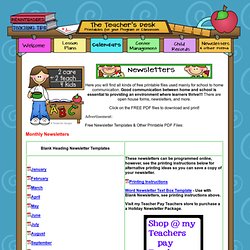
Good communication between home and school is essential to providing an environment where learners thrive!!! There are open house forms, newsletters, and more. Unsolved Mysteries: Introduction to Research. Www.coreknowledge.org/mimik/mimik_uploads/documents/67/CCSH.pdf. 95.01.07: It’s A Mystery To Me. Edgar Allan Poe is credited with writing the first detective story, The Murders in the Rue Morgue.
With this story and several others, he set down the standards for all future writers of detective fiction. The discussion that follows is meant to give a broad overview of the genre and subgenre of detective fiction. This is not meant to be a comprehensive discussion, but rather is presented as a brief introduction to the detective story. Much of the information is credited to Hillary Waugh from his book Guide to Mysteries and Mystery Writing.
Most detective stories, but not all, have as the main character an eccentric detective. Many detective stories have an admiring and slightly stupid foil who chronicles the accomplishments of the detective. What's Next™ Database. Our What's Next®: Books in Series database helps you search series fiction.
A series is two or more books linked by character(s), settings, or other common traits. Oral English Activities. Speech and Public Speaking. Debate Deconstructed. As of July 1, 2013 ThinkQuest has been discontinued.
We would like to thank everyone for being a part of the ThinkQuest global community: Reciprocal Revision: Making Peer Feedback Meaningful. ReadWriteThink couldn't publish all of this great content without literacy experts to write and review for us.
If you've got lessons plans, activities, or other ideas you'd like to contribute, we'd love to hear from you. More Find the latest in professional publications, learn new techniques and strategies, and find out how you can connect with other literacy professionals. Sometimes Learning Hurts: Using Revision Activities. As promised, here is the reverse outline and some other activities to help students approach revisions of drafts.
Feel free to modify them as you see fit, and contact me with questions and ideas for using these and other revision tools. Fourth Meetup: Creative Writing Exercises Extravaganza : : The Writing Nut. We met at the Mitsuwa Food Court last September 30, 2010 for our first ever Creative Writing Session.
After a quick review of last week’s meeting, we dove into this meetup’s session—which was about getting the creative juices flowing and about mastering the art of description. The first part of the meetup was about generating/ sparking story ideas, and what to do with these story ideas, once generated. The second part of the meetup was dedicated to various writing activities. The writing exercises were designed to improve writing skills, by honing the use of language. The $39 Experiment: Asking Random Companies for Free Stuff. Letter Generator. Is a Sentence a Poem? Picture Books as Framing Texts: Research Paper Strategies for Struggling Writers. ReadWriteThink couldn't publish all of this great content without literacy experts to write and review for us.
If you've got lessons plans, videos, activities, or other ideas you'd like to contribute, we'd love to hear from you. More Find the latest in professional publications, learn new techniques and strategies, and find out how you can connect with other literacy professionals. More Teacher Resources by Grade. Chicago Tribune News in Education - chicagotribune.com. Americans experience Russia deja vu Teachers: Download the lesson and print it out for use in your classroom.
(PDF format) Common Core State Standard RL.CSS.2/4 Grades 6-12: Students determine the meaning of political cartoons through the analysis of their literal, symbolic and figurative meanings of the elements the artist used and their effect. Students are asked to describe the overall effect of the cartoon, and how the artist’s choices combine to create that effect. Finally, students determine the purpose of the cartoon and how it relates to current issues through discussion questions.
IDEA: International Debate Education Association - Debate Resources & Debate Tools. Docs - Home. The Basic Skills of Debating. RE: Electives - Outlook Web Access Light. Building a Middle School Debate Team. Building a Team Materials for Building and Organizing a Team.