
Deep Sea Photography: Deep-sea Animals. …free your imagination… Plants & Animals News. DSWild-Boar-21.jpg (JPEG Image, 652x435 pixels) Morsa3.jpg (JPEG Image, 650x469 pixels) Monkey_6.jpg (JPEG Image, 400x580 pixels) 6a00d8341bf8f353ef014e8be9731b970d-800wi (JPEG Image, 800x586 pixels) Lost in a Warming World? II by Dennis_Bromage. Ss-091103-animal-friends-12.ss_full.jpg (JPEG Image, 1200x796 pixels) - Scaled (64. Turtle_eating_flower_girl-600x400.jpg (JPEG Image, 600x400 pixels) Biology That Makes Us Tick: Free Stanford Course by Robert Sapolsky. How To Be A Bat [Life in Motion] Main Exhibits. This site brings together many links on bacteria, bacteriology, and related topics available on the web.

It also provides crystal-clear information about many aspects of bacteria. If you're unfamiliar with the subject, here's a start: Bacteria are living things that are neither plants nor animals, but belong to a group all by themselves. They are very small-individually not more than one single cellhowever there are normally millions of them together, for they can multiply really fast. We provide many links to pictures, video's, and explanatory text. Choose from the three main menues at the top the Main exhibits, to find general information on bacteria, the Bacterial species files, to find lists of links about specific bacteria, or the Special feature files, for some fun reading.
Botany.com: Plant Encyclopedia to Identify Plants, Flowers, Trees & More. How to Grow Bioluminescent Algae at Home. World's smallest orchid discovered with petals only one cell thick. American botanist Lou Jost, one of the world's leading orchid hunters, is responsible for discovering 60 new species of orchid in the last decade alone.
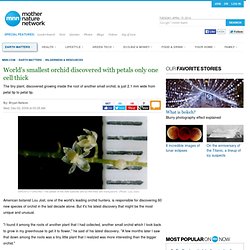
But it's his latest discovery that might be the most unique and unusual. "I found it among the roots of another plant that I had collected, another small orchid which I took back to grow in my greenhouse to get it to flower," he said of his latest discovery. "A few months later I saw that down among the roots was a tiny little plant that I realized was more interesting than the bigger orchid.
" As reported by The Independent, the minuscule new orchid is just 2.1 mm wide, and instantly supersedes the species Platystele jungermannioides as the world's smallest. Mossgraffiti. Top 10 Most Dangerous Plants in the World. 1. Most likely to eat a rat Giant Pitcher Plant: Nepenthes attenboroughii Discovered more than 5000 feet above sea level on Mount Victoria in the Philippines, the giant, carnivorous pitcher plant secretes a nectar-like substance to lure unsuspecting prey into a pool of enzymes and acid.
15 houseplants for improving indoor air quality. Mushroom Life. Kingdom of Fungi Home Page B. Mushroom Pictures & Mushroom Reference. Unique and Weird-Looking Edible Plants. What is pleasing to the eyes are conceived to be enticing to eat.

Some plant foods look odd and peculiar but they are delicious too. Healing foods reference database. Medicinal Herb Vaults. Healing foods reference database. Living Earth School of Herbalism. GENERAL INTEREST STUDENTS General Interest students may register for any designated general interest courses as long as they have taken the appropriate prerequisites (when required).

General Interest students are not required to enroll in a certificate or diploma program. They are also not required to complete assignments or write exams for any course. However, it is highly recommended that they do so as it will enhance their learning experience. General Interest students who choose not to write exams or complete assignments for any course will be considered to have fulfilled the requirements of that course for the purposes of meeting prerequisite requirements for additional courses. General Interest students who wish to enroll in any certificate or diploma program may do so as long as they have met the academic requirements of the program in which they would like to enroll.
Complete and hand in all assignments for the course. 8 hair care treatments you can make yourself. Eggs, yogurt and honey are, at first glance, all components of a tasty breakfast — but they also happen to be hair treatment ingredients, and affordable, all-natural ones at that.

And they're not the only ones. Virtual Body. Epigenetics. One example of an epigenetic change in eukaryotic biology is the process of cellular differentiation.
During morphogenesis, totipotent stem cells become the various pluripotent cell lines of the embryo, which in turn become fully differentiated cells. In other words, as a single fertilized egg cell – the zygote – continues to divide, the resulting daughter cells change into all the different cell types in an organism, including neurons, muscle cells, epithelium, endothelium of blood vessels, etc., by activating some genes while inhibiting the expression of others.[5] Historical usage of "epigenetics"[edit] The term "epigenetics" has also been used in developmental psychology to describe psychological development as the result of an ongoing, bi-directional interchange between heredity and the environment.[13] Interactivist ideas of development have been discussed in various forms and under various names throughout the 19th and 20th centuries.
Biology, Genetics - “The ghost in your genes”