
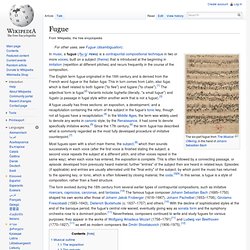
Fugue. From New World Encyclopedia Measures 1-9 of "Fuga a 3 voci" by J.S.

Bach In music, a fugue [fjuːg]) is a type of counterpoint or contrapuntal composition. It begins with a theme stated by one of the voices playing alone. A second voice then enters and plays the same theme, while the first voice continues on with a contrapuntal accompaniment. The form evolved during the seventeenth century from several earlier types of contrapuntal compositions such as ricercars, capriccios, canzonas, and fantasias. The word fugue comes from the Latin fuga (flight) and fugere (to flee). Characteristics and anatomy Number of voices The number of voices in a fugue generally ranges from three to five, but eight or even ten voices are possible in large choral or orchestral fugues. The term "part" is often used in the context of the fugue as a synonym for "voice. " Musical outline A fugue begins with an exposition of its subject by one of the voices in the tonic key.
Timing of entries Mirror Fugue. The Baroque. Baroque Period: 1600-1750 Baroque : -Indicates a particular style in the arts.

_Baroque means: -elaborately ornamental -Flamboyant -Bizarre -Baroque Art is a complex mixture of -Rationalism -Sensuality -Materialism -Spirituality Baroque painters: -Gian Lorenzo Bernini -Peter Paul Rubens -Rembrandt Van Rijn. Baroque painters exploited their materials to expand the potential of color, depth, ornament and detail to create totally structured worlds. Baroque Composers: The two giants of baroque composition were J.S. Other Baroque composers were: -Antonio Vivaldi -Arcangelo Corelli -Claudio Monteverdi.
-Early Baroque composers favored homophonic texture over the polyphonic texture typical of Renaissance Music. -Baroque music features contrats between bodies of sound. -The early baroque: was characterized by homophonic texture. Bach: Toccata and Fugue in D minor, BWV 565. Best Early Baroque Fugues(1/20) Fuga del nono tono(Late 1500s - 1612 Italy)By Giovanni Gabrieli. Original Fugue in C major (Klavier) in Baroque Style R 744. Fugue. The English term fugue originated in the 16th century and is derived from the French word fugue or the Italian fuga.
This in turn comes from Latin, also fuga, which is itself related to both fugere ("to flee") and fugare ("to chase").[1] The adjectival form is fugal.[2] Variants include fughetta (literally, "a small fugue") and fugato (a passage in fugal style within another work that is not a fugue).[3] Musical outline[edit] A fugue begins with the exposition and is written according to certain predefined rules; in later portions the composer has more freedom, though a logical key structure is usually followed. Further entries of the subject will occur throughout the fugue, repeating the accompanying material at the same time.[13] The various entries may or may not be separated by episodes. What follows is a chart displaying a fairly typical fugal outline, and an explanation of the processes involved in creating this structure.
The exposition[edit] Example of a tonal answer in J.S. Listen.