
A Thought. EBooks Are Real Books. Deal With It. Ebooks are not going away, ever.
Amazon now sells more ebooks than print books. In Canada, 16% of books purchased are digital. Ebook sales in the UK increased over 188% in the first six months of 2012. More and more people are consuming their books from a screen, and I’m having trouble mustering righteous anger about it–but if you stick your neck out and say the word “ebook,” you’ll still get people lobbing “those aren’t real books!” Impact. E-books and their impact on print book sales « Self Publishing Today. The American Association of Publishers (AP) recently reported that sales of e-books rose to $90.3 million in February 2011.
E-book release accounted for 20.4% in total book sales that month. In the first two months of 2011, e-books sales rose 169.4% while print books declined by 24.8%. In 2010, online retailer Amazon also reported that it sold 115 million e-books, compared to 100 million print books. Ebooks vs. paper books: which is greener? Ebooks vs. paper books Are ebooks really greener than physical books?
The debate is still going on and the final word hasn't been said yet. Eco-Libris is following the discussion and providing you with links to articles, reports and other sources of information that address this issue. The real dangers of e-books. Schools. 21st Century Educator. Thousands of post-primary pupils to start school year using e-books. Image: Colm Mahady / Fennells via Edco POST PRIMARY LEVEL e-books will be used in place of paper copies by thousands of students this year, following a successful two-year pilot of the programme with selected schools by the Educational Company of Ireland (Edco).
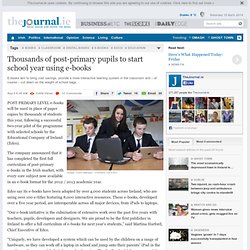
The company announced that it has completed the first full curriculum of post-primary e-books in the Irish market, with every core subject now available in an e-book format for the 2012 / 2013 academic year. Edco say its e-books have been adopted by over 4,000 students across Ireland, who are using over 100 e-titles featuring 8,000 interactive resources. These e-books, developed over a five year period, are interoperable across all major devices, from iPads to laptops. “Our e-book initiative is the culmination of extensive work over the past five years with teachers, pupils, developers and designers. “Pupils and teachers have taken very quickly to the new technology,” he said.
Read: End of heavy schoolbags? Already a fan? Legal. The Wrong War Over eBooks: Publishers Vs. Libraries. The music industry dropped DRM years ago. So why does it persist on e-books? So maybe you were lucky enough to get an e-reader for the holidays.
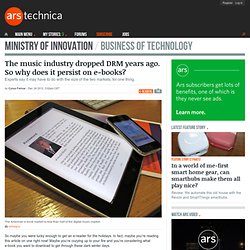
In fact, maybe you’re reading this article on one right now! Maybe you’re cozying up to your fire and you’re considering what e-book you want to download to get through these dark winter days. But you’re an Ars reader, and you actually know (and care!) What DRM stands for. After all, we’ve been covering digital rights management for years, ever since it was a contentious issue in the music industry. And that leaves this question: where’s the DRM outrage over e-books? For many industry watchers, it comes down to the fact that generally speaking, most people own more individual pieces of music than they do individual books—the American digital music market is still much bigger than the digital book market. From a cultural standpoint, people want to put music on more devices than they do e-books, and some will want to remix that music.
The "wrong end of the stick" ? A rather cozy birdcage Looking to the Cloud. Basics. Infographic on eBook Readers and the Book Publishing Industry. Over the last few years we have seen eBooks and eBook Readers rise as one of the fastest growing segments of the book publishing industry.
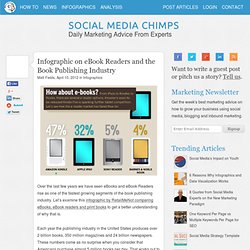
Let’s examine this infographic by RetailMeNot comparing eBooks, eBook readers and print books to get a better understanding of why that is. Each year the publishing industry in the United States produces over 2 billion books, 350 million magazines and 24 billion newspapers. These numbers come as no surprise when you consider that Americans purchase almost 5 million books per day. That works out to almost 57 books purchased per second. Considering Americans’ appetite for books, how has the introduction of eBooks and eBook readers impacted the publishing industry? eBook and Print Book Sales. India's 'iPad': Will the $35 Tablet Sell in the U.S.? India's version of the iPad may have been inspired by Apple's tablet but it costs a fraction of the price.
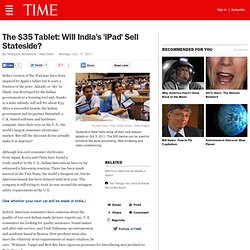
Aakash, or 'sky' in Hindi, was developed by the Indian government as a learning tool and, thanks to a state subsidy, will sell for about $35. After a successful launch, the Indian government and its partner Datawind, a U.K. -based software and hardware company, have their eyes on the U.S., the world's largest consumer-electronics market. But will the discount device actually make it in America?
Although low-cost consumer electronics from Japan, Korea and China have found a ready market in the U.S., Indian innovations have so far witnessed a lukewarm reaction. Indeed, American consumers have concerns about the quality of low-cost Indian-made devices, experts say. The makers of Aakash, though, are confident that they've got sufficient interest from the U.S. — and elsewhere. For Aakash, emerging markets will probably be key. eBook Reader Reviews - TopTenREVIEWS.