
Phy4c_hw. Homework 6 (Chapter 15, Mechanical Waves) Edition 12 (Edition 11) 15.47 (15.46) Guitar String, 15.53 (15.51) Ant Joy Ride, 15.59 (15.57) Two-Dimensional Waves 15.59 (15.57) Clothesline Nodes, 15.79 (15.77) Tuning an Instrument, 15.82 (Deep-Sea Diver).

Homework 5 Chapter 20 Edition 12: 20.40 (figure 20.24), 20.42 (Heat Pump), 20.45 (an experimental power plant), 20.48 (TD process for a refrigerator), 20.50 (a Stirling Cycle engine), 20.53 (automotive thermodymanics) Homework 4 Chapter 19 Edition 12 19.41, 19.45, 18.48, 19.53, 19.56, 19.57, 19.60, 19.66, 19.68, 19.69 Homework 3 Chapter 18 Edition 12: 18.55, 18.58 (Pressure on Venus), 18.65 (How many atoms are you), 18.68 (Insect collisions), 18.76 (Hydrogen on the Sun), 18.80, 18.82, 18.84 17.95 Spacecraft Reentry: A spacecraft made of aluminium circles the earth at a speed of 7700 m/s.
A) How much heat is required to raise the temperature of 1.5 mol of rock salt from 10.0 K to 40.0 K? Moon landing. Clickable imagemap of the locations of all successful soft landings on the Moon to date.
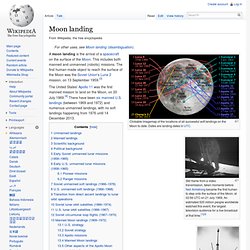
Dates are landing dates in UTC. Still frame from a video transmission, taken moments before Neil Armstrong became the first human to step onto the surface of the Moon, at 02:56 UTC on 21 July 1969. An estimated 500 million people worldwide watched this event, the largest television audience for a live broadcast at that time.[1][2] Luna 2, the first object made on Earth to reach the surface of the Moon. A moon landing is the arrival of a spacecraft on the surface of the Moon. The United States' Apollo 11 was the first manned mission to land on the Moon, on 20 July 1969.[4] There have been six manned U.S. landings (between 1969 and 1972) and numerous unmanned landings, with no soft landings happening from 1976 until 14 December 2013.
Unmanned landings[edit] The Soviet Union achieved the first unmanned lunar soil sample return with the Luna 16 probe on 24 September 1970. Manned landings[edit] Déjà vu. The psychologist Edward B.

Titchener in his book 1928 A Textbook of Psychology, explained déjà vu as caused by a person having a brief glimpse of an object or situation, before the brain has completed "constructing" a full conscious perception of the experience. Such a "partial perception" then results in a false sense of familiarity.[1] Scientific approaches reject the explanation of déjà vu as "precognition" or "prophecy", but rather explain it as an anomaly of memory, which creates a distinct impression that an experience is "being recalled".[2][3] This explanation is supported by the fact that the sense of "recollection" at the time is strong in most cases, but that the circumstances of the "previous" experience (when, where, and how the earlier experience occurred) are uncertain or believed to be impossible.
Links with disordersEdit PharmacologyEdit Certain drugs increase the chances of déjà vu occurring in the user. Memory-based explanationsEdit ParapsychologyEdit Jamais vuEdit. Wolfram. AnandTech. Benchmark CPUs. Benchmark GPUs. Eg. limiting agent. Guess.
Pearltrees videos.