
The Flipped Classroom: Turning the Traditional Classroom on its Head. Association for Experiential Education: A community of progressive educators and practitioners. What is Experiential Education?
Tell me and I will forget. Show me and I may remember. Involve me and I will understand. ~Chinese Proverb Defining the work we do, the values we hold and the principles that guide us is part of the experience of being a life-long learner and an active member of the Association for Experiential Education. Experiential education is a philosophy that informs many methodologies in which educators purposefully engage with learners in direct experience and focused reflection in order to increase knowledge, develop skills, clarify values, and develop people's capacity to contribute to their communities.
Am I an Experiential Educator? Experiential education is often utilized in many other disciplines: Non-formal education Place-based education Project-based education Hands-on Global education Environmental education Student-centered education Informal education Active learning Service learning Cooperative learning Expeditionary learning. What Works in Tech Tools: Spotlight on ClassDojo. Digital Tools Teaching Strategies ClassDojo With the thousands of ed-tech tools available to teachers, it can be difficult to find those that work well and complement teaching strategies.

It takes a lot of time to research and integrate, and for teachers in cash-strapped schools, access to some technology is completely out of their reach. Sam Chaudhary and Liam Don, the co-founders of ClassDojo, had the tech limitations of many public schools in mind when they designed the free service, a behavior management tool meant to reduce the amount of time teachers spend trying to get students’ attention. Classes need just one device — an interactive whiteboard, a computer connected to a projector, or tablet or smartphone. ClassDojo works on three principles: Each student gets an avatar and either receives or loses points. “What I saw teachers struggle with is how to get the value out of a tool without changing the structure of what they were doing.” Eight Things in Education That Will Change in the Digital Age. What’s Worth Investing In? How to Decide What Technology You Need.
Lenny Gonzalez The promise of technology in the pursuit of learning is vast — and so are the profits.
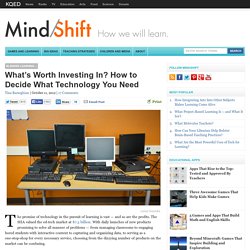
The SIIA valued the ed-tech market at $7.5 billion. With daily launches of new products promising to solve all manner of problems — from managing classrooms to engaging bored students with interactive content to capturing and organizing data, to serving as a one-stop-shop for every necessary service, choosing from the dizzying number of products on the market can be confusing. But when it comes to the specific task of helping students, what’s the best app in education? “A web browser,” said Chris Lehmann, Principal of Science Leadership Academy in Philadelphia, a school that’s embraced technology for years. “If all we’re doing is valuing test scores, then we’re just using technology to deliver the same traditional curriculum.”
Lehmann is famous in progressive education circles for his quote: “Technology must be like oxygen: ubiquitous, necessary, and invisible.” Related. Will the New Online Standardized Tests Be Different? Digital Tools Sarah Garland Fifth graders at Townsend Elementary in the Appoquinimink district waiting to begin the state standardized reading test.

By Sarah Garland New high-tech standardized tests are coming soon to schools across the country, but will these new tests really revolutionize how we measure whether children are learning? The designers of the new tests, which a majority of states plan to adopt in two years, are allowing a sneak peek at sample questions. Two competing state coalitions have taken on the job of designing the new tests, the Partnership for Assessment of Readiness for College and Careers (PARCC) and the Smarter Balanced Assessment Consortium, and both have posted examples of what’s coming on their websites. In some questions, which the test designers have called “computer enhanced,” students will be asked to drag words or numbers across the screen, or to highlight phrases or sentences in a reading passage. Grobstein, not just MY problem. (610) 526-5098 pgrobste@cc.brynmawr.edu 21 August 1991 Sometimes it pays to let off steam a little bit.

Even in public. Sometimes it turns out that everyone is bothered by something, and no one is exactly sure what it is, and everyone thinks it must be something wrong with themselves. Then someone says something about it, and it turns out its sort of the same something that has been bothering everybody else, and everybody feels a little better, and maybe even something gets done about it. I teach biology in a college, a pretty good one that costs students a lot of money and that lots of people have heard of. Free will? Home | Search Serendip Free WILL?
Lessons Worth Sharing. SmartlyEdu: Education is about to get smart. The PTA arrives in Mexicos schools. When Karina Saldaña enrolled her first child in elementary school, she hoped for the kind of parent participation that didn't exist when she was growing up.

Her own school director was “untouchable” to both teachers and students alike, Ms. Saldaña says. Skip to next paragraph Karina Saldaña, a parent-representative on the local PTA, says she is pleased with the level of communication between parents, teachers, and the director at the Fray Matias de Cordova school in Tuxtla Gutierrez, the capital of Chiapas, Mexico, April 26. Sara Miller Llana/The Christian Science Monitor Subscribe Today to the Monitor Click Here for your FREE 30 DAYS ofThe Christian Science MonitorWeekly Digital Edition.