
The Question All Smart Visualizations Should Ask - Michael Schrage. By Michael Schrage | 1:00 PM March 26, 2013 “A picture is worth a thousand words” may be a lovely cliché, but it’s exactly the wrong way to view visualization.

As admirable as the craft, message, and data-driven artistry of the Edward Tuftes and Stephen Fews may be, successful visualization is less about effectively conveying complex information than creatively provoking human interaction. Infographics should (quite literally) be seen more as interfaces to interpersonal engagement than aesthetically pleasing packages of numbers and analytics. The essential question smart “visualization” and “visualizers” should address is not, “What’s the best and most accessible way of presenting the data?” But “What kinds of conversation and interaction should our visualization evoke?”
Visualization works best when generating situational awareness and contexts that otherwise wouldn’t exist. So I cannot overstress the power and importance of visualizations as portals. Is this unduly harsh or cynical? John Benjamins Publishing Company. Information Design Journal (IDJ) is a peer-reviewed international journal that bridges the gap between research and practice in information design.

IDJ is a platform for discussing and improving the design, usability, and overall effectiveness of ‘content put into form’ — of verbal and visual messages shaped to meet the needs of particular audiences. IDJ offers a forum for sharing ideas about the verbal, visual, and typographic design of print and online documents, multimedia presentations, illustrations, signage, interfaces, maps, quantitative displays, websites, and new media.
IDJ brings together ways of thinking about creating effective communications for use in contexts such as workplaces, hospitals, airports, banks, schools, or government agencies. On the one hand, IDJ explores the design of information, with a focus on writing, the visual design, structure, format, and style of communications. Information design. Information design is the practice of presenting information in a way that fosters efficient and effective understanding of it.
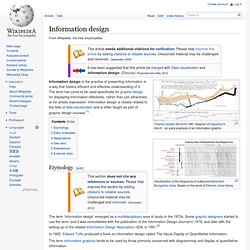
The term has come to be used specifically for graphic design for displaying information effectively, rather than just attractively or for artistic expression. Information design is closely related to the field of data visualization and is often taught as part of graphic design courses.[1] Etymology[edit] The term 'information design' emerged as a multidisciplinary area of study in the 1970s. Some graphic designers started to use the term, and it was consolidated with the publication of the Information Design Journal in 1979, and later with the setting up of the related Information Design Association (IDA) in 1991.[2] In 1982, Edward Tufte produced a book on information design called The Visual Display of Quantitative Information.
The term information graphics tends to be used by those primarily concerned with diagramming and display of quantitative information. InfoDesign: Understanding by Design. What is information design? - Definition from WhatIs.com. Information design is the detailed planning of specific information that is to be provided to a particular audience to meet specific objectives.

The information designer may or may not have available (or may create) an information architecture that defines the overall pattern or structure that is imposed on the information design and an information plan that defines information units and how they are to be completed. The output of an information design is sometimes expressed in written instructions, plans, sketches, drawings, or formal specifications. However, on very small projects, information design is likely to be much less formal. Information design can be distinguished from information architecture and information planning. In one view, there are three hierarchical levels of activity: Information architecture, which is the general set of ideas about how all information in a given context should be organized. Contributor(s): Michael Lawlor This was last updated in September 2005.