
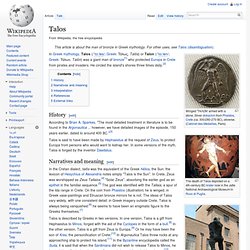
Talos. The death of Talos depicted on a 4th-century BC krater now in the Jatta National Archaeological Museum in Ruvo di Puglia.
History[edit] According to Brian A. Achelous. Achelous was often reduced to a bearded mask, an inspiration for the medieval Green Man.
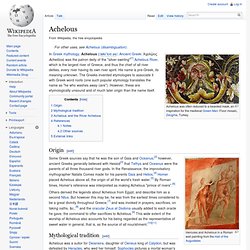
Floor mosaic, Zeugma, Turkey. In Greek mythology, Achelous (/ækɨˈloʊ.əs/; Ancient Greek: Ἀχελῷος Achelōos) was the patron deity of the "silver-swirling"[1] Achelous River, which is the largest river of Greece, and thus the chief of all river deities, every river having its own river spirit. His name is pre-Greek, its meaning unknown. The Greeks invented etymologies to associate it with Greek word roots (one such popular etymology translates the name as "he who washes away care"). However, these are etymologically unsound and of much later origin than the name itself.
Origin[edit] Asterion. According to Karl Kerenyi[3] and other scholars, the second Asterion, the star at the center of the labyrinth on Cretan coins, was in fact the Minotaur, as the compiler of Bibliotheca (III.1.4) asserts: Pasiphaë gave birth to Asterius, who was called the Minotaur.
He had the face of a bull, but the rest of him was human; and Minos, in compliance with certain oracles, shut him up and guarded him in the Labyrinth. "Minotaur" is simply a name of Hellene coining to describe his Cretan iconic bull-man image: see Minotaur. Helios. Names[edit]
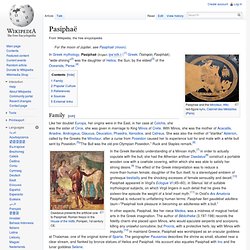
Pasiphaë. In Greek mythology, Pasiphaë (English /pəˈsɪfɨ.iː/;[1] Greek: Πασιφάη Pasipháē), "wide-shining"[2] was the daughter of Helios, the Sun, by the eldest[3] of the Oceanids, Perse.[4] Family[edit] Daedalus presents the artificial cow to Pasiphaë: Roman fresco in the House of the Vettii, Pompeii, 1st century CE.
Cicero writes in De Natura Deorum that the Spartan ephors would sleep at the shrine of Pasiphaë, seeking prophetic dreams to aid them in governance. According to Plutarch,[13] Spartan society twice underwent major upheavals sparked by ephors' dreams at the shrine during the Hellenistic era. In one case, an ephor dreamed that some of his colleagues' chairs were removed from the agora, and that a voice called out "this is better for Sparta"; inspired by this, King Cleomenes acted to consolidate royal power. Daedalus. Family[edit] The Labyrinth[edit] Daedalus is first mentioned by Homer as the creator of a wide dancing-ground for Ariadne.[12] He also created the Labyrinth on Crete, in which the Minotaur (part man, part bull) was kept.
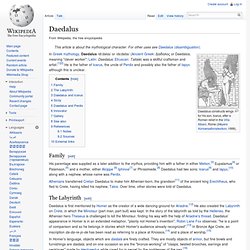
In the story of the labyrinth as told by the Hellenes, the Athenian hero Theseus is challenged to kill the Minotaur, finding his way with the help of Ariadne's thread. Daedalus' appearance in Homer is in an extended metaphor, "plainly not Homer's invention", Robin Lane Fox observes: "he is a point of comparison and so he belongs in stories which Homer's audience already recognized".[13] In Bronze Age Crete, an inscription da-da-re-jo-de has been read as referring to a place at Knossos,[14] and a place of worship.[15] In Homer's language, objects which are daidala are finely crafted.
This story thus encourages others to consider the long-term consequences of their own inventions with great care, lest those inventions do more harm than good. Daedalus and Icarus[edit] Chaos (cosmogony) Ananke (mythology) The goddess,"Ananke" is derived from the common Ancient Greek noun ἀνάγκη, (Ionic αναγκαίη : anankaiê) meaning force, constraint or necessity.
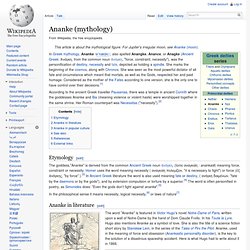
Homer uses the word meaning necessity ( αναγκαίη πολεμίζειν, "ιt is necessary to fight") or force (ἐξ ἀνάγκης, "by force" ).[3] In Ancient Greek literature the word is also used meaning fate or destiny, ( ανάγκη δαιμόνων, "fate by the daemons or by the gods"), and by extension compulsion or torture by a superior.[4] The word is often personified in poetry, as Simonides does: "Even the gods don’t fight against ananke".[5] In the philosophical sense it means necessity, logical necessity,[6] or laws of nature[7] The word "Ananke" is featured in Victor Hugo's novel Notre-Dame of Paris, written upon a wall of Notre-Dame by the hand of Dom Claude Frollo.
In his Toute la Lyre, Hugo also mentions Ananke as a symbol of love. Aether (mythology) In Greek mythology, Aether or Aither (Æthere, Ancient Greek: Αἰθήρ, pronounced [aitʰɛ̌ːr]), also known as Akmon or Acmon in Latin (possibly from the same route as "Acme") is one of the primordial deities, the first-born elementals.
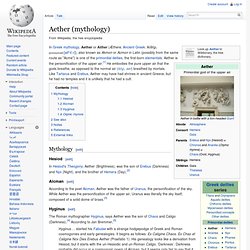
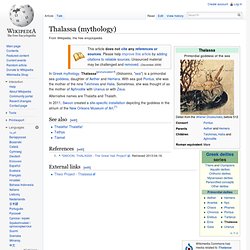
Aether is the personification of the upper air.[1] He embodies the pure upper air that the gods breathe, as opposed to the normal air (ἀήρ, aer) breathed by mortals. Like Tartarus and Erebus, Aether may have had shrines in ancient Greece, but he had no temples and it is unlikely that he had a cult. Hyginus ... started his Fabulae with a strange hodgepodge of Greek and Roman cosmogonies and early genealogies. It begins as follows: Ex Caligine Chaos. Ex Chao et Caligine Nox Dies Erebus Aether (Praefatio 1). Thalassa (mythology) Alternative names are Thalatta and Thalath.
Theoi Project - Thalassa. Aphrodite. Aphrodite ( Because of her beauty, other gods feared that their rivalry over her would interrupt the peace among them and lead to war, so Zeus married her to Hephaestus, who, because of his ugliness and deformity, was not seen as a threat.
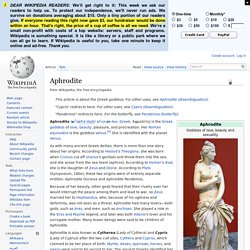
Aphrodite had many lovers—both gods, such as Ares, and men, such as Anchises. She played a role in the Eros and Psyche legend, and later was both Adonis's lover and his surrogate mother. Many lesser beings were said to be children of Aphrodite. Erinyes. Two Furies, from a nineteenth-century book reproducing an image from an ancient vase In Greek mythology the Erinyes (/ɪˈrɪniˌiz/;[1] Greek: Ἐρῑνύες [ῠ], pl. of Ἐρῑνύς [ῡ], Erinys; literally "the avengers"),[2][3][n 1] were female chthonic deities of vengeance; they were sometimes referred to as "infernal goddesses" (χθόνιαι θεαί). A formulaic oath in the Iliad invokes them as "those who beneath the earth punish whosoever has sworn a false oath".[7] Burkert suggests they are "an embodiment of the act of self-cursing contained in the oath".[8] They correspond to the Furies or Dirae in Roman mythology.[9] Description[edit] It is also worth mentioning that modern Tuvans, a Turkic people, call their shamanic protector spirit érénï, a cognate term for the ancient Hellenic erinnyes, which were dark "fury" spirits who punished and pursued sinners.[17]
Nemesis (mythology) In Greek mythology, Nemesis (Greek, Νέμεσις), also called Rhamnousia/Rhamnusia ("the goddess of Rhamnous") at her sanctuary at Rhamnous, north of Marathon, was the spirit of divine retribution against those who succumb to hubris (arrogance before the deities). Another name was Adrasteia, meaning "the inescapable. "[1] The Greeks personified vengeful fate as a remorseless goddess: the goddess of revenge. Telchines. In Greek mythology, the Telchines (Ancient Greek: Τελχῖνες, Telkhines) were the original inhabitants of the island of Rhodes, and were known in Crete and Cyprus.
Mythology[edit] They were regarded as excellent metallurgists: various accounts[3][4] state that they were skilled metal workers in brass and iron, and made a trident for Poseidon and a sickle for Cronus, both ceremonial weapons.[5] By some accounts, their children were highly worshipped as gods in the three ancient Rhodian towns of Ialysos (Ἰαλυσός), Kamiros (Κάμειρος) and Lindos (Λίνδος). Korybantes. The English "Pyrrhic Dance" is a corruption of the original Pyrríkhē or the Pyrríkhios Khorós ("Pyrrhichian Dance"). It has no relationship with the king Pyrrhus of Epirus, who invaded Italy in the 3rd century BC, and who gave his name to the Pyrrhic victory, which was achieved at such cost that it was tantamount to a defeat. Kouretes also presided over the infancy of Dionysus, another god who was born as a babe, and of Zagreus, a Cretan child of Zeus, or child-doublet of Zeus.
The wild ecstasy of their cult can be compared to the female Maenads who followed Dionysus. The Kouretes dancing around the infant Zeus as pictured in Jane Ellen Harrison, Themis 1912, p. 23. Homer referred to select young men as kouretes, when Agamemnon instructs Odysseus to pick out kouretes, the bravest among the Achaeans" to bear gifts to Achilles.[9] The Greeks preserved a tradition down to Strabo's day, that the Kuretes of Aetolia and Acarnania in mainland Greece had been imported from Crete.[10] Cronus. Ruler of the Titans in Ancient Greek mythology Mythology[edit] Only Cronus was willing to do the deed, so Gaia gave him the sickle and placed him in ambush.[4] When Uranus met with Gaia, Cronus attacked him with the sickle, castrating him and casting his testicles into the sea. From the blood that spilled out from Uranus and fell upon the earth, the Gigantes, Erinyes, and Meliae were produced.
The testicles produced a white foam from which the goddess Aphrodite emerged. For this, Uranus threatened vengeance and called his sons Titenes[a] for overstepping their boundaries and daring to commit such an act. Cronus learned from Gaia and Uranus that he was destined to be overcome by his own sons, just as he had overthrown his father. Rhea (mythology) Rhea (or Cybele), after a marble, 1888. Then she hid Zeus in a cave on Mount Ida in Crete.
According to varying versions of the story: Rhea only appears in Greek art from the fourth century BC, when her iconography draws on that of Cybele; the two therefore, often are indistinguishable;[10] both can be shown on a throne flanked by lions, riding a lion, or on a chariot drawn by two lions. In Roman religion, her counterpart Cybele was Magna Mater deorum Idaea, who was brought to Rome and was identified in Roman mythology as an ancestral Trojan deity. Cybele. Cybele (/ˈsɪbɨliː/; Phrygian: Matar Kubileya/Kubeleya "Kubeleyan Mother", perhaps "Mountain Mother"; Turkish Kibele; Lydian Kuvava; Greek: Κυβέλη Kybele, Κυβήβη Kybebe, Κύβελις Kybelis) was an originally Anatolian mother goddess; she has a possible precursor in the earliest neolithic at Çatalhöyük (in the Konya region) where the statue of a pregnant goddess seated on a lion throne was found in a granary.
Dactyl (mythology) When Greeks offered a most solemn oath, often they would press their hands against the earth as they uttered it. Hephaestus. Cabeiri. Arges. Cyclops. Mythology and literature[edit] Various ancient Greek and Roman authors wrote about cyclopes. Hesiod described them as three brothers who were primordial giants. Typhon. Typhon was described in pseudo-Apollodorus, Bibliotheke, as the largest and most fearsome of all creatures. His human upper half reached as high as the stars, and his hands reached east and west. Echidna (mythology) Campe. This article is about the mythological monster. Iphigenia. Zagreus. Thracians. Eumolpus. Erechtheus. Pontus (mythology) Chthonic. Twelve Olympians. Protogenoi. Naiad. Uranus (mythology) Gaia (mythology) Oceanus. Doris (mythology) Nereus. Proteus.