
Ningishzida. Ningishzida (sum: dnin-g̃iš-zid-da) is a Mesopotamian deity of the underworld.
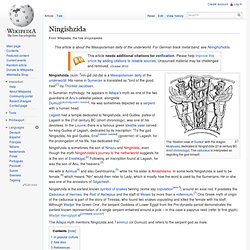
His name in Sumerian is translated as "lord of the good tree"[1] by Thorkild Jacobsen. In Sumerian mythology, he appears in Adapa's myth as one of the two guardians of Anu's celestial palace, alongside Dumuzi[disambiguation needed]. He was sometimes depicted as a serpent with a human head. Lagash had a temple dedicated to Ningishzida, and Gudea, patesi of Lagash in the 21st century BC (short chronology), was one of his devotees. In the Louvre, there is a famous green steatite vase carved for king Gudea of Lagash, dedicated by its inscription: "To the god Ningiszida, his god Gudea, Ensi[citation needed] (governor) of Lagash, for the prolongation of his life, has dedicated this".
His wife is Azimua[4] and also Geshtinanna,[5] while his his sister is Amashilama. In popular culture[edit] The god appears in the Simon Necronomicon under the spelling Ninnghizhidda. See also[edit] References[edit] Further reading[edit] Rod of Asclepius. Rod of Asclepius In Greek mythology, the Rod of Asclepius (⚕;[1] sometimes also spelled Asklepios or Aesculapius), also known as the asklepian,[2] is a serpent-entwined rod wielded by the Greek god Asclepius, a deity associated with healing and medicine.
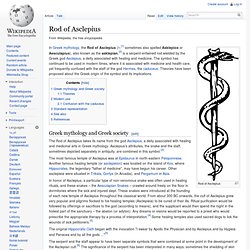
The symbol has continued to be used in modern times, where it is associated with medicine and health care, yet frequently confused with the staff of the god Hermes, the caduceus. Theories have been proposed about the Greek origin of the symbol and its implications. Greek mythology and Greek society[edit] The Rod of Asclepius takes its name from the god Asclepius, a deity associated with healing and medicinal arts in Greek mythology. In honor of Asclepius, a particular type of non-venomous snake was often used in healing rituals, and these snakes – the Aesculapian Snakes – crawled around freely on the floor in dormitories where the sick and injured slept. The staff has also been variously interpreted. Caduceus. Modern depiction of the caduceus as the symbol of commerce Hermes Ingenui[1] carrying a winged kerykeion upright in his left hand, Roman copy reflecting an unknown Greek original of the 5th century BCE.

(Museo Pio-Clementino, Rome). By extension of its association with Mercury and Hermes, the caduceus is also a recognized symbol of commerce and negotiation, two realms in which balanced exchange and reciprocity are recognized as ideals.[5][6] This association is ancient, and consistent from the Classical period to modern times.[7] The caduceus is also used as a symbol representing printing, again by extension of the attributes of Mercury (in this case associated with writing and eloquence).
The caduceus is often used incorrectly as a symbol of healthcare organisations and medical practice (especially in North America), due to confusion with the traditional medical symbol, the rod of Asclepius, although this has only one snake and is never depicted with wings. Ancient Near East[edit] Hermes Trismegistus.