
List of deities. This is an index to polytheistic deities of the different religions, cultures and mythologies of the world, listed by type and by region.
This is not a list of names or epithets of gods in modern monotheistic religions, for which see "Names of God". For deified individuals see "List of people who have been considered deities", "Apotheosis" and "Imperial cult". For deities whose cult is fictional see "List of deities in fiction". By classification[edit] Ruler of the Pantheon[edit] Celestial, Cosmological[edit] Chthonic[edit] Human sphere[edit] Demigods, Deified Heroes[edit] By cultural sphere[edit] Near East and North Africa[edit] Osiris, lord of the dead. Central / Northern Asia[edit] East Asia[edit] India / South Asia[edit] The image illustrates the Hindu belief that each part of the cow embodies a particular deity Southeast Asia[edit] Europe[edit] Sub-Saharan Africa[edit] Americas[edit] Australia-Oceania[edit] Syncretic mythologies[edit] List of Theosophical/Ascended Master Teachings deities.
Names of God. This article is about names for the monotheist belief of a singular God.

For theonyms generally, see List of deities. Names of God, or Holy Names, describe a form of addressing God present in a monotheist notion of a singular God in liturgy or prayer.[1] Prayer involving the name of God has become a part of both Western and Eastern monotheist spiritual practices. A number of traditions have lists of many names of God, many of which enumerate the various qualities of a supreme being. Exchange of names held sacred between different religious traditions is typically limited. One definition of the Name of God was given by Elisha Mulford as "that name which passes into the common forms of thought". The nature of a holy name can be described as either personal or attributive. Abrahamic religions[edit] According to the Bible, the name of God was used during the lifetime of Adam and Eve, but the Hebrew Bible implies that by the time Moses was born none of mankind still knew the name. Hyang. Hyang (Kawi, Javanese, Sundanese, and Balinese) is an unseen spiritual entity that has supernatural power in ancient Indonesian mythology.

This spirit can be either divine or ancestral. The reverence for this spiritual entity can be found in Sunda Wiwitan, Kejawen, and Balinese Hinduism. In modern Indonesian this term tends to be associated with gods, devata, or God. The realm where the hyangs reside is called kahyangan; now is a synonym for svarga or heaven in modern Indonesian. Origin[edit] Before the adoption of Hinduism, Buddhism and Islam, the natives of Indonesian archipelago believe in the powerful but unseen spiritual entity that can be both benevolent or malevolent. In ancient Sundanese, Javanese, and Balinese society, this unseen spiritual entity is identified as "hyang". Etymology[edit] In Sundanese, the term "nga-hyang" means "disappear" or "unseen". Characteristics[edit] In Bali, Hyang are said to only move in straight lines.
Kami. Amaterasu, one of the central kami in the Shinto faith Kami (Japanese: 神?)
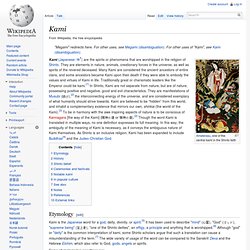
Are the spirits or phenomena that are worshipped in the religion of Shinto. They are elements in nature, animals, creationary forces in the universe, as well as spirits of the revered deceased. Many Kami are considered the ancient ancestors of entire clans, and some ancestors became Kami upon their death if they were able to embody the values and virtues of Kami in life. Traditionally great or charismatic leaders like the Emperor could be kami.[1] In Shinto, Kami are not separate from nature, but are of nature, possessing positive and negative, good and evil characteristics.
Sky deity. Category:Deities by association. Category:Deities, spirits, and mythic beings.