
Bridge To Nowhere? NOAA Confirms High Methane Leakage Rate Up To 9% From Gas Fields, Gutting Climate Benefit. By Joe Romm "Bridge To Nowhere?
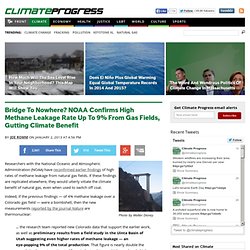
NOAA Confirms High Methane Leakage Rate Up To 9% From Gas Fields, Gutting Climate Benefit" Photo by Walter Disney Researchers with the National Oceanic and Atmospheric Administration (NOAA) have reconfirmed earlier findings of high rates of methane leakage from natural gas fields. If these findings are replicated elsewhere, they would utterly vitiate the climate benefit of natural gas, even when used to switch off coal. Indeed, if the previous findings — of 4% methane leakage over a Colorado gas field — were a bombshell, then the new measurements reported by the journal Nature are thermonuclear: … the research team reported new Colorado data that support the earlier work, as well as preliminary results from a field study in the Uinta Basin of Utah suggesting even higher rates of methane leakage — an eye-popping 9% of the total production. The Uinta Basin is of particular interest because fracking has increased there over the past decade.
Related Posts: Lettre aux candidats à l'élection présidentielle et leurs réponses. Environmental Health Policy Institute. Hydraulic Fracking: How Great Is the Risk to Health? Check back each month for new topics and responses Welcome to the June issue of PSR’s Environmental Health Policy Institute.

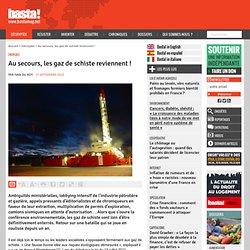
Non au gaz de schiste. Au secours, les gaz de schiste reviennent ! - Energies. Il est déjà loin le temps où les leaders socialistes s’opposaient fermement aux gaz de schiste. « Une fausse bonne idée aux risques écologiques démesurés », expliquait il y a un an Arnaud Montebourg [1].
Lors du débat sur la loi du 13 juillet 2011, interdisant la fracturation hydraulique, le futur ministre du Redressement productif, le futur Premier ministre et le futur Président – alors dans l’opposition – ont même signé une proposition de loi « visant à interdire l’exploration et l’exploitation des hydrocarbures non conventionnels, à abroger les permis exclusifs de recherche de mines d’hydrocarbures non conventionnels et à assurer plus de transparence dans le code minier ». Non aux gaz de schistes! Site de vigilance et d'alerte des collectifs « anti gaz et huiles de schiste » Gardois. Gasland: A film by Josh Fox.
A ffirming Gasland by Josh Fox. Dear audience, press, and peers: I have been overwhelmed by the amazing, positive responses to the film.

Fracturation hydraulique. Un article de Wikipédia, l'encyclopédie libre.
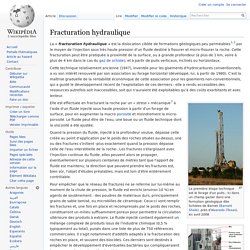
La « fracturation hydraulique » est la dislocation ciblée de formations géologiques peu perméables[1]’[2] par le moyen de l'injection sous très haute pression d'un fluide destiné à fissurer et micro-fissurer la roche. Hydraulic fracturing. The first experimental use of hydraulic fracturing was in 1947, and the first commercially successful applications were in 1949.
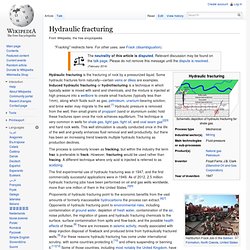
As of 2012, 2.5 million hydraulic fracturing jobs have been performed on oil and gas wells worldwide, more than one million of them in the United States.[4][5] Frac job in progress Geology[edit] Mechanics[edit] NGSPC.com. 'No reason' to ban fracking?? E.P.A. Says Hydraulic Fracturing Likely Marred Wyoming Water. Sick From Fracking? Doctors, Patients Seek Answers. Hide caption Michelle Salvini (left) and Terri DiCarlo take a break from work outside the Cornerstone Care clinic in Burgettstown, Pa.

Mysterious fumes have repeatedly sickened clinic staffers, forcing them to evacuate the building several times. Maggie Starbard/NPR Hide caption Environmental health specialist Dr. Michael McCawley (center) and Cornerstone CEO Robert Mt.Joy meet to talk about what's happening at the clinic. Maggie Starbard/NPR Hide caption Cornerstone nurse Kay Allen (center) talks with her co-workers. Some staffers stopped coming into the clinic because of the fumes. Hide caption Burgettstown is located in a rural corner of southwest Pennsylvania. Kay Allen had just started work, and everything seemed quiet at the Cornerstone Care community health clinic in Burgettstown, Pa.
EPA Checking For Contamination After Fracking Spill. Explosion rocks natural gas compressor station. SPRINGVILLE TWP. - An explosion at a natural gas compressor station in Susquehanna County on Thursday morning blew a hole in the roof of the complex holding the engines, shaking homes as far as a half-mile away and drawing emergency responders from nearby counties.

The 11 a.m. blast at the Lathrop compressor station off Route 29 sent black and gray clouds billowing from the building for several hours, but the damage was contained to the site and no one was injured, said a spokeswoman for Williams Partners LP, which owns the Lathrop station. Automated emergency shutdown procedures stopped gas from entering or leaving the compressors, and Williams will do a full investigation of the cause and damage as soon as it is safe to go back into the building, Williams spokeswoman Helen Humphreys said. "The emergency shutdown equipment did work properly to isolate and minimize the incident," she said. Earthquakes in Arkansas May Be Man-Made, Experts Warn.
The sudden swarm of earthquakes in Arkansas -- including the largest quake to hit the state in 35 years -- is very possibly an after effect of natural-gas drilling, experts warn.

Is fracking behind Oklahoma’s earthquakes? One of the strongest earthquakes in the history of Oklahoma hit near the town of Sparks on Saturday night.

At 5.6 in magnitude, it was the bell-ringer of a series of shakes. What is not clear is where this unusual seismic activity is coming from. The Oklahoman reported: After the main shock, there were 12 temblors registering at magnitudes of 3.0 or higher and more than 70 quakes with magnitudes of 1.0 to 2.5, Oklahoma Geological Survey research scientist Amie Gibson said Sunday. “We really hope that the 5.6 was the main shock because I don’t want to see anything like that again, personally. Gaz de schiste aux Etats-Unis: un bilan "pas terrible" pour Total, selon le PDG. Ohio: Fracking waste tied to earthquakes.