
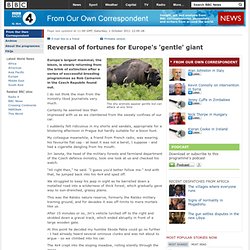
3D Printing Community to Crowdsource Saving a Species. I Went Back to the Land to Feed My Family. Facebook. How Mark Boyle Lives on $0 a Year. Reversal of fortunes for Europe's 'gentle' giant. Europe's largest mammal, the bison, is slowly returning from the brink of extinction after a series of successful breeding programmes as Rob Cameron in the Czech Republic found out.
Recent Human Evolution Detected in Quebec Town History. Though ongoing human evolution is difficult to see, researchers believe they’ve found signs of rapid genetic changes among the recent residents of a small Canadian town.
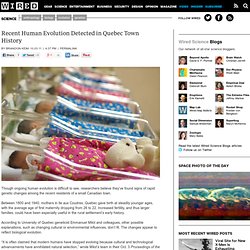
Between 1800 and 1940, mothers in Ile aux Coudres, Quebec gave birth at steadily younger ages, with the average age of first maternity dropping from 26 to 22. Increased fertility, and thus larger families, could have been especially useful in the rural settlement’s early history. According to University of Quebec geneticist Emmanuel Milot and colleagues, other possible explanations, such as changing cultural or environmental influences, don’t fit. The changes appear to reflect biological evolution. “It is often claimed that modern humans have stopped evolving because cultural and technological advancements have annihilated natural selection,” wrote Milot’s team in their Oct. 3 Proceedings of the National Academy of Sciences paper. 'Our study supports the idea that humans are still evolving.'
Paris launches electric car-sharing scheme. 1 October 2011Last updated at 00:11 Electric rental cars will be available to hire across Paris from next week Paris is launching its first car-sharing project as it aims to clear its traffic-clogged boulevards.
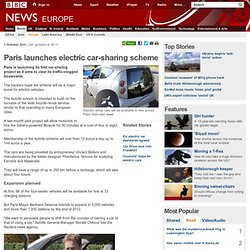
The backers hope the scheme will be a major boost for electric vehicles. Denmark introduces world's first food fat tax. Perception Is Reality. Prehistoric cave etchings 'created by three-year-olds' 30 September 2011Last updated at 01:43 Archaeologist Jessica Cooney told the BBC's David Sillito that the most prolific artist was a five-year-old girl Prehistoric etchings found in a cave in France are the work of children as young as three, according to research.
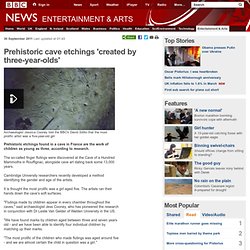
The so-called finger flutings were discovered at the Cave of a Hundred Mammoths in Rouffignac, alongside cave art dating back some 13,000 years. Cambridge University researchers recently developed a method identifying the gender and age of the artists. Really? The Claim: Fingers Wrinkle Because of Water Absorption. Where All Work Is Created Equal. A partir du 27 septembre, l'humanité aura consommé toutes les ressources naturelles de l'année. Leroy-Merlin se paye les labos citoyens. Leroy-Merlin se passionne pour le phénomène des fab labs, ces lieux citoyens dédiés au partage d'outils de fabrication et de production.
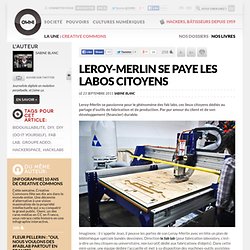
Par pur amour du client et de son développement (financier) durable. Imaginons : il s’appelle Jean, il pousse les portes de son Leroy-Merlin avec en tête un plan de bibliothèque spéciale bandes dessinées. Direction le fab lab (pour fabrication laboratory, c’est-à-dire un lieu citoyen ou universitaire, non lucratif, dédié aux fabrications d’objets).
Dans cette mini-usine, une équipe dédiée l’accueille et met à sa disposition des machines-outils assistées par ordinateur. Dimension, matériau, elle l’aide à modéliser le meuble de ses rêves grâce à un logiciel de Conception assistée par ordinateur (CAO). Le comité de direction emmené en visite Une explosion des messages sur le sujet dans leurs réseaux sociaux d’entreprise Permettre aux chefs de produit de mettre la main à la pâte facilement. Reality Television and American Culture. On January 6, 1973, the anthropologist Margaret Mead published a startling little essay in TV Guide.
Close Read: Troy Davis: Executed. Update: After a delay during which the Supreme Court considered a stay, Troy Davis was executed at 11:08 P.M.
Troy Davis is scheduled to die in a couple of hours; it is now very hard to see any way that he won’t be. He was convicted of murder, and sentenced to death, and his appeals, including a last-minute one to the Georgia parole board, for clemency, have been denied. An execution in America is not a singular thing: there have been more than thirty this year, and Davis isn’t even the only one scheduled to die today. (There’s also Lawrence Russell Brewer, in Texas.) Inundated with place names « Derek Watkins. New website, app estimate forced labor behind products - Sep. 21. New app and website estimate how much forced labor is used to make everyday products.
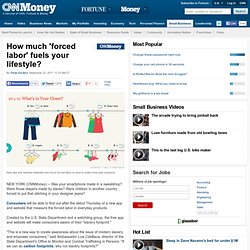
NEW YORK (CNNMoney) -- Was your smartphone made in a sweatshop? Were those diapers made by slaves? Were children in another country forced to put that stitching in your designer jeans? Consumers will be able to find out after the debut Thursday of a new app and website that measure the forced labor in everyday products. Created by the U.S. How Americans Spend Their Day. November 4-6, 2011. How water bottles create cheap lighting in Philippines. Stockbox Grocer's Food Desert Solution: The Shipping Container - Food. A group of Seattle entrepreneurs has come up with one solution to the urban food desert problem, and it doesn't involve adding traditional supermarkets to underserved areas.
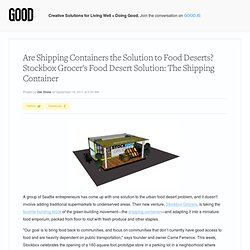
Their new venture, Stockbox Grocers, is taking the favorite building block of the green-building movement—the shipping container—and adapting it into a miniature food emporium, packed from floor to roof with fresh produce and other staples. "Our goal is to bring food back to communities, and focus on communities that don’t currently have good access to food and are heavily dependent on public transportation," says founder and owner Carrie Ferrence. This week, Stockbox celebrates the opening of a 160-square-foot prototype store in a parking lot in a neighborhood where corner stores are the only source of food. Up to five customers can shop at once, said Ferrence, and only one person is needed to staff the operation. Guatemalan Schools Built from Bottles, Not Bricks - Environment.
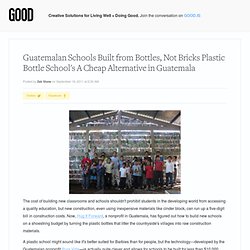
The cost of building new classrooms and schools shouldn't prohibit students in the developing world from accessing a quality education, but new construction, even using inexpensive materials like cinder block, can run up a five-digit bill in construction costs.
Will we all be tweaking our own genetic code? 18 September 2011Last updated at 22:39 By Karen Weintraub Cambridge, Massachusetts Professor George Church explains his vision for the future of genetics You have to wonder what's going on in the DNA of Harvard genetics professor George Church. Futures Impossible : a new methodology to study world events. The study of the future, as a scientific and intellectual endeavor, used to be driven by the careful extrapolation of trends, as in Herman Kahn’s Year 2000, or the forecasting of complex interaction among many variables, as in the Club of Rome’s Limits to Growth and Paul Ehrlich’s Population Bomb. Life Neutral - Life Beyond Conflict. Fish shrinkage probed in lab. 18 September 2011Last updated at 09:15 By Jennifer Carpenter Science reporter, BBC News The team will pull out the largest individuals from the tanks every sixth week. China's stake in Zambia's election. 19 September 2011Last updated at 00:32 GMT By Louise Redvers BBC News, Lusaka If you want proof that China has arrived in Africa, look no further than Zambia, which is gearing up for parliamentary and presidential elections on Tuesday.
Its capital Lusaka has recently become the first African city to offer Chinese currency banking services. The city's Bank of China branch now handles counter deposits and withdrawals in yuan. It is expected longer term that Chinese businesses operating in Zambia will start using the currency amongst themselves to reduce the amount of commission paid when changing from the Zambian kwacha via the US Dollar. Continue reading the main story.