
Open Source Apps: the Monster List. It's become something of an annual tradition at Datamation to end the year with a gigantic compilation of all the open source software we've surveyed over the past twelve months or so.
(See 2010's Open Source Apps: the Ultimate List and 2009's Open Source Software: The Monster List.) This year's retrospective is bigger than ever with 957 excellent open source applications featured. The complete list is a lot to handle in one sitting, so we've divided it into categories. Also, please note that the projects in each category are listed in alphabetical order, not from best to worst or vice versa. As always, if you'd like to add a project to list, feel free to do so in the comments section below. Second Law of Thermodynamics May Explain Economic Evolution. (PhysOrg.com) -- Terms such as the "invisible hand," laissez-faire policy, and free-market principles suggest that economic growth and decline in capitalist societies seem to be somehow self-regulated.
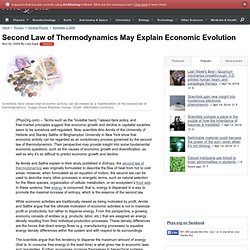
Now, scientists Arto Annila of the University of Helsinki and Stanley Salthe of Binghampton University in New York show that economic activity can be regarded as an evolutionary process governed by the second law of thermodynamics. Their perspective may provide insight into some fundamental economic questions, such as the causes of economic growth and diversification, as well as why it’s so difficult to predict economic growth and decline.
As Annila and Salthe explain in their study published in Entropy, the second law of thermodynamics was originally formulated to describe the flow of heat from hot to cold areas. From this thermodynamic perspective, decision making is ultimately about choosing the action that causes energy to flow along the most steeply descending energy gradient. Open Education. Public Data Sources. National institutes of statistics. Open source. Disinformation. Open-source fabrication technologies. Product Variety, Consumer Preferences, and Web Technology: Can the Web of Data Reduce Price Competition and Increase Customer Satisfaction? Books, Ebooks and Self publishing. Data. Graphs and networks. Cloud Library. Statistical Data. Mind Maps/Thinking Maps/Graphic Organizers.
Data gathering, presentation.