
World Port Source - Port of Yuzhny. Thermal coal prices to remain at high levels in long term: analyst - Coal. Manila (Platts)--14Mar2012/619 am EDT/1019 GMT Thermal coal prices will remain at relatively high levels over the long term despite aggressive mine expansions to meet the growth in Asian demand, particularly from China and India, Wood Mackenzie coal analyst Prakash Sharma said Thursday.

Sharma told the Coaltrans India conference that seaborne thermal coal demand will "grow exponentially" from now until 2030 mainly because of the increase in demand from China and India. He said that although there will be "aggressive" thermal coal supply expansions, steam coal prices in the long term will defy expectations of a drop and will instead remain at high levels. Sharma said there may be short-term seasonal fluctuations such as the drop in prices in the current quarter, but the Newcastle reference coal price for Australian coal will increase progressively.
Article continues below... China and India will be the top two demand drivers, Sharma said. --Cecilia Quiambao, cecilia_quiambao@platts.com. Global Coal - Standard Trading Contract. The introduction of globalCOAL's Standard Coal Trading Agreement (SCoTA) in 2001 revolutionised international coal trading.

For the first time it became possible to buy and sell physical coal cargos quickly, efficiently, and with no basis risk. Today, with over 2,000 Licensed Users worldwide, SCoTA is recognised as the contract of choice for the trade of seaborne thermal coal. SCoTA underlies all transactions on the globalCOAL platform and can also be used offline, in bilateral and brokered deals. What is SCoTA? Coal - Energy Explained, Your Guide To Understanding Energy. Coal takes millions of years to create Coal is a combustible black or brownish-black sedimentary rock composed mostly of carbon and hydrocarbons.

It is the most abundant fossil fuel produced in the United States. Coal is a nonrenewable energy source because it takes millions of years to create. The energy in coal comes from the energy stored by plants that lived hundreds of millions of years ago, when the Earth was partly covered with swampy forests. For millions of years, a layer of dead plants at the bottom of the swamps was covered by layers of water and dirt, trapping the energy of the dead plants. Annual Coal Report. The Annual Coal Report (ACR) provides annual data on U.S. coal production, number of mines, productive capacity, recoverable reserves, employment, productivity, consumption, stocks, and prices.

All data for 2012 and prior years are final. Highlights for 2012: U.S. coal production decreased 7.2 percent from 2011, driven by lower electric power sector demand, to roughly 1.02 billion short tons. Productive capacity of U.S. coal mines decreased 3.5 percent to 1.28 billion short tons. The average number of employees in U.S. coal mines decreased 1.9 percent to 89,838 employees. Contact: Nicholas Paduano Phone: 202-287-6326 Email: Nicholas Paduano Fax: 202-287-1944. Coal. Energy In Brief Articles What is the role of coal in the United States?

Energy Information Administration - International Coal Price, Coal Import Cost, and Coal Import and Export Price Data. Coal, fossil fuel - World Coal Association. Coal Online - Browser : Transport, storage and handling of coal. Author: Anne M Carpenter, Darrell Porter, David H Scott, Simon Walker This Chapter covers various aspects of the transportation, storage and handling of coal, predominantly between the producer and the end-user.

Thus the descriptions begin with transport, which for coal (as a bulk commodity) typically encompasses road haulage, railways and seaborne delivery. The use of barges on inland waterways and as an interconnecting link between land- and sea-freight is also locally important, and is addressed here, while brief mention is also made of the infrastructure and technology involved at coal-handling ports. The Chapter continues with a review of stockpiling philosophy and the technology used, not only for handling incoming coal and then reclaiming it for onward shipment or for use as fuel, but also in terms of the minimisation of the environmental impact of stockyards. View the Flash version online Click here if you would like to view the document online as a flash file. Coal Online - Viewer : Studying the structural chemistry of coal. European Association for Coal and Lignite. In 2010, global coal trade amounted to just over one billion tonnes or 14.8 % of world coal production of 7.2 billion tonnes.

These figures show that coal is mainly used in the vicinity of deposits. However, coal from mines with low production costs and favourable locations near to sea ports can be delivered competitively to overseas consumers. Imported hard coal to Europe makes a significant contribution to the EU’s security of energy supply and offers a competitive fuel which can be easily and safely transported and stocked. Coal. Bituminous coal Coal (from the Old English term col, which has meant "mineral of fossilized carbon" since the 13th century)[1] is a combustible black or brownish-black sedimentary rock usually occurring in rock strata in layers or veins called coal beds or coal seams.
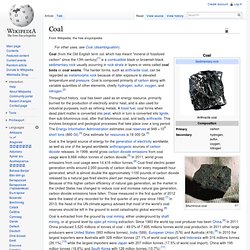
The harder forms, such as anthracite coal, can be regarded as metamorphic rock because of later exposure to elevated temperature and pressure.