
Node Hosting · joyent/node Wiki. Hosting compatible with Node Managed Managed providers provide a simplified "Node Appliance" solution.
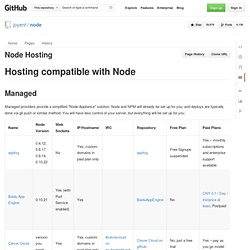
Node and NPM will already be set up for you, and deploys are typically done via git push or similar method. You will have less control of your server, but everything will be set up for you. Empty cells mean we weren't sure what to put there. Self-Managed Preconfigured "Node Appliance" solution where Node and NPM are already set up for you, and deploys are typically done via git push or similar method. Node JS, Knockout JS, Mongo DB, RabbitMQ - the killer combination - Technology. Lets start with the Node JS for the first installment ====================================================== QUICK NOTE: By readers request - browse towards the end to find file upload example using Node and formidable.

Seriously. Look at the below code snippet. And you wrote a HTTP server. Its as easy. This is not the end but just the start. IMPATIENTS CAN SKIP THIS SECTION Now let me take a step back and tell you where I am going and why. To understand in little deeper Node nitigrities I recommend to start with awesome book The Node Beginner Book by Manuel Kiessling. Exports.route makes route (any member - here is a function) available to other programs - remember it. Janl/mustache.js. File uploads using Node.js: now for real. Introduction Node.js is a very interesting server-side Javascript application framework.

It is based on Google’s V8 Javascript engine and implements evented I/O, so it is blazing fast. It looks very promising for certain types of applications, mostly those that require long-running connections. This includes streaming big files, keeping persistent connections used for realtime communication (chat, games), applications using third-party web services (with long call times), etc. There is good enough API reference available for Node.js, however it is not trivial to start development as event-based approach is quite unusual compared to commonly used thread-based networking.
However the given examples have problem — they are too far from real world problems. File uploads using Node.js: once again. I’ve already wrote an article about file uploads in Node.js before.

However Node.js is in rapid development and so many things have changed since then. So, I decided to do an updated version, which accommodates for such changes: events module was removedposix module was replaced by fsvarious changes into HTTP request/response APImultipart module refactored into separate projectconvenient fs.createWriteStream instead of low-level API. How to debug node.js applications. How does one start a node.js server as a daemon process. Shell - How to run commands via NodeJS child process. Child Process Node.js v0.8.11 Manual. Stability: 3 - Stable Node provides a tri-directional popen(3) facility through the child_process module.

It is possible to stream data through a child's stdin, stdout, and stderr in a fully non-blocking way. (Note that some programs use line-buffered I/O internally. That doesn't affect node.js but it means data you send to the child process is not immediately consumed.) To create a child process use require('child_process').spawn() or require('child_process').fork(). Class: ChildProcess# Modules · joyent/node Wiki. This page is deprecated.

Feel free to add to it, but be advised that it is, at best, a faded relic of Node modules that were written before npm was a dominant force in the Node.js ecosystem. It is not all that useful any more. If you are a newcomer, it can be handy to at least get a starting point. However, note that there are many tens of thousands of modules in the npm registry, and only just under 2,000 modules here. Writing My First Node.js Module And Event Emitter. // Include the event emitter class - the controller is a specialized // instance of the event emitter and will emit the events: // - data / response // - error / errorType (HTTP Status code) var EventEmitter = require( "events" ).EventEmitter; // Include the Girl Service layer. var girlService = require( ". // Create an instance of our event emitter. var controller = new EventEmitter(); // Add a handle method to the event emitter instance (controller) // so that the HTTP server will be able to pass the request off for // proper routing. controller.handle = function( request, response ){ // We are going to be looking at urls for RESTful commands. // These will be in the form of: // NOTE: I am using the term RESTful in the loosest sense. // Really, this is just easy for illustration purposes. // girls/get // girls/{id}/get // girls/{id}/delete // girls/add/{name} // Define our patterns. var patterns = { getAll: new RegExp( "girls/get", "i" ), getGirl: new RegExp( "girls/(\\d+)/get", "i" ),

Node.js REST framework. Develop a RESTful API Using Node.js With Express and Mongoose... 6 Must Have Node.js Modulesblog. So you're thinking about using node.js: awesome.

If you're new to the community you're probably thinking "what's the best node.js module / library for X? " I think it's really true when experienced language gurus say "80% of your favorite language is your favorite library. " This is the first in a series of articles will give you a high-level overview of some of our favorite node.js libraries at Nodejitsu. Today we'll take a look at these libraries: API v3.