
Petty kingdom. A petty kingdom is one of a number of small kingdoms, described as minor or "petty" by contrast to an empire or unified kingdom that either preceded or succeeded it (e.g. the numerous kingdoms of Anglo-Saxon England unified into the Kingdom of England in the 10th century, or the numerous Gaelic kingdoms of Ireland unified as the Kingdom of Ireland in the 16th).

Alternatively, a petty kingdom would be a minor kingdom in the immediate vicinity of larger kingdoms, such as the medieval Kingdom of Mann and the Isles relative to the kingdoms of Scotland or England or the Viking kingdoms of Scandinvia. By the European High Middle Ages, many post-Roman Early Middle Ages petty kingdoms had evolved into principalities, grand duchies, or duchies. By the European Early Modern era many of these principalities had been mediatized into larger monarchies, but the ruling families were considered morganatic for marriage considerations, and ranked equal to royal families in society. Cyprus[edit] Nordic countries. The Nordic countries is a geographical and cultural region in Northern Europe and the North Atlantic.

It consist of five countries (Denmark, Finland, Iceland, Norway and Sweden) as well as their autonomous regions (the Åland Islands, the Faroe Islands and Greenland). The Nordic countries have much in common in their way of life, history, language and social structure. Politically, Nordic countries do not form a separate entity, but they co-operate in the Nordic Council.
Industrial Revolution. Iron and Coal, 1855–60, by William Bell Scott illustrates the central place of coal and iron working in the industrial revolution and the heavy engineering projects they made possible.
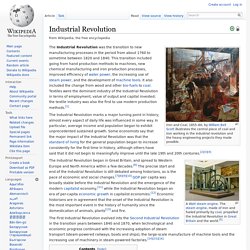
The Industrial Revolution was the transition to new manufacturing processes in the period from about 1760 to sometime between 1820 and 1840. This transition included going from hand production methods to machines, new chemical manufacturing and iron production processes, improved efficiency of water power, the increasing use of steam power, and the development of machine tools. It also included the change from wood and other bio-fuels to coal. Textiles were the dominant industry of the Industrial Revolution in terms of employment, value of output and capital invested; the textile industry was also the first to use modern production methods.[1]