
Einstein for Everyone. Einstein for Everyone Nullarbor Press 2007revisions 2008, 2010, 2011, 2012, 2013 Copyright 2007, 2008, 2010, 2011, 2012, 2013 John D.

Norton Published by Nullarbor Press, 500 Fifth Avenue, Pittsburgh, Pennsylvania 15260 with offices in Liberty Ave., Pittsburgh, Pennsylvania, 15222 All Rights Reserved John D. An advanced sequel is planned in this series:Einstein for Almost Everyone 2 4 6 8 9 7 5 3 1 ePrinted in the United States of America no trees were harmed web*bookTM This book is a continuing work in progress. January 1, 2015. Preface For over a decade I have taught an introductory, undergraduate class, "Einstein for Everyone," at the University of Pittsburgh to anyone interested enough to walk through door. With each new offering of the course, I had the chance to find out what content worked and which of my ever so clever pedagogical inventions were failures. At the same time, my lecture notes have evolved. This text owes a lot to many. I i i.
Inner product space. Geometric interpretation of the angle between two vectors defined using an inner product Definition[edit] Formally, an inner product space is a vector space V over the field F together with an inner product, i.e., with a map that satisfies the following three axioms for all vectors and all scalars Conjugate symmetry: Note that when F = R, conjugate symmetry reduces to symmetry.

Functional analysis. One of the possible modes of vibration of an idealized circular drum head.
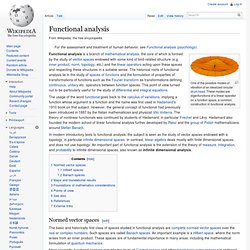
These modes are eigenfunctions of a linear operator on a function space, a common construction in functional analysis. Normed vector spaces[edit] The basic and historically first class of spaces studied in functional analysis are complete normed vector spaces over the real or complex numbers. Such spaces are called Banach spaces. An important example is a Hilbert space, where the norm arises from an inner product. More generally, functional analysis includes the study of Fréchet spaces and other topological vector spaces not endowed with a norm. Hilbert spaces[edit] Hilbert spaces can be completely classified: there is a unique Hilbert space up to isomorphism for every cardinality of the orthonormal basis. . Banach space. Definition[edit] or equivalently:

Lp space. In mathematics, the Lp spaces are function spaces defined using a natural generalization of the p-norm for finite-dimensional vector spaces.

They are sometimes called Lebesgue spaces, named after Henri Lebesgue (Dunford & Schwartz 1958, III.3), although according to the Bourbaki group (Bourbaki 1987) they were first introduced by Frigyes Riesz (Riesz 1910). Wavelet. A wavelet is a wave-like oscillation with an amplitude that begins at zero, increases, and then decreases back to zero.

It can typically be visualized as a "brief oscillation" like one might see recorded by a seismograph or heart monitor. Generally, wavelets are purposefully crafted to have specific properties that make them useful for signal processing. Sobolev space. In mathematics, a Sobolev space is a vector space of functions equipped with a norm that is a combination of Lp-norms of the function itself as well as its derivatives up to a given order.

The derivatives are understood in a suitable weak sense to make the space complete, thus a Banach space. Intuitively, a Sobolev space is a space of functions with sufficiently many derivatives for some application domain, such as partial differential equations, and equipped with a norm that measures both the size and regularity of a function. Sobolev spaces are named after the Russian mathematician Sergei Sobolev. Their importance comes from the fact that solutions of partial differential equations are naturally found in Sobolev spaces, rather than in spaces of continuous functions and with the derivatives understood in the classical sense.
Motivation[edit] There are many criteria for smoothness of mathematical functions. Where α a multi-index of order |α| = k and Ω is an open subset in ℝn. Is used. and. Convolution. Computing the inverse of the convolution operation is known as deconvolution.
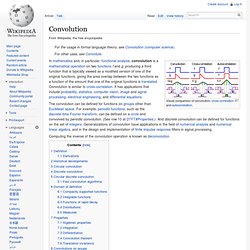
Definition[edit] The convolution of f and g is written f∗g, using an asterisk or star. It is defined as the integral of the product of the two functions after one is reversed and shifted. As such, it is a particular kind of integral transform: While the symbol t is used above, it need not represent the time domain. For functions f, g supported on only (i.e., zero for negative arguments), the integration limits can be truncated, resulting in In this case, the Laplace transform is more appropriate than the Fourier transform below and boundary terms become relevant. Splines. Expertise: Intermediate What is the general idea?

Here is an overview of how we will proceed to construct spline basis functions. In fact, this is how most basis function systems are constructed. First we begin with the simplest possible prototype for a basis function. We call this prototype a mother function, Φ(t). Lateral Shift: We displace the mother function along the t axis, often by defining the displaced version to be Φ(t - δ), where δ is the amount of the shift. The shift and scale operations are too simple to require further comment at this point, but we now need to focus on how spline functions are made more smooth. How does this smoothing operation work? Figure 1: Two box functions. Now let's apply a tilt to the mother box function by multiplying it by the function whose value is t if 0 ≤ t, and 0 if t < 0. At the same time, we shift the original box function one unit to the right to obtain Φ(t - 1) = 1, 1 ≤ t < 2 and 0 elsewhere.
Figure 2 shows this process.