
Chinas Top 6 Environmental Concerns. China's environmental crises seem to arise on a scale as sweeping and epic as the vast nation itself: Thousands of dead, bloated pigs floating down the river that supplies Shanghai with its drinking water.
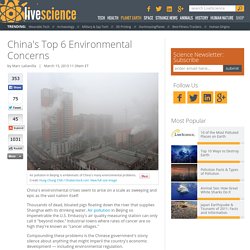
Air pollution in Beijing so impenetrable the U.S. Embassy's air quality measuring station can only call it "beyond index. " Industrial towns where rates of cancer are so high they're known as "cancer villages. " Compounding these problems is the Chinese government's stony silence about anything that might imperil the country's economic development — including environmental regulation. But China's increasingly restive population of 1.3 billion people is now starting to demand government action to combat the deadly plagues of pollution and disease that are stalking the 21st century's economic powerhouse.
Chinese officials, however, have barely started to acknowledge the problem. In China, public anger over secrecy on environment. China's Three Gorges Dam: An Environmental Catastrophe? SHANGHAI—For over three decades the Chinese government dismissed warnings from scientists and environmentalists that its Three Gorges Dam—the world's largest—had the potential of becoming one of China's biggest environmental nightmares.
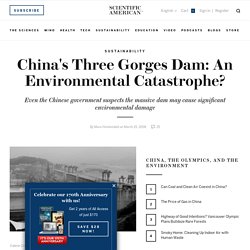
But last fall, denial suddenly gave way to reluctant acceptance that the naysayers were right. Chinese officials staged a sudden about-face, acknowledging for the first time that the massive hydroelectric dam, sandwiched between breathtaking cliffs on the Yangtze River in central China, may be triggering landslides, altering entire ecosystems and causing other serious environmental problems—and, by extension, endangering the millions who live in its shadow. Government officials have long defended the $24-billion project as a major source of renewable power for an energy-hungry nation and as a way to prevent floods downstream. When complete, the dam will generate 18,000 megawatts of power—eight times that of the U.S.'s Hoover Dam on the Colorado River. Www.footprintnetwork.org/images/article_uploads/China_Ecological_Footprint_2012.pdf.
Environmental problems in China. Air pollution Respiratory and heart diseases related to air pollution are the leading cause of death in China.
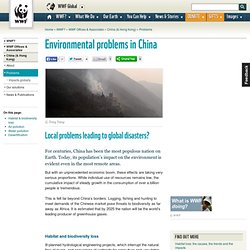
While some progress has been achieved in improving energy efficiency and carbon dioxide emissions reduction, 75% of energy production is still dependent on coal. Meanwhile, demand for automobiles is growing fast. Various studies estimate pollution costs the Chinese economy about 7-10% of GDP each year. Water pollution Decades of waste poured from factories and cities into China's rivers have turned many of them into open sewers.
The water quality of major lakes (including reservoirs) and urban lakes is also relatively poor, with many suffering algal blooms and eutrophication. China urbanization impact biodiversity - Google Search. Www.cbd.int/doc/publications/cbo-booklet-2012-en.pdf. Www.cbd.int/en/subnational/partners-and-initiatives/cbo/cbo-scientific-analysis-and-assessment/cbo-saa_chapter-2_13-oct-2012. China urbanization impact biodiversity - Google Search. The Retreat of the Elephants: An Environmental History of China - Mark Elvin - Google Books. The ecological effects of China’s urbanization: water pollution in Shanghai. The problem of water pollution can be found throughout China, mainly due to agricultural and domestic waste products resulting from urbanization.
Indeed, since the late 1970s, China has been experiencing a period of economic reform and expansion accompanied by widespread urbanization. The quality of China’s lake and river water are classified according to the country’s environmental quality standards for surface water. The ranking is organized in order of increasing pollution levels (based on the concentrations of 30 substances): from Grade I to Grade V, indicating good, fairly good, slightly polluted, poor, and hazardous. Grade II and Grade III water are suitable for drinking, swimming, and household use; Grade IV water is acceptable for industrial use; Grade V water is only acceptable for agricultural irrigation. There is also a category for the worst water, which is unsuitable for any use. IWRM Karlsruhe - Integrated Water Resources Management. Urbanization which has been taking place for decades in Bangkok Metropolitan Administration (BMA), Thailand shows by rapid increment of the number population in the area since 1947.
At present condition from total land area of 1,568.737 km2 about 700 km2 is urbanized area. Corresponds to the urbanization in BMA area, analysis of rainfall pattern change is conducted in the related area. Data of daily rainfall data from 1969 up to 2007 from three rainfall stations, i.e. Bangkok Metropolis, Bang Na, and Don Muang station is used as the basic data of rainfall pattern analysis. Whereas daily rainfall data from 30 rainfall stations in BMA area from 1991 upto 2007 is used as the basic data for rainfall spatial distribution analysis in BMA area.