
Valve launches 'Steam for Schools' program. Valve has announced plans for ‘Steam for Schools’, a program that aims to provide a free, limited version of Steam to classrooms for educational purposes. Valve’s director of educational programs Leslie Redd unveiled the initiative earlier today at the Games for Change festival in New York City. “We have a limited version of Steam, which is called 'Steam for Schools', And what we're doing is asking for teachers, after school programs, organizations – anywhere where there's a student relationship, which includes homeschooling – for them to submit a form to be part of it.” Educators will be able to apply this summer for beta inclusion, which includes a limited version of the Steam platform that includes Portal 2, the game's level editor, and its workshop for hosting and organizing user-created levels.
This new version of Steam will be free for administrators, and will provide administrator access to customize what students can and can’t do with the programs. Video games help autistic students in classrooms. From wire service reports Read more by staff and wire services reports At the University of Michigan, software engineering students this spring designed several Kinect games for children with autism. On-screen, Michael Mendoza’s digital avatar stands before a wonderland of cakes and sweets, but his message is all business: “I. Get. Frustrated when people push me and call me—and call me—a teacher’s pet!” In another classroom at Steuart W. Purported Xbox 720 To Cost $299 With Blu-ray Support, Kinect 2 And Virtual Reality In Time For Holiday 2013.
The current gen Xbox may be a year past its halfway point but a purported “leaked” document dating back to August 2010 from a Microsoft presentation details the next gen Xbox 720 in great detail.

Features for the next Xbox, according to the document, will include native Blu-ray playback, full support for HD and 3-D, and beefed up hardware (graphics and processor) under the hood. Other bits and pieces from the doc include PVR functionality, a low power mode setting during media playback and what amounts to an always-on mode. Gates did say years ago that the Xbox would eventually become the nerve center for any living room. And based on recent events, it’s not entirely out of the realm of possibility that Microsoft is making a play to turn the Xbox into a stand-alone set-top box for all things video.
Storybricks. Why Teachers Use Digital Games and Why Schools Teach Gaming. 5.14.12 | A national survey of teachers who use digital games in K-8 classrooms found that the majority—60 percent—report games foster student collaboration and help students to stay focused on specific tasks.

The survey of 505 teachers also found that half of those who identified as “very or moderately comfortable” with digital games in the classroom use games regularly: 32 percent use games two to four times per week, and 18 percent use games daily. Social media and video games in classrooms can yield valuable data for teachers. Photo by BarbaraLN Social media, video games, blogs and wikis are playing increasingly important roles in classrooms across the country.

Some worry that incorporating more social media and other technologies into education is leading to too much computer time, as well as to a generation of students deficient in the face-to-face social skills needed to survive in the workplace. Proponents say schools need to find ways to use these technologies to improve teaching and learning, or else risk losing the attention of digital natives. A paper released earlier this week by the Brookings Institution addresses how social media, blogs and video games are improving education by increasing access to people and information in various forms, including Twitter feeds, blog posts, videos and books.
These tools are also increasing people’s ability to share information with networks and contribute their own thoughts. Create, Capture, Upload: New Site Features Kids’ Digital Projects. Teaching Strategies DIY.org By Katrina Schwartz Refrigerators and fireplace mantles might still be covered with children’s projects, but more and more, those projects are finding a home online.
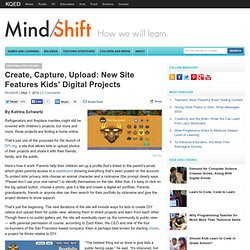
That’s just one of the purposes for the launch of DIY.org, a site that allows kids to upload photos of their projects and share it with their friends, family, and the public. Here’s how it work: Parents help their children set up a profile that’s linked to the parent’s email, which gives parents access to a dashboard showing everything that’s been posted on the account. That’s just the beginning. “The boldest thing we’ve done is give kids a public facing page,” he said. The creators also wanted the comment system to be 100% positive, which is why the only way to comment on a piece of art is to give it one of four stickers: Awesome, Beautiful, Favorite, and Genius.
Right now, DIY is a free service. Related. Chad Sansing, Ignite Talk Thursday. GETIdeas: Derek Robertson on why we should engage with gaming for learning. Pullias Lecture: "Games, Learning, and the Looming Crisis in Higher Education" Rethinking Learning: The 21st Century Learner. Games and Education Scholar James Paul Gee on Video Games, Learning, and Literacy. KinectEDucation. Video Games for Learning: Resource Roundup.
The Education Arcade. Games-ED: games based learning. Game2Design: play, design, build. How Video Games Are Changing Education. Angry Birds, Farmville and Other Hyperaddictive ‘Stupid Games’ I am learning : Games Based Revision, Assessment, Homework Setting and Exam Practice. Global Conflicts Portal. Serious Games Initiative.
Brain Age : Home. Immune Attack. Kinect Applications. Jesse Schell - Learning is Beautiful. Video Games for Learning? Why Not? Editor's Note: This post was originally posted on career advice expert, Penelope Trunk's Homeschooling blog.

If you'd rather read it (and the comments) there, go here. The Atari-generation often defaults to an automatic mindset that books are for learning and games are for play. However, many have no accurate frame of reference. The types of games kids are learning with today, were not available to them when they were children. What is Games Based Learning? My reflections on #gbl from #tmplay - Enabling Environments. 3 Top Game Based Learning Links: Weekly GBL Digest – 1. Ten reasons why game based learning works in education.
Innovative Learning Based on Mobile Games. M-learning expanding educational opportunities Via: mGBL – mobile Game-Based Learning ProjectWithin the mobile Game-Based Learning project (mGBL) eleven partner organizations from Austria, Croatia, Great Britain, Italy, and Slovenia have joined forces to work on the development of a platform for the presentation of educational content in a playful and emotional way on mobile devices.

This work is co-funded by the European Community under the Information Society Technologies (IST) Program of the Sixth Framework Program (FP6). Building on the latest innovations in the field of m-learning and on the latest research results from the field of didactics, new approaches to game-based learning are being developed for use on mobile phones. The platform is targeted at young adults between the ages of 16 and 24, and focuses on education in career guidance, health, and commerce. The platform currently supports three types of games: Assessment in Game-Based Learning « Game-Based Learning Talk.
Assessment in game-based learning (GBL) programs can be far superior to your typical weekly multiple-choice test.
Games are all about constant assessment. Games do not actively “teach” – they don’t say “here is some knowledge for you to remember” – but rather they provide constant challenges and then give you feedback on your decisions, and that is how you learn. So, in order to better understand how to design effective GBL programs, let’s take a look at some characteristics and considerations of assessment in GBL. More formative feedback “The most valuable assessment for instruction is the continuous, deeply engaged feedback loop of formative assessment” – quote from EdWeek article.
Games can provide a greater amount and better quality of formative feedback than a traditional classroom. Better assessment than traditional methods How is feedback in the game mapped to the learning objectives? And, please feel free to assess this article in the comments! Does games based learning work? « One of the questions educators ask me about games is “Does games based learning work?”.

It’s a reasonable question, but it’s not the what people mean. Firstly, I can’t begin to answer without also asking them in return “Is play a serious activity?”. Most people seem believe it is, and can cite numerous examples from their own lives. What they are really asking is “How could games based learning work in my context”. This is almost impossible to definitively answer, but we can find numerous arguments to say that it might already be working – we just need to be more conscious of where and when. cc licensed ( BY ) flickr photo shared by dan taylor Children engage in learning processes in several different contexts.
Game players can take up a game or put it down at will, but the first-year writing course is rarely voluntary. Game Based Learners. Game Design. Game Based Learning.