4th amendment warrant for E-mail required
< digital rights
< DigitalIssues
< clarinette02
Get flash to fully experience Pearltrees
In a landmark decision issued today in the criminal appeal of U.S. v. Warshak , the Sixth Circuit Court of Appeals has ruled that the government must have a search warrant before it can secretly seize and search emails stored by email service providers. Closely tracking arguments made by EFF in its amicus brief , the court found that email users have the same reasonable expectation of privacy in their stored email as they do in their phone calls and postal mail. EFF filed a similar amicus brief with the 6th Circuit in 2006 in a civil suit brought by criminal defendant Warshak against the government for its warrantless seizure of his emails.
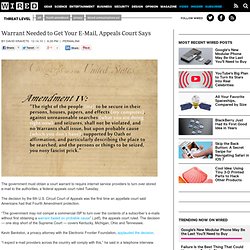
The government must obtain a court warrant to require internet service providers to turn over stored e-mail to the authorities, a federal appeals court ruled Tuesday. The decision by the 6th U.S. Circuit Court of Appeals was the first time an appellate court said Americans had that Fourth Amendment protection. “The government may not compel a commercial ISP to turn over the contents of a subscriber’s e-mails without first obtaining a warrant based on probable cause ” (.pdf), the appeals court ruled.
In the last three years, three federal circuits have published opinions on whether the Fourth Amendment applies to e-mail (dividing 2-1). In all three cases, the initial panel opinions were withdrawn or overturned on other grounds, leaving the issue surprisingly unsettled. This morning, the Sixth Circuit handed down an opinion by Judge Boggs that addresses the question directly and concludes that the Fourth Amendment protects e-mail held by an ISP with a full warrant requirement. The case is United States v. Warshak , a criminal appeal following conviction involving the same set of facts that were the subject of one of the earlier circuit court cases later overturned en banc.