
Introducing Programming to Preschoolers. Kids and Coding Teaching Strategies Flickr: AngryJulieMonday By Heather Chaplin Since MIT’s Lifelong Kindergarten group released Scratch in 2007, kids ages 8 to 13 have built more than 2.2 million animations, games, music, videos and stories using the kid-friendly programming language.
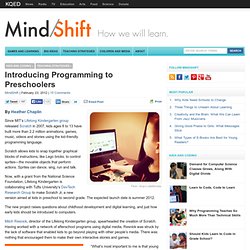
Scratch allows kids to snap together graphical blocks of instructions, like Lego bricks, to control sprites—the movable objects that perform actions. Sprites can dance, sing, run and talk. Now, with a grant from the National Science Foundation, Lifelong Kindergarten is collaborating with Tufts University’s DevTech Research Group to make Scratch Jr, a new version aimed at kids in preschool to second grade. The new project raises questions about childhood development and digital learning, and just how early kids should be introduced to computers. Mitch Resnick, director of the Lifelong Kindergarten group, spearheaded the creation of Scratch. “Computers for most people are black boxes. Related. Online treatment for fatigue syndrome huge success - News - OnMedica.
Jo Carlowe Thursday, 1 March 2012 Fatigue In Teenagers on the interNET (FITNET), the first web-based therapeutic programme for adolescents with CFS is substantially more effective than treatment as usual at reducing symptoms of this debilitating disorder, with nearly two-thirds reporting recovery after just six months.

The findings published Online First in The Lancet, reveal that after just six months of treatment, 63% of adolescents receiving the FITNET intervention reported that they had recovered, almost eight times as many as those given standard care. "With FITNET, effective treatment is within reach for any adolescent with CFS. These findings stress the need for proper and rapid diagnosis and making medical professionals aware of adolescent CFS and the treatment options", explains Sanne Nijhof from the University Medical Centre Utrecht in The Netherlands, lead author of the research.
Social Networking.
Mobile firms back new GSMA app privacy guidelines. Mapsandapps. Sky News LIVE Feb 2012: NHS Future Forum "Maps and Apps" Native iPad app coming to MacPractice software users. For Apple fans, MacPractice has been a popular practice management and clinical electronic medical record software for Apple computers.

They often partner with Apple for workshops geared towards medical professionals — as one of our physician editors witnessed while at his local Apple Store. The iMedicalApps team has previously reported on the MacPractice software and we lamented that there wasn’t a native iPad solution for the software. At that time, there was a workaround that allowed clinicians to login from an iPad to their Apple computer and view the MacPractice software remotely. Obviously, this isn’t an ideal situation. That has changed with the upcoming release of Clipboard, a native iPad application that works seamlessly with the desktop software. MacPractice’s CEO Mark Hollis explains why the app was created. While doctor’s have frequently requested a native MacPractice app, the task of creating the app has been an interesting challenge for the company.
The CCHIR: Researching Web 2.0 & Mobile Technology in Healthcare. With Web 2.0 and mobile technology making their way to the forefront of pharmacology and public health, there has been a growing need for in-depth research into their effects and benefits.

Many pharma companies and healthcare systems are connecting with consumers through mobile apps, social media, and other online platforms, but what do these new systems actually do to improve health literacy and patient education? It’s questions like this that prompted Fort Lauderdale’s Nova Southeastern University College of Pharmacy to open America’s first Center for Consumer Health Informatics Research (CCHIR). The Center’s mission is to “generate discoveries that leverage the potential of consumer health informatics to improve patient health.” The top 50 iPad apps. It's easy to forget that when Apple's first iPad was unveiled in January 2010, there were plenty of cynics questioning the need for a slate-shaped device sitting somewhere between a smartphone and a laptop computer.
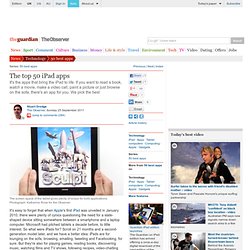
Microsoft had pitched tablets a decade before, to little interest. So what were iPads for? Scroll on 21 months and a second-generation model later, and we have a better idea: iPads are for lounging on the sofa, browsing, emailing, tweeting and Facebooking, for sure. Joining in the conversation - social media and mental health services.
Older people.