
Heat Your Room with 1 Candle plus Flowerpots, Nuts and Washers. After a crazy week when half a million people visited our site to check out the video, 'How to Heat Your Room for 8 Pence a Day', we thought you would appreciate a refinement of this idea that generates even more heat from a candle by increasing the thermal mass within the first pot.

Please share this page too so that those who saw the first post can also test out this new design. Putting it all Together The process for putting together the candle heater is very simple: Untitled. Rare energy Video by international film maker. How Much Is Left? The Limits of Earth's Resources, Made Interactive. A Table That Turns Your Kitchen Into Mini Ecosystem [UPDATED] Convenience and efficiency are king when it comes to product design.
![A Table That Turns Your Kitchen Into Mini Ecosystem [UPDATED]](http://cdn.pearltrees.com/s/pic/th/ecosystem-business-innovation-37523442)
What could be more efficient than a natural ecosystem? That's the insight behind a "living kitchen" designed by the brilliant young design studio Studio Gorm. They looked at what we have in our kitchens--fruits, vegetables, organic waste--and figured: That's actually enough to create a miniature system for watering fresh herbs, composting the waste, and generating new soil. Colossal Magnetic Levitation Wind Turbine Proposed. It's a vision of a magnetically levitated wind turbine that can generate one gigawatt of power (enough to power 750,000 homes).
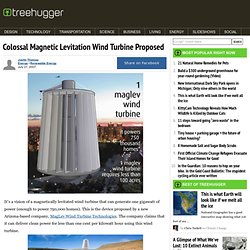
This is the device proposed by a new Arizona-based company, MagLev Wind Turbine Technologies. The company claims that it can deliver clean power for less than one cent per kilowatt hour using this wind turbine. Magnetic levitation is a very efficient method of capturing wind energy. The blades of the turbine are suspended on a cushion of air, and the energy is directed to linear generators with minimal fiction losses. But the big advantage with maglev is that it reduces maintenance costs, and increases the lifespan of the generator. The company also points out that building a single huge turbine like this reduces construction and maintenance costs, and it requires less land space than hundreds of conventional turbines. China already has Maglev wind turbines in operation, see: The World's First "Magnetic Levitation" Wind Turbines Unveiled in China. The world can be powered by alternative energy, using today's technology, in 20-40 years, says Stanford researcher Mark Z. Jacobson.
January 26, 2011 A new study – co-authored by Stanford researcher Mark Z.
Jacobson and UC-Davis researcher Mark A. Delucchi – analyzing what is needed to convert the world's energy supplies to clean and sustainable sources says that it can be done with today's technology at costs roughly comparable to conventional energy. Gravity Lamp Lasts 200 Years, Will Gmm/r2 Torchiere Lamps Out. Recycled Building Material Stronger than Concrete.
A new building material has the potential to divert large quantities of waste from landfills. UK company Affresol offers a truly novel building material called Thermo Poly Rock (TPR), which is made from select waste products. The resulting material is stronger than concrete, is waterproof, fire retardant, and can be used to build low-cost modular housing. Each house built with TPR panels will save an average of 18 tons of waste material from being disposed of in landfills. "Every country in the world has issues with waste and we now have an opportunity to turn waste into an enduring housing resource that is 100% recyclable. " - Ian McPherson, Affresol TPR is cold-produced from waste products mixed with resin and polymers which can then be poured into molds like concrete.. The TPR panels can be used to frame houses, saving large amounts of lumber in the building process, and because the material is waterproof, houses can be put up year-round.
Solar goes Hyper in the U.S. As the U.S. government continues to heap billions in subsidies to the world's wealthiest coal and oil companies, the solar industry has been struggling to make it in the United States.
This is sad for many reasons, not the least of which is that we're missing out on one of the biggest growth industries in the world. Currently there are 16 gigawatts of installed solar power globally. That number will grow to about 1,800 gigawatts in the next 20 years, making it one of the best job creators. U.S. engineers invented the solar panel, and the U.S. should be dominating that market.
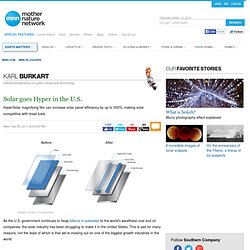
Instead, foreign manufacturers (particularly in China) have taken our IP and run with it, as we become increasingly dependent on foreign oil and dirty coal operations to meet our power needs. Fortunately HyperSolar, a new U.S. company, offers a ray of sunny hope on the clean energy frontier. The company does not manufacture solar panels. What if solar got fossil fuel subsidies? 6 Cents Per kWh: World's Largest Solar Project Unveiled.
Stirling Energy and Southern California Edison have announced they plan to construct a 4,500-acre solar generating station in Southern California.
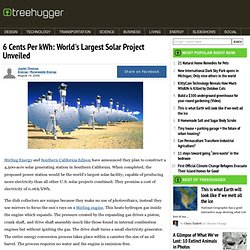
When completed, the proposed power station would be the world's largest solar facility, capable of producing more electricity than all other U.S. solar projects combined. They promise a cost of electricity of 0.06$/kWh.