
National Underground Railroad Freedom Center. Rebellion: John Horse and the Black Seminoles, First Black Rebels to Beat American Slavery. Alan Macfarlane on 'modernity' and anthropology. The Huxley Lecture, Royal Anthropological Institute, 2012.
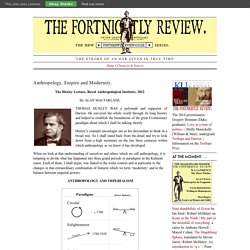
By ALAN MACFARLANE. THOMAS HUXLEY WAS a polymath and supporter of Darwin. He surveyed the whole world through its long history and helped to establish the foundations of the great Evolutionary paradigm about which I shall be talking shortly. Huxley’s example encourages me as his descendant to think in a broad way. So I shall stand back from the detail and try to look down from a high mountain on the last three centuries within which anthropology as we know it has developed.
When we look at that understanding of ourselves and others which we call anthropology, it is tempting to divide what has happened into three grand periods or paradigms in the Kuhnian sense. Hydria Project. American Memory from the Library of Congress - Home Page. Welcome to The Official site of The Universal Zulu Nation. The authors/submitters alone is responsible for what is expressed blackedoutthroughwhitewashp2 Muslim Scientists and Islamic Civilization African History on the Internet - Kingdoms and Ancient Civilizations Correcting_Rewritten_History MindStation X : Renaissance Dr.

Ivan Van Sertima Italy - Italian Renaissance - Zoological studies Re: For Sale: A DNA Test to Measure Racial Mix KAM Africans in Early Europe The TRUE Black History Home Page European Crusades, Christianisation, and Colonisation West Africa William Greaves: Documenting The Truth In Film - Global Black News ...
African Contributions to World History Sephardim and their History The Iberian Golden Age, European Expansion Origins of Islamic Intolerence by Mark Silverberg African American and Ancient Egyptians ANCIENT AFRICA AND EARLY ROME The Civilization of the Renaissance in Italy - Chapter II. Library.thinkquest.org/08aug/01150/Shamba.html. As of July 1, 2013 ThinkQuest has been discontinued.

We would like to thank everyone for being a part of the ThinkQuest global community: Students - For your limitless creativity and innovation, which inspires us all. Teachers - For your passion in guiding students on their quest. Partners - For your unwavering support and evangelism. Parents - For supporting the use of technology not only as an instrument of learning, but as a means of creating knowledge. Home - African Ceremonies. INTRODUCTION TO THE PALEOLITHIC DIET. By Dr.
Ben Balzer, family physician There are races of people who are all slim, who are stronger and faster than us. They all have straight teeth and perfect eyesight. Arthritis, diabetes, hypertension, heart disease, stroke, depression, schizophrenia and cancer are absolute rarities for them. These people are the last 84 tribes of hunter-gatherers in the world. The diet is usually referred to as the "Paleolithic Diet" referring to the Paleolithic or Stone Age era. The basic principles of the Paleolithic Diet are so simple that most high school students can understand them. All major dietary components are covered- (i.e. vitamins, fats, protein, fats, carbohydrates, antioxidants and phytosterols etc). Joseph Beuys. Joseph Beuys (German pronunciation: [ˈjoːzɛf ˈbɔʏs]; 12 May 1921 – 23 January 1986) was a German Fluxus, happening and performance artist as well as a sculptor, installation artist, graphic artist, art theorist and pedagogue of art.
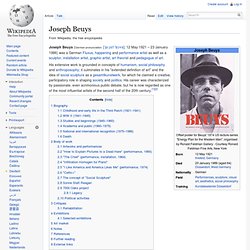
His extensive work is grounded in concepts of humanism, social philosophy and anthroposophy; it culminates in his "extended definition of art" and the idea of social sculpture as a gesamtkunstwerk, for which he claimed a creative, participatory role in shaping society and politics. His career was characterized by passionate, even acrimonious public debate, but he is now regarded as one of the most influential artists of the second half of the 20th century.[1][2] Biography[edit] Childhood and early life in the Third Reich (1921–1941)[edit] Joseph Beuys was born in Krefeld, the son of the merchant Josef Jakob Beuys (1888–1958) and Johanna Maria Margarete Beuys (born Hülsermann, 1889–1974).
WW II (1941–1945)[edit] Studies and beginnings (1945–1960)[edit] Maps. Home page Down to: 6th to 15th Centuries | 16th and 19th Centuries | 1901 to World War Two | 1946 to 21st Century The Ancient World ... index of places Aegean Region, to 300 BCE Aegean Region, 185 BCE Africa, 2500 to 1500 BCE Africa to 500 CE African Language Families Alexander in the East (334 to 323 BCE)

Brain Games & Brain Training. Will We Ever Have a Fully Digital Brain? Dark winters 'led to bigger human brains and eyeballs' 27 July 2011Last updated at 08:26 By Judith Burns Science reporter, BBC News Researchers measured skulls from the 1800s Humans living at high latitude have bigger eyes and bigger brains to cope with poor light during long winters and cloudy days, UK scientists have said.
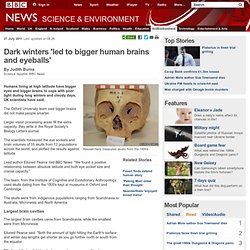
The Oxford University team said bigger brains did not make people smarter. Larger vision processing areas fill the extra capacity, they write in the Royal Society's Biology Letters journal. The scientists measured the eye sockets and brain volumes of 55 skulls from 12 populations across the world, and plotted the results against latitude. Lead author Eiluned Pearce told BBC News: "We found a positive relationship between absolute latitude and both eye socket size and cranial capacity. "