
Insect drives robot to track down smells (w/ video) A small, two-wheeled robot has been driven by a male silkmoth to track down the sex pheromone usually given off by a female mate.

The robot has been used to characterise the silkmoth's tracking behaviours and it is hoped that these can be applied to other autonomous robots so they can track down smells, and the subsequent sources, of environmental spills and leaks when fitted with highly sensitive sensors. The results have been published today, 6 February, in the journal Bioinspiration and Biomimetics. Chris Worth - Google+ - In our rundown of the 10 most popular uploads to The Ec... Misab PA - Google+ - Two human look-a-like robots invented by Japanese engin... Michał Jurczuk - Google+ - DARPA shows off latest advances to four-legged LS3 robo... Will People Alive Today Have the Opportunity to Upload Their Consciousness to a New Robotic Body? When Steve Jobs passed away last year, a joke bounced around--not that there was anything particularly funny about it--that the man who had done so much to shape modern technology hadn't really died at all, but rather had figured out how to upload himself into the Mac OS so he could live on with us, and with his products, forever.
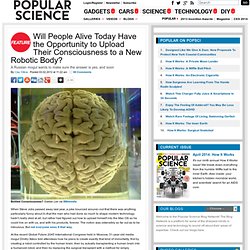
The notion was ostensibly so far out as to be ridiculous. But not everyone sees it that way. At the recent Global Future 2045 International Congress held in Moscow, 31-year-old media mogul Dmitry Itskov told attendees how he plans to create exactly that kind of immortality, first by creating a robot controlled by the human brain, then by actually transplanting a human brain into a humanoid robot, and then by replacing the surgical transplant with a method for simply uploading a person's consciousness into a surrogate 'bot. Which is terrifying and amazing and disconcerting all at the same time. If only it were that easy. Newsroom - One and done: Single-atom transistor is end of Moore's Law; may be beginning of quantum computing.
A controllable transistor engineered from a single phosphorus atom has been developed by researchers at the University of New South Wales, Purdue University and the University of Melbourne.
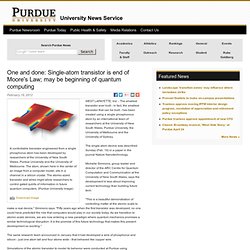
The atom, shown here in the center of an image from a computer model, sits in a channel in a silicon crystal. The atomic-sized transistor and wires might allow researchers to control gated qubits of information in future quantum computers. (Purdue University image) Download image. Best Science Pictures of 2011 Announced. Photograph courtesy B.

Anasori, M. Naguib, Y. Gogotsi, and M. British student designs bamboo smartphone. First quantum jiggles detected in solid object - physics-math - 28 January 2012. NOTHING sits still.

Even at absolute zero, when the thermal jiggling of matter is frozen, all things must still buzz to the tune of quantum mechanics. Now this subtle jittering has been detected in a small silicon bar, the first solid object ever to reveal its quantum vibrations. The Pirate Bay adds 'physibles' 3D-printing category. The Pirate Bay has announced what it is calling the "next step" for the sharing society -- a category called 'physibles' where people can share schematics for 3D-printable objects.

In a blog post, the organisation writes in its own inimitable way: "…after the internets evolutionised data to go from analogue to digital, it's time for the next step. Today most data is born digitally. It's not about the transition from analogue to digital anymore. We don't talk about how to rip anything without losing quality since we make perfect one to one digital copies of things. Music, movies, books, all come from the digital sphere. The Pirate Bay reckons that the next step in copying will be making physical objects from digital files. The benefits to society could be huge, the blog states -- after all, could we not print food for the hungry or eradicate child labour? Updated 14:32 24/01/2011: As Jack reminds us in the comments below, there are alternatives if you're looking for 3D printer plans. Smallest magnetic memory uses just 12 atoms - physics-math - 12 January 2012. By Jeff Hecht Video: Data storage on an atomic level Talk about doing more with less.

A dozen atoms have been made to store a bit of data magnetically – a feat normally performed by a million atoms. The work could one day help shrink the devices that store computer data. Today’s hard drives record data using a tiny electromagnet to align the spins of atoms in a metallic film that rotates below it. Unfortunately, that collective magnetic field also affects adjacent bits, limiting how closely they can be packed. The trick is to make adjacent atoms spin in opposite directions. Evolution of complexity recreated using 'molecular time travel' Public release date: 8-Jan-2012 [ Print | E-mail Share ] [ Close Window ] Contact: John Easton john.easton@uchospitals.edu 773-795-5225University of Chicago Medical Center Much of what living cells do is carried out by "molecular machines" – physical complexes of specialized proteins working together to carry out some biological function.

How the minute steps of evolution produced these constructions has long puzzled scientists, and provided a favorite target for creationists. In a study published early online on Sunday, January 8, in Nature, a team of scientists from the University of Chicago and the University of Oregon demonstrate how just a few small, high-probability mutations increased the complexity of a molecular machine more than 800 million years ago. Super-fast camera the size of a dustbin is able to capture the speed of light. By Daily Mail Reporter Updated: 08:14 GMT, 19 December 2011 It might be the size of a dustbin, but scientists have managed to invent a camera that can capture the speed of light.

The super-fast camera can show a bullet-shaped pulse of light travelling from one end of a laboratory flask to another in a fraction of a second. World’s Smallest Steam Engine Is Size of Fog Droplet. Engineers have made a tiny engine a few micrometers wide, or roughly the size of a water droplet found in fog.

The device is both confined and powered by a “trap” of laser light, and it sputters a bit. The fact that it works at all, however, may push the boundary of what’s possible in engineering microscopic machines. “The machine is so small that its motion is hindered by microscopic processes which are of no consequence in the macroworld,” said physicist Clemens Bechinger of the University of Stuttgart in a press release. A study about the microscopic Stirling engine was published Dec. 11 in Nature Physics. Synthetic cricket pricks up its 'ears' Woolly mammoth to be brought back to life from cloned bone marrow 'within five years' World's 'lightest material' unveiled by US engineers. 18 November 2011Last updated at 13:23 Engineers say the material is less dense than aerogels and metallic foams. Neutrinos remain faster than light after new tests. Following September's spectacular announcement, Professor John Ellis, a leading particle physicist told Channel 4 News that if true, the research would really "revolutionise" physics but that it was too early to start talking about time travel: "I'm sorry but I just don't think this is going to lead to realistic time travel.
It's a very subtle phenomenon in extreme circumstances," he said. That first finding was recorded when 15,000 neutrino beams were pumped over three years from Cern to Gran Sasso, an underground Italian laboratory near Rome. Physicists on the experiment said they had checked and rechecked over many months anything that could have produced a misreading before announcing what they had found. Jacques Martino, director of the French National Institute of Nuclear and Particle Physics, who worked on the second experiment, said that while this test was not a full confirmation, it did remove some of the potential systematic errors that may have occurred in the first one.
Citroen EGGO Concept Car. Top 10 futuristic concept laptop designs. The technology world is always exciting and unpredictable. It changes all the time. You never know what technology will be there in the next 5, 2, or even the next year. 30 years ago, nobody thought that everyone would need a personal computer. 20 years ago, our parents would never dream of a small, portable PC that we call laptop nowadays. Over time, thousands of models of laptops of all sizes have been introduced, but nobody knows what else is to come.
The best we can do is to take a look into the future with our Top 10 Futuristic Concept laptop designs, They are astoundingly sexy concept laptops with spellbinding features and cutting technology. 'Flying carpet' of conductive plastic takes flight. 30 September 2011Last updated at 07:56 By Roland Pease BBC News. 12 Events That Will Change Everything, Made Interactive. Hot 100 Gadgets - The Worlds Hottest gadgets 2011. The T3 Hot 100 2015 Welcome to T3’s Hot 100 – the ninth annual celebration of the best tech movers and shakers that we expect to burn brightest this year and beyond. It’s the ultimate cutting-edge wish list, unveiling the gadgets, innovations, trends, brands and burgeoning talent that are igniting our imagination and preparing to take the tech world by storm.
No rumours, no speculation – everything on the list is a nailed-on certainty, either right now, this year or next, from super phones to space tourism, and even a dash of huge tech personalities to boot. If you’re looking for more awesome tech, check out 10 things you need to know about self-driving cars Apple Watch. Smallest electric motor now just a nanometer wide.
Way back in the early days of 2011, the world's smallest electric motor was so...big. Did the Large Hadron Collider Just Debunk Superstring Theory? New data from Europe's Large Hadron Collider may signal the end of one of the most popular theories in physics, superstring theory. The Possible Discovery of the Higgs Will Shake the Foundations of Physics. We are all aware that the Large Hadron Collider (LHC) is the most powerful machine on planet earth and not yet operating at its full capacity. Since 2008, scientists at the CERN physics lab have slowing been increasing the intensity of the particle beams, with each time seeming to break its previous record. Did the use of psychedelics lead to a computer revolution? How to Make a Transparent Mouse with a Few Simple Ingredients. On the left: A mouse embryo preserved in para-formaldehyde. On the right: A mouse embryo soaked in Scale for two weeks.
What’s the News: The trouble with brains, organs, and tissues in general, from a biologist’s perspective, is that they scatter light like nobody’s business. HMZ-T1: Sony unveils world's first 3D head-mounted display that is as immersive as 'sitting in a cinema' The HMZ device enables the wearer to experience cinema-like viewing, equivalent to watching a 750-inch screen from 20 metres away By Graham Smith Updated: 12:17 GMT, 31 August 2011.
LED Lights Make Augmented Vision a Reality. LED Lights Make Augmented Vision a Reality. NASA's lasercom system aims to beam a HD video feed from Mars. As cameras technology has allowed us to increase the resolution of the images we capture and video we watch, so has the bandwidth required to transfer that imagery. In space, the amount of data that can be sent is currently limited due to the radio frequency (RF) systems being relied upon. Firing laser beams into the sky could make it rain, say scientists. Ever since ancient farmers called on the gods to send rain to save their harvests, humans have longed to have the weather at their command. That dream has now received a boost after researchers used a powerful laser to produce water droplets in the air, a step that could ultimately help trigger rainfall.
While nothing can produce a downpour from dry air, the technique, called laser-assisted water condensation, might allow some control over where and when rain falls if the atmosphere is sufficiently humid. Laser Crosswalk Saves Pedestrians From a Painful Death. Future Interfaces: 15 Peripherals Straight Out of Science Fiction. Www.virtusphere.com. Nextep1.jpg (605×682) 7 Man-Made Substances that Laugh in the Face of Physics. Com feature. Chronology of Events in Science, Mathematics, and Technology.
Magnetic Fields: Made Visible in Video - Technology. Human remote control may spell end for teachers. New Technology - Latest Technology Research and Advancements. New and Emerging Technology News. Future technology. Nanodots breakthrough may lead to 'a library on one chip' Solar-powered 3-D printer prints glass from sand. Casio's insane 3D printing tech cranks out artwork you could trip over.