
Phenomenology. Modern Philosophy. Staffweb.hkbu.edu.hk/ppp/top/top19. 19.

NIETZSCHE'S MORAL BREAKTHROUGH We saw last time how Kant tried to intensify the rational significance of acting morally by arguing that morality is based on an internal sense of freedom and moral duty. His idea that there is a universally valid "voice" inside of us, telling each person the difference between right and wrong, may seem odd to many of us who have been raised in a modern western culture, so thoroughly immersed as it is in relativism.
As a quick review of Kant's moral philosophy, and in order to point up some of the differences between Kant's view that moral ends (or aims) are "objective" and the common view that they are all "subjective", I have summarized some of the main differences in Figure 19.1. Frankfurt School: The Theodor Adorno Internet Archive.
Philosophy since the Enlightenment, by Roger Jones. Internet Encyclopedia of Philosophy. Squashed Philosophers- Condensed Plato Aristotle Augustine Descartes Hume Marx Freud Copernicus Hobbes Sartre Ayer Sade Wittgenstein Einstein. A magazine of ideas. Philosophy Research Base - StumbleUpon. Philosophy 320: History of Ancient Philosophy. On Human Nature, by Arthur Schopenhauer. General Philosophy. Philosophy for Beginners - Download free content from Oxford University. Nietzsche on Mind and Nature - Download free content from Oxford University. Index of philosophy. Philosophy: The Classics. Aesthetics and the Philosophy of Art. Linguistics and Philosophy. Information Philosopher - Introduction. Introduction The Information Philosopher has established that quantum mechanics and thermodynamics play a central role in the creation of all things.
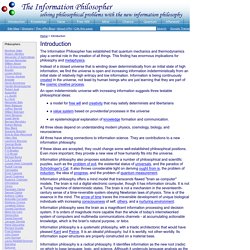
This finding has enormous implications for philosophy and metaphysics. Instead of a closed universe that is winding down deterministically from an initial state of high information, we find the universe is open and increasing information indeterministically from an initial state of relatively high entropy and low information. Information is being continuously created in the universe, not least by human beings who are just learning that they are part of the cosmic creative process. An open indeterministic universe with increasing information suggests three testable philosophical ideas: a model for free will and creativity that may satisfy determinists and libertarians a value system based on providential processes in the universe an epistemological explanation of knowledge formation and communication. Man is Free. For Teachers For Scholars.
Information Philosopher - Introduction. George Berkeley: Philosophy Metaphysics of Idealist Philosopher GeorgeBerkeley. Esse est percipi. Quotes. Famous Idealist Philosopher - George Berkeley (1685 - 1753) Explaining George Berkeley's idealism philosophy (esse est percipi) and the interconnection of mind, body and universe with realism of Wave Structure of Matter (WSM).

George Berkeley Quotes 'The Principles Concerning Human Knowledge', Pictures, Biography My purpose therefore is, to try if I can discover what those principles are, which have introduced all that doubtfulness and uncertainty, those absurdities and contradictions into the several sects of philosophy; insomuch that the wisest men have thought our ignorance incurable, conceiving it to arise from the natural dullness and limitation of our faculties. ... .. we are under an invincible blindness as to the true and real nature of things. ..
Hence a great number of dark and ambiguous terms presumed to stand for abstract notions, have been introduced into metaphysics and morality, and from these have grown infinite distractions and disputes amongst the learned. 2. The Laughter of Dionysus: Bataille and Derrida on Joyce & James Luchte: Philosophy. This essay, a work in progress, was originally presented at the SEP-FEP Joint Conference in Cardiff in 2009.

In his essay on Bataille, ‘From Restricted to General Economy: A Hegelianism without Reserve,’[1] Derrida alludes to Bataille’s reference to Joyce’s Finnegan’s Wake in his essay, ‘Hegel, Death and Sacrifice’,[2] in which the ‘Welsh Coffin’ is illustrated as the symbol of a communal event that is performed – comically, as with the ‘wake’ in the southern United States – in the face of the singular ‘event’ of death. As Derrida retells Bataille’s (second-hand) story,[3] the deceased is stood up in his coffin in pride of place amongst his fellows – dressed with a top hat, cigar and suit – and who, contrary to the usual and useful expulsion of the corpse, begin to essentially ‘roast’ the one who had passed – but, is still strangely in attendance. Ancient Greek Philosophy&[Internet Encyclopedia of Philosophy] The Ancient Greek philosophers have played a pivotal role in the shaping of the western philosophical tradition.
![Ancient Greek Philosophy&[Internet Encyclopedia of Philosophy]](http://cdn.pearltrees.com/s/pic/th/philosophy-encyclopedia-6063310)
This article surveys the seminal works and ideas of key figures in the Ancient Greek philosophical tradition from the Presocratics to the Neoplatonists. It highlights their main philosophical concerns and the evolution in their thought from the sixth century BCE to the sixth century CE. The Ancient Greek philosophical tradition broke away from a mythological approach to explaining the world, and it initiated an approach based on reason and evidence. Initially concerned with explaining the entire cosmos, the Presocratic philosophers strived to identify its single underlying principle. Their theories were diverse and none achieved a consensus, yet their legacy was the initiation of the quest to identify underlying principles. List of unsolved problems in philosophy.
This is a list of some of the major unsolved problems in philosophy.

Clearly, unsolved philosophical problems exist in the lay sense (e.g. "What is the meaning of life? ", "Where did we come from? ", "What is reality? ", etc.). Aesthetics[edit] Essentialism[edit] In art, essentialism is the idea that each medium has its own particular strengths and weaknesses, contingent on its mode of communication.
Art objects[edit] This problem originally arose from the practice rather than theory of art. While it is easy to dismiss these assertions, further investigation[who?] Epistemology[edit] Western Philosophy. Philosophy Timeline. TWILIGHT OF THE IDOLS. Philosophers and Their Works.