
Self Knowledge. Behavioural Economics. Behavioural Economics / Finance.
Neuroscience. Scientists Manipulate and Erase Memories. Empathy. How Great Entrepreneurs Think. What distinguishes great entrepreneurs?

Discussions of entrepreneurial psychology typically focus on creativity, tolerance for risk, and the desire for achievement—enviable traits that, unfortunately, are not very teachable. So Saras Sarasvathy, a professor at the University of Virginia's Darden School of Business, set out to determine how expert entrepreneurs think, with the goal of transferring that knowledge to aspiring founders. While still a graduate student at Carnegie Mellon, Sarasvathy—with the guidance of her thesis supervisor, the Nobel laureate Herbert Simon—embarked on an audacious project: to eavesdrop on the thinking of the country's most successful entrepreneurs as they grappled with business problems.
She required that her subjects have at least 15 years of entrepreneurial experience, have started multiple companies—both successes and failures—and have taken at least one company public. Your Brain Knows a Lot More Than You Realize. Meanwhile, a similar story was unfolding oceans away.
During World War II, under constant threat of bombings, the British had a great need to distinguish incoming aircraft quickly and accurately. Which aircraft were British planes coming home and which were German planes coming to bomb? Several airplane enthusiasts had proved to be excellent “spotters,” so the military eagerly employed their services. These spotters were so valuable that the government quickly tried to enlist more spotters—but they turned out to be rare and difficult to find. The government therefore tasked the spotters with training others. It was a grim attempt. With a little ingenuity, the British finally figured out how to successfully train new spotters: by trial-and-error feedback. The Knowledge GapThere can be a large gap between knowledge and awareness. Consider patients with anterograde amnesia, who cannot consciously recall new experiences in their lives.
Is Google Making Us Stupid? "Dave, stop.
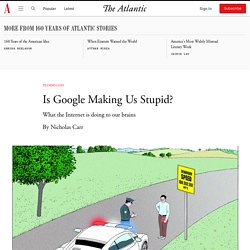
Stop, will you? Stop, Dave. Will you stop, Dave?” So the supercomputer HAL pleads with the implacable astronaut Dave Bowman in a famous and weirdly poignant scene toward the end of Stanley Kubrick’s 2001: A Space Odyssey. Bowman, having nearly been sent to a deep-space death by the malfunctioning machine, is calmly, coldly disconnecting the memory circuits that control its artificial “ brain.
I can feel it, too. I think I know what’s going on. For me, as for others, the Net is becoming a universal medium, the conduit for most of the information that flows through my eyes and ears and into my mind. I’m not the only one. Low IQ & Conservative Beliefs Linked to Prejudice. Spoilers Don’t Spoil Anything. I've got a weak spot for pulp fiction, especially when it involves a mysterious twist.

I like unironic thrillers and mediocre Agatha Christie imitations. Basically, I like any kind of fiction that lets me forget for vast stretches of time that I'm sitting in an airport terminal. I read these books in an unusual way: I begin with the last five pages, seeking out the final twist first. The twist won't make sense at this point, but that doesn't matter -- I enjoy reading the story with the grand finale in mind.
(Hell, I even cheated with Harry Potter.) Thinking. DISTORTED THINKING. Illusion and fallacy. Cognitive Biases. Top 10 Common Faults In Human Thought. Humans The human mind is a wonderful thing.
Cognition, the act or process of thinking, enables us to process vast amounts of information quickly. For example, every time your eyes are open, you brain is constantly being bombarded with stimuli. You may be consciously thinking about one specific thing, but you brain is processing thousands of subconscious ideas. Unfortunately, our cognition is not perfect, and there are certain judgment errors that we are prone to making, known in the field of psychology as cognitive biases. The Gambler’s fallacy is the tendency to think that future probabilities are altered by past events, when in reality, they are not.
Reactivity is the tendency of people to act or appear differently when they know that they are being observed. Pareidolia is when random images or sounds are perceived as significant. Interesting Fact: the Rorschach Inkblot test was developed to use pareidolia to tap into people’s mental states. Self-fulfilling Prophecy. List of cognitive biases. Systematic patterns of deviation from norm or rationality in judgment Cognitive biases are systematic patterns of deviation from norm and/or rationality in judgment. They are often studied in psychology, sociology and behavioral economics.[1] Although the reality of most of these biases is confirmed by reproducible research,[2][3] there are often controversies about how to classify these biases or how to explain them.[4] Several theoretical causes are known for some cognitive biases, which provides a classification of biases by their common generative mechanism (such as noisy information-processing[5]).
Gerd Gigerenzer has criticized the framing of cognitive biases as errors in judgment, and favors interpreting them as arising from rational deviations from logical thought.[6] Explanations include information-processing rules (i.e., mental shortcuts), called heuristics, that the brain uses to produce decisions or judgments. Belief, decision-making and behavioral[edit] Social[edit] [edit] The Brain.