
Study Published in Journal Nature Suggests New Genomic Pathways for Neuroblastoma. USB stick can sequence DNA in seconds - tech - 17 February 2012. Supply of Methotrexate, a Cancer Drug, May Run Out Soon. Preparing for Precision Medicine. Somatic Mutation Detection in Whole Genome Sequencing Data. A paper online at Bioinformatics describes our flagship algorithm for detecting somatic point mutations in whole-genome sequencing of tumor samples.
This freely available software package, called SomaticSniper, performs a Bayesian comparison of the genotype likelihoods in tumor and normal samples at every [covered] position in the genome. The study includes a detailed investigation of common sources of false positive mutation calls (usually from sequencing- or alignment-related artifacts) and describes a filtering strategy to remove them from mutation callsets.
Inception: First Cancer Genomes Like many bioinformatics algorithms, SomaticSniper reached publication after a long and colorful history. It began in 2008 when we sequenced the first cancer genome, AML1. Linkage analysis in the next-generation sequencing era. [Hum Hered. 2011] - PubMed - NCBI. Analysis in the next-generation sequencing era.
![Linkage analysis in the next-generation sequencing era. [Hum Hered. 2011] - PubMed - NCBI](http://cdn.pearltrees.com/s/pic/th/analysis-generation-sequencing-22494667)
Source Inherited Disease Research Branch, National Human Genome Research Institute, National Institutes of Health, Baltimore, Md., USA. How Your Genes Will Drive Personalized Medicine. This month I was honored to be the master of ceremonies at the Personalized Medicine World Conference in Silicon Valley, California. for the second time.
About 850 scientists, venture capitalists and physicians attended and most all of them, have many more letters after their name for advanced degrees than I have! These smart folks have been building the technology and processes to enable all of us to receive preventive medicine and treatments that, when needed, are an exact match for our individual biology. Yes, we humans are largely the same, genetically speaking, but those subtle differences can make all the difference for our health risks, and for what type of disease we have when we develop one. Cancer drugs affect mouse genomes for generations. Three common chemotherapy drugs cause DNA mutations not only in mice that receive treatment, but also in their offspring, according to a study published today in the Proceedings of the National Academy of Sciences USA1.
The results suggest that the genome in treated mice became destabilized yielding new mutations long after exposure to the drugs has ceased. A similar phenomenon has been observed in mice exposed to radiation. Genomic damage can be seen in the offspring of mice who have received chemotherapy drugs. Company Combines Genomics, Digital Tech For A Health Care Revolution. -- -- Modern medical technology is revealing the secrets of the human genome at an accelerating rate, and also making it possible to give patients anywhere intensive monitoring once available only in the hospital.
But translating medical technology into medical practice has fallen far behind, says , a cardiologist. Damani has co-founded a company called MD Revolution to close that gap. Damani said the company personalizes medicine to the individual, something that advances in genomics is supposed to provide, but hasn't materialized. Genomics refers to the complete set of DNA in an individual. "Medicine lacks plasticity, and the average technology takes 15 to 20 years to (enter) clinical practice, and we can't afford to do that anymore," Damani said. Medical-research cache in works. By Emily Gersema - Jan. 28, 2012 01:29 PM The Republic | azcentral.com.
UK widens patient access to genomic cancer tests - NEWS - NHS articles - Pharmaceutical Industry. The UK's National Health Service (NHS) will make molecular tests more widely available so clinicians can move away from the “blanket prescription” of cancer drugs.
The tests use genomic technology to tell in advance whether patients are likely to respond to a particular drug, helping to provide targeted treatment for individual patients. But before the NHS can use them the molecular tests will need to win the backing of the National Institute for Health and Clinical Excellence's (NICE). Once that's done a new commissioning and funding structure will be set up for them, which the government wants the NHS Commissioning Board to oversee. Health Secretary Andrew Lansley said the new system would “ensure speedy introduction of high quality tests” to improve patients' survival chances and quality of life.
Cancer Genome Project will put San Antonio in research spotlight - San Antonio Business Journal. South Texas Accelerated Research Therapeutics’ Dr.
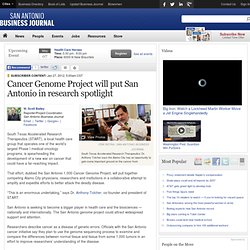
Anthony Tolcher says the Alamo City has an opportunity to gain some important ground on the cancer front. South Texas Accelerated Research Therapeutics (START), a local health care group that operates one of the world’s largest Phase I medical oncology programs, is spearheading the development of a new war on cancer that could have a far-reaching impact. That effort, dubbed the San Antonio 1,000 Cancer Genome Project, will pull together competing Alamo City physicians, researchers and institutions in a collaborative attempt to amplify and expedite efforts to better attack the deadly disease. “This is an enormous undertaking,” says Dr. Anthony Tolcher, co-founder and president of START.
San Antonio is seeking to become a bigger player in health care and the biosciences — nationally and internationally. Researchers describe cancer as a disease of genetic errors. Order of magnitude W. Why You Might Want Your Next Medical Exam Via Computer. Curing Cancer Relies on Genome Mapping With DNA Evidence Guiding Treatment. Kristal James, a medical technician in suburban Dallas, spent more than a year fighting rapidly spreading breast cancer that looked like it might take her life.
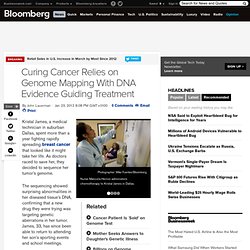
As doctors raced to save her, they decided to sequence her tumor’s genome. The sequencing showed surprising abnormalities in her diseased tissue’s DNA, confirming that a new drug they were trying was targeting genetic aberrations in her tumor. Bioinformatics-for-personal-genome-interpretation. Billings on Genome Sequencing, Cancer Treatment. International Cancer Genome Consortium. Catalogue of Somatic Mutations in Cancer - COSMIC. My Cancer Genome - Genetically Informed Cancer Medicine.
Patient's genome will enable custom, personalized medicine. Medicine increasingly is being refocused to deliver tailor-made results for patients in much the same way that clothes, diets and even golf clubs can be customized to meet the needs of one person.
Personalized medicine, which experts say represents the future of health care, begins by mapping a patient's genome, or hereditary information. With that information, doctors can formulate drugs or doses of drugs made specifically for the patient, ensuring both the drug and dosage are safe for that patient. More than safety, it also ensures that the drug will work -- and that's important because many drugs on the market today just don't work for everyone. "Something like 90 percent of the drugs on the market today are effective in about 40 percent of the population," said Clayton W. Naeve, senior vice president and chief information officer for Memphis-based St. "Think about that for a second.
He should know. However, drug companies and manufacturers are running with the ball, he said.