
Relating - Air, Water, Earth, Fire - The Psychological Types. Elemental Correspondences: Air, Fire, Water, Earth, Spirit. 5. Elemental Magic: Fire Water Earth Air / Wind Correspondences Chart Table and Element Symbols North-South-East-West, Spring-Summer-Autumn-Winter. 5.
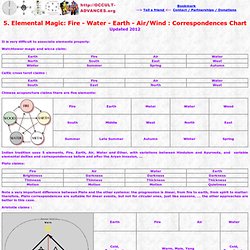
Elemental Magic: Fire - Water - Earth - Air/Wind : Correspondences ChartUpdated 2012 It is very difficult to associate elements properly: Watchtower magic and wicca claim: Celtic cross tarot claims : Chinese acupuncture claims there are five elements: LucyTuning - LucyScaleDevelopments - Colour, Pi and musical tuning. LucyScaleDevelopments present: extract from Pitch, Pi, and Other Musical Paradoxes.......... by Charles E.
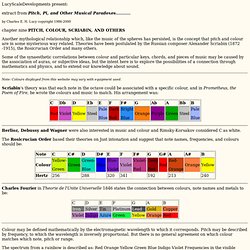
H. Lucy copyright 1986-2000. I Ching. The I Ching, also known as the Classic of Changes, Book of Changes, Zhouyi and Yijing, is one of the oldest of the Chinese classic texts.[1] The book contains a divination system comparable to Western geomancy or the West African Ifá system; in Western cultures and modern East Asia, it is still widely used for this purpose.
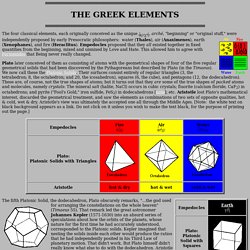
Traditionally, the I Ching and its hexagrams were thought to pre-date recorded history,[2] and based on traditional Chinese accounts, its origins trace back to the 3rd and 2nd millennia BCE.[3] Modern scholarship suggests that the earliest layers of the text may date from the end of the 2nd millennium BCE, but place doubts on the mythological aspects in the traditional accounts.[4] Some consider the I Ching the oldest extant book of divination, dating from 1,000 BCE and before.[5] The oldest manuscript that has been found, albeit incomplete, dates back to the Warring States period (475–221 BCE).[6] History[edit] Traditional view[edit] Modernist view[edit] Golden Dawn Research Center - The Four Elements in the Western Tradition. THE GREEK, INDIAN, & CHINESE ELEMENTS. The four classical elements, each originally conceived as the unique , arché, "beginning" or "original stuff," were independently proposed by early Presocratic philosophers: water (Thales), air (Anaximenes), earth (Xenophanes), and fire (Heraclitus).
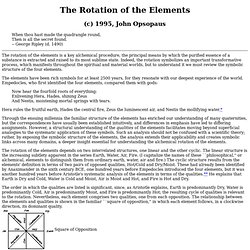
The Rotation of the Elements. (c) 1995, John Opsopaus When thou hast made the quadrangle round, Then is all the secret found. -- George Ripley (d. 1490)
Frequently Asked Questions (FAQ): Ancient "Elements of Nature" Wu Xing. Diagram of the interactions between the Wu Xing.
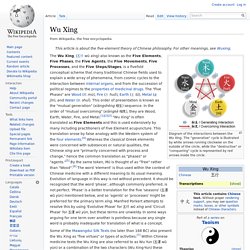
The "generative" cycle is illustrated by white arrows running clockwise on the outside of the circle, while the "destructive" or "conquering" cycle is represented by red arrows inside the circle. Some of the Mawangdui Silk Texts (no later than 168 BC) also present the Wu Xing as "five virtues" or types of activities.[7] Within Chinese medicine texts the Wu Xing are also referred to as Wu Yun (五運 wŭ yùn) or a combination of the two characters (Wu Xing-Yun) these emphasise the correspondence of five elements to five 'seasons' (four seasons plus one). Another tradition refers to the wŭ xíng as wŭ dé 五德, the Five Virtues (zh:五德終始說). The system of five phases was used for describing interactions and relationships between phenomena. The Phases[edit] The five phases are usually used to describe the state in nature: Cycles[edit] Inter-promoting (mother/son)Inter-acting (grandmother/grandson)Over-acting (kè cycle)Counter-acting (reverse kè) Bagua[edit]
Acupuncture & the 5 elements - Practice L. Spring-Taylor, Bern. Traditional Chinese Medicine (TCM) of which acupuncture and the 5 Elements is a part, recognises that health is more than the absence of disease and it has a unique capacity to maintain and enhance our potential for well-being and happiness.
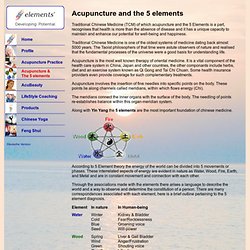
Traditional Chinese Medicine is one of the oldest systems of medicine dating back almost 5000 years. The Taoist philosophers of that time were astute observers of nature and realised that the fundamental processes of the universe were a good basis for understanding life. Acupuncture is the most well known therapy of oriental medicine. Aristotle's Physics: the Five Elements - a knol by Ira Glickstein. Introduction Aristotle’s writings date from over 2300 years ago.
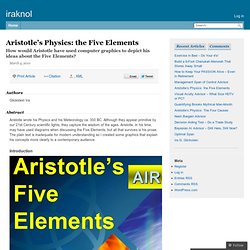
They include many books chock full of wondrous ideas. Classical element. For other uses of 4 elements, see Four elements (disambiguation). For other uses of 5 elements, see Five elements (disambiguation). Many philosophies and worldviews have a set of classical elements believed to reflect the simplest essential parts and principles of which anything consists or upon which the constitution and fundamental powers of anything are based. Most frequently, classical elements refer to ancient beliefs inspired by natural observation of the phases of matter.
Historians trace the evolution of modern theory pertaining to the chemical elements, as well as chemical compounds and mixtures of natural substances to medieval, Islamic and Greek models. Many concepts once thought to be analogous, such as the Chinese Wu Xing, are now understood more figuratively. Ancient classic element systems Classical elements in Babylonia. Mountain Man Dot Com, Australia: Publications of Peace and Of Great Souls - A Welcome Home Page. Elemental: The Four Elements, Earth, Fire, Air, Water in Greek ... According to the Empedocles, a Greek philosopher, scientist and healer who lived in Sicily in the fifth century B.C., all matter is comprised of four "roots" or elements of earth, air, fire and water.
Fire and air are outwardly reaching elements, reaching up and out, whereas earth and water turn inward and downward. In his Tetrasomia, or Doctrine of the Four Elements, Empedocles described these elements not only as physical manifestations or material substances, but also as spiritual essences. He associated these elements with four Greek gods and goddesses - air with Zeus, earth with Hera, fire with Hades, and water with Nestis (believed to be Persephone): Now hear the fourfold roots of everything:Enlivening Hera, Hades, shining ZeusAnd Nestis, moistening mortal springs with tears.