
PERSONALIZED INSTRUCTION. Phi Delta Kappan By James W.
Keefe and John M. Jenkins Kenneth Sirotnik and John Goodlad caution us to think in terms of school "renewal" rather than "reform. " Sirotnik (1999) tells us that reform is usually preoccupied with accountability rather than evaluation. Renewal is concerned primarily with what Sarason (1989) calls "creating new settings" that reflect critical inquiry about educational practice. Personalization of instruction and learning is the effort on the part of a school to take into account individual student characteristics and needs, and flexible instructional practices, in organizing the learning environment. In the past, antecedents of personalization have been known under different names: nongraded education, continuous progress education, individualized instruction, individually guided or prescribed education, and so forth. What, then, are the basic elements of a personalized approach to instruction?
1. Personalized Learning Chart - Personalized Learning Toolkits. Personalization vs Differentiation vs Individualization. This chart is cross-posted on our new site at Personalize Learning.

After writing the post “Personalization is NOT Differentiating Instruction,” I received some very interesting feedback and more hits than any other of my posts. I think I hit a nerve. So Kathleen McClaskey and I did some research on what personalization is and the differences between differentiation and individualization. We found very little information on the differences. And what we did find, we disagreed with many of the points. Personalized Learning Chart by Barbara Bray and Kathleen McClaskey is licensed under a Creative Commons Attribution-NonCommercial-NoDerivs 3.0 Unported License. . The Education Alliance at Brown University : Portfolio Detail. Personalization%20in%20Schools. Personalized Learning Chart Version 2. CBAM: Stages of Concern about Personalized Learning. Change is not easy.

If you are considering transforming to personalized learning environments, you may have concerns about the changes you have to do to make this work for you and your learners. If you are a coach or professional developer, you are working with teachers guiding them through the changes they need to do to personalize learning. This chart can help you determine what type of strategies to use to guide change about the following seven stages: Awareness (do not know about or sure what Personalized Learning is)Informational (tell me more about Personalized Learning)Personal (concerned how Personalized Learning will impact them as a teacher)Management (concerned about managing the classroom when learning is personalized)Consequence (wants to know how Personalized Learning will impact teaching and learning)Collaborative (looking forward to share with and learn from other teachers)Refocusing (interested to support teachers and lead the way to personalize learning)
Personalize Learning: Personalization vs Differentiation vs Individualization. Ten Tips for Personalized Learning via Technology. At Forest Lake Elementary School, in Columbia, South Carolina, the student population grows more diverse by the day.
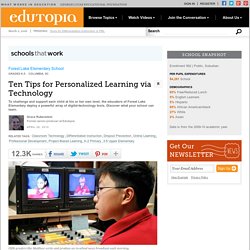
Income levels, ethnicities, family structures, first languages, interests, and abilities now vary so much, that a traditional teaching approach, with a uniform lesson targeted to the average-level student, just doesn't cut it. (Sound familiar to you educators out there?) To challenge and support each child at his or her own level, the Forest Lake teachers and staff are deploying a powerful array of widely available digital-technology tools. Each classroom is equipped with an interactive whiteboard and a Tech Zone of eight Internet-enabled computers. Plus, teachers have access to gadgets including digital cameras, Flip cameras, remote-response clickers, and PDAs. More important than the gadgets themselves, of course, is how the teachers use them to create personalized lessons and a productive environment where each child is engaged. 1. 2. 3. 4. 5. 6. 7. 8. 9.