
How Do We Prepare Our Children for What’s Next? Culture Digital Tools Teaching Strategies Paul Schultz What kids learn at a young age will determine whether they're prepared for a future full of unknowns.
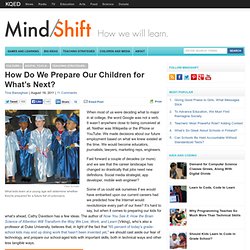
When most of us were deciding what to major in at college, the word Google was not a verb. It wasn’t anywhere close to being conceived at all. Neither was Wikipedia or the iPhone or YouTube. Fast forward a couple of decades (or more) and we see that the career landscape has changed so drastically that jobs need new definitions. Some of us could ask ourselves if we would have embarked upon our current careers had we predicted how the Internet would revolutionize every part of our lives? “We’re 15 years into something so paradigm-changing that we have not yet adjusted our institutions of learning, work, social life, and economic life to account for the massive change.” Davidson offers three can-do suggestions for parents: EXPERIMENT WITH SCRATCH. Here’s the full transcript of my interview with Davidson. Q. A. Q. A. Q. A. Cathy Davidson Q. Inquiryhub.
PBL – the best teaching method in the 21st century instruction. Let me start this article with what Obama says in a speech at the Center for American Progress : “ Let’s be clear — we are failing too many of our children.
We’re sending them out into a 21st century economy by sending them through the doors of 20th century schools.” This is a true statement issued from the lips of a political person rather than an educator. There is a profound disconnect between what students are being taught and what the actual world is demanding of them as adults. It sounds like there exists two worlds one inside the school and the other outside. This double faced situation has a direct impact on today's educational landscape creating thus the popular controversy of “ the right person in the wrong place “ dilemma. There is a huge need for a total reformation of school systems and curriculums to better fit in the 21st century education. Today, however, I am introducing you to a teaching ,or better say, instructional method that is called Project Based Learning. .: AnimAction, Inc - Awareness Through Animation ™ :.
Featured Project Detail : Adobe Youth Voices .: AnimAction, Inc - Awareness Through Animation ™ :. In June 2006, Adobe launched a new global philanthropic program, Adobe Youth Voices.

The program engages 12-18 year-olds with digital tools to develop critical skills necessary to become active and engaged members of their communities. Through documentary filmmaking, animation, digital images, audio and web projects, these youth are encouraged to "create with purpose" and have a voice in changing their communities. For full details on the program, please see the Adobe press release that announced the program and the program's Web site. AnimAction was invited to collaborate as an animation training partner with Adobe Youth Voices partners iEARN, the world's largest non-profit global network of K-12 educators and youth using technology to design and collaborate on projects that make a difference in the world, and Listen Up! , a leading youth media organization based out of New York, to conduct the workshops.
Collaboration Centre. Flipped Learning: A Response to Five Common Criticisms. Flipped learning: A response to five common criticisms. One of the reasons this debate exists is because there is no true definition of what “flipped learning” is.
Over the past few years, the Flipped Learning method has created quite a stir. Some argue that this teaching method will completely transform education, while others say it is simply an opportunity for boring lectures to be viewed in new locations. While the debate goes on, the concept of Flipped Learning is not entirely new. Dr. Eric Mazur of Harvard University has been researching this type of learning since the early ’90s, and other educators have been applying pieces of the Flipped Learning method for even longer. Flipped Classroom. How flipping works for you Save time; stop repeating yourself Record re-usable video lessons, so you don't have to do it again next year.

It's easy to make minor updates to perfect lessons over time once the initial recording is done. Five Best Practices for the Flipped Classroom. Ok, I'll be honest.
I get very nervous when I hear education reformists and politicians tout how "incredible" the flipped-classroom model, or how it will "solve" many of the problems of education. It doesn't solve anything. It is a great first step in reframing the role of the teacher in the classroom. It fosters the "guide on the side" mentality and role, rather than that of the "sage of the stage. " It helps move a classroom culture towards student construction of knowledge rather than the teacher having to tell the knowledge to students. It also creates the opportunity for differentiated roles to meet the needs of students through a variety of instructional activities. 1) Need to Know How are you creating a need to know the content that is recorded? 2) Engaging Models. Teacher Vodcasting and Flipped Classroom Network - A professional learning community for teachers using vodcasting in the classroom.
ShowMe - The Online Learning Community. Technology Integration Matrix.