
Lewis Carroll. Un article de Wikipédia, l'encyclopédie libre.
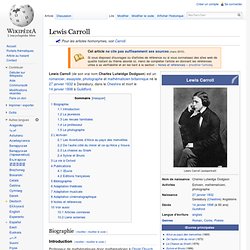
Pour les articles homonymes, voir Carroll. Lewis Carroll Lewis Carroll (autoportrait) Œuvres principales Biographie[modifier | modifier le code] Introduction[modifier | modifier le code] La jeunesse[modifier | modifier le code] Charles Lutwidge Dodgson naît d’un père pasteur anglican, au sein d’une famille de onze enfants dont deux seulement se sont mariés. Charles Dodgson, dans son âge mûr, devait prendre souvent plaisir à mystifier ses jeunes correspondantes en commençant ses lettres par la signature et en les terminant par le commencement.
Quant au bégaiement, il serait peut-être à l’origine des fameux « mots-valises » à double signification. . « Tout flivoreux vaguaient les borogoves, Les verchons fourgus bourniflaient. » Les revues familiales[modifier | modifier le code] Compte tenu de l’époque et du milieu, ses parents étaient irréprochables. Le professeur[modifier | modifier le code] C’est à cette époque que naît véritablement Lewis Carroll. Through the Looking-Glass. Through the Looking-Glass, and What Alice Found There (1871) is a novel by Lewis Carroll (Charles Lutwidge Dodgson), the sequel to Alice's Adventures in Wonderland (1865).
The themes and settings of Through the Looking-Glass make it a kind of mirror image of Wonderland: the first book begins outdoors, in the warm month of May (4 May),[a] uses frequent changes in size as a plot device, and draws on the imagery of playing cards; the second opens indoors on a snowy, wintry night exactly six months later, on 4 November (the day before Guy Fawkes Night),[b] uses frequent changes in time and spatial directions as a plot device, and draws on the imagery of chess.
In it, there are many mirror themes, including opposites, time running backwards, and so on. Alice's Adventures in Wonderland - Wikipedia, the free encyclope. Background[edit] Page from the original manuscript copy of Alice's Adventures Under Ground, 1864 Alice was published in 1865, three years after the Reverend Charles Lutwidge Dodgson and the Reverend Robinson Duckworth rowed in a boat, on 4 July 1862[4] (this popular date of the "golden afternoon"[5] might be a confusion or even another Alice-tale, for that particular day was cool, cloudy and rainy[6]), up the Isis with the three young daughters of Henry Liddell (the Vice-Chancellor of Oxford University and Dean of Christ Church): Lorina Charlotte Liddell (aged 13, born 1849) ("Prima" in the book's prefatory verse); Alice Pleasance Liddell (aged 10, born 1852) ("Secunda" in the prefatory verse); Edith Mary Liddell (aged 8, born 1853) ("Tertia" in the prefatory verse).[7] The journey began at Folly Bridge near Oxford and ended five miles away in the village of Godstow.
Synopsis[edit] Chapter Twelve – Alice's Evidence: Alice is then called up as a witness. Characters[edit] Symbolism[edit] Jabberwocky. "Jabberwocky" is considered one of the greatest nonsense poems written in English.[2][3] Its playful, whimsical language has given English nonsense words and neologisms such as "galumphing" and "chortle".
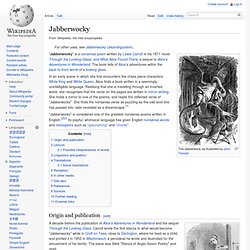
Origin and publication[edit] Alice climbing into the looking glass world. Illustration by John Tenniel, 1871 A decade before the publication of Alice's Adventures in Wonderland and the sequel Through the Looking Glass, Carroll wrote the first stanza to what would become "Jabberwocky" while in Croft on Tees, close to Darlington, where he lived as a child, and printed it in 1855 in Mischmasch, a periodical he wrote and illustrated for the amusement of his family. The piece was titled "Stanza of Anglo-Saxon Poetry" and read: Twas bryllyg, and ye slythy tovesDid gyre and gymble in ye wabe:All mimsy were ye borogoves;And ye mome raths outgrabe.
Pictures. Books.