
Minds on Fire: Open Education, the Long Tail, and Learning 2.0 - ERM0811.pdf. Minds on Fire: Open Education, the Long Tail, and Learning 2.0 (EDUCAUSE Review. © 2008 John Seely Brown and Richard P.

Adler. Text illustrations © 2008 Susan E. Haviland. The text of this article is licensed under the Creative Commons Attribution 3.0 Unported license ( EDUCAUSE Review, vol. 43, no. 1 (January/February 2008): 16–32 John Seely Brown and Richard P. John Seely Brown is a Visiting Scholar and Advisor to the Provost at the University of Southern California (USC) and Independent Co-Chairman of a New Deloitte Research Center. Comments on this article can be posted to the web via the link at the bottom of this page. More than one-third of the world’s population is under 20. €”Sir John Daniel, 1996 The world has become increasingly “flat,†as Tom Friedman has shown.
It is unlikely that sufficient resources will be available to build enough new campuses to meet the growing global demand for higher education—at least not the sort of campuses that we have traditionally built for colleges and universities. The Brewing Perfect Storm of Opportunity. Social Learning: an explanation using Twitter. 10 ideas to work and learn smarter. Choosing the right social and collaboration platform. The future of e-learning is social learning. Die 20 besten Social Learning Tools » Artikel » Absolit.
Egal ob Online-Umfragen, Web-Conferencing, Gruppenarbeit oder Film- und Podcast-Erstellung – für alles gibt es Gratistools.

Hier sind die wichtigsten. Jane Hart hat auf Ihrer Website C4LPT eine Liste der “Top 100 Tools for Learning” zusammengestellt. Die Reihenfolge basiert auf der Berwertung durch Weiterbildungs-Profis. Ganz oben stehen Tools, die viele schon kennen und nutzen: Twitter, YouTube, Google Docs, Delicious (bei uns ist das Mister Wong), Skype, und Facebook. Auch diese Dienste sollten Sie jedoch einmal ansehen, wenn Sie sie noch nicht kennen:Slideshare: Präsentationen für andere verfügbar zu machen und in die Website einbauen.Google Reader: RSS-Reader, um immer aktuell informiert zu sein.WordPress: Das führende System, um eigene Blogs einzurichten.Flickr: Die führende Bilddatenbank, um eigene Bilder für andere verfügbar zu machen.
Hier sind ein paar Dinge, die nicht jeder nutzt, die aber ganz praktisch sind Be Sociable, Share! Social learning theory. Is a perspective that states that people learn within a social context.
It is facilitated through concepts such as modeling and observational learning. [ 1 ] [ edit ] Theory According to Social Learning theory, models are an important source for learning new behaviors and for achieving behavioral change in institutionalized settings. [ 2 ] Social learning theory is derived from the work of Albert Bandura which proposed that observational learning can occur in relation to three models: [ 3 ] • Live model – in which an actual person is demonstrating the desired behaviour • Verbal instruction – in which an individual describes the desired behaviour in detail, and instructs the participant in how to engage in the behavior • Symbolic – in which modeling occurs by means of the media, including movies, television, Internet, literature, and radio. An important factor of Bandura’s social learning theory is the emphasis on reciprocal determinism. Constructivism (learning theory)
Jean Piaget: founder of Constructivism In past centuries, constructivist ideas were not widely valued due to the perception that children's play was seen as aimless and of little importance.
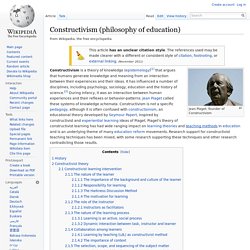
Jean Piaget did not agree with these traditional views, however. He saw play as an important and necessary part of the student's cognitive development and provided scientific evidence for his views. Today, constructivist theories are influential throughout much of the non-formal learning sector. One good example of constructivist learning in a non-formal setting is the Investigate Centre at The Natural History Museum, London. For more detailed information on the philosophy of the construction of human knowledge, see constructivist epistemology.
Formalization of the theory of constructivism is generally attributed to Jean Piaget, who articulated mechanisms by which knowledge is internalized by learners. It is important to note that constructivism is not a particular pedagogy.