
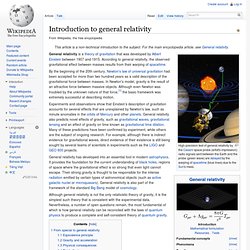
Introduction to general relativity. High-precision test of general relativity by the Cassini space probe (artist's impression): radio signals sent between the Earth and the probe (green wave) are delayed by the warping of spacetime (blue lines) due to the Sun's mass.
General relativity is a theory of gravitation that was developed by Albert Einstein between 1907 and 1915. According to general relativity, the observed gravitational effect between masses results from their warping of spacetime. Special relativity. Special relativity implies a wide range of consequences, which have been experimentally verified,[2] including length contraction, time dilation, relativistic mass, mass–energy equivalence, a universal speed limit, and relativity of simultaneity.
It has replaced the conventional notion of an absolute universal time with the notion of a time that is dependent on reference frame and spatial position. Rather than an invariant time interval between two events, there is an invariant spacetime interval. Combined with other laws of physics, the two postulates of special relativity predict the equivalence of mass and energy, as expressed in the mass–energy equivalence formula E = mc2, where c is the speed of light in vacuum.[3][4] A defining feature of special relativity is the replacement of the Galilean transformations of classical mechanics with the Lorentz transformations.
Time and space cannot be defined separately from one another. Special Relativity. Xania has nominated himself for use of the Checkuser tools.

Please provide your input on this important decision. Special Relativity From Wikibooks, open books for an open world. Relativity: Einstein's theory of relativity in animations and film clips. Einstein Light.