
Cadran solaire - construction. Only French comments.
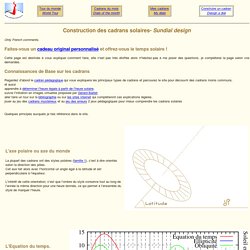
Faites-vous un cadeau original personnalisé et offrez-vous le temps solaire ! Cette page est destinée à vous expliquer comment faire, elle n'est pas très étoffée alors n'hésitez-pas à me poser des questions, je compléterai la page selon vos demandes. Le Soleil filmé par la NASA pendant cinq ans dans une vidéo à tomber par terre.
Une vidéo de la NASA nous montre le Soleil, ces cinq dernières années, en accéléré, et c’est beau à s’en taper les fesses sur un pot de cornichons. Récemment, la NASA a fêté un anniversaire : ça fait cinq ans que l’administration aéronautique filme le Soleil, toute la journée et toute la nuit, sans discontinuer, grâce au Solar Dynamics Observatory. L’observatoire a pour but d’enrichir nos connaissances concernant l’astre (les mécanisme à l’origine du cycle solaire, le fonctionnement des flux magnétiques…). Il a été lancé lancé le 11 février 2010 et, pour fêter les cinq ans de sa mise en fonctionnement, la NASA nous propose une vidéo reprenant les images des cinq dernières années. « Le Sonar Dynamics Observatory capture plus d’une image par seconde et a fourni des clichés d’une clarté sans précédent montrant comment les explosions massives grossissent et entrent en éruption sur le soleil depuis son lancement le 11 février 2010.
Et bon sang, c’est tellement beau. SDO: Year 5. This photo shows the Sun's power in exquisite detail. From 93 million miles away, we earthlings are blissfully unaware of the sheer magnitude of powerful activity roiling on the the sun’s surface.

But thanks to NASA’s Solar Dynamics Observatory (SDO) spacecraft, which has been snapping pictures of the sun for the last five years, we can see this massive monster in action, like in the SDO image below: What you’re seeing is a representation of The sun’s magnetic field is constantly changing unlike Earth’s, which means it’s growing and shrinking in strength. Sometimes it can swell to be thousands of times stronger than Earth’s. When that happens, it generates black blemishes called sun spots, as shown in the image below: (2) Twitter. A timelapse of the Sun in 4K. Project. Modélisation 3D du soleil. Illustration: CEA Modélisation 3D du Soleil: de son cœur à sa surface Une équipe du laboratoire Astrophysique Instrumentation & Modélisation (CEA/CNRS/Université Paris Diderot) a réussi à modéliser les effets d'ondes de gravité dans une simulation du Soleil (Le Soleil (Sol en latin, Helios ou Ήλιος en grec) est l'étoile centrale du système solaire.
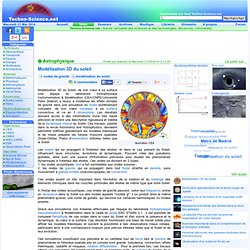
Dans la classification astronomique, c'est une étoile de type naine jaune, et...) extrêmement complète, de son cœur nucléaire (Le terme d'énergie nucléaire recouvre deux sens selon le contexte :) à sa surface (Une surface désigne généralement la couche superficielle d'un objet. Le terme a plusieurs acceptions, parfois objet géométrique, parfois frontière physique, et est souvent abusivement confondu avec sa mesure,...) convective, et ce en 3 dimensions (Dans le sens commun, la notion de dimension renvoie à la taille ; les dimensions d'une pièce sont sa longueur, sa largeur et sa profondeur/son...). Looking In The Sun's Rear-View Mirror: A New Map Of The Local Interstellar Medium.
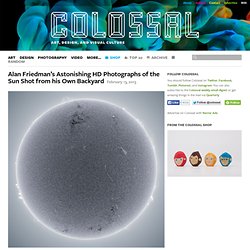
Groupement Français pour l'Observation et l'Etude du Soleil. Alan Friedman’s Astonishing HD Photographs of the Sun Shot from his Own Backyard. Alan Friedman is a fascinating guy.
La NASA dévoile les multiples visages du Soleil grâce à la sonde SDO. Une nouvelle composition réalisée par la NASA expose les différents aspects du soleil mis en évidence à différentes longueurs d’onde par le Solar Dynamics Observatory (SDO).
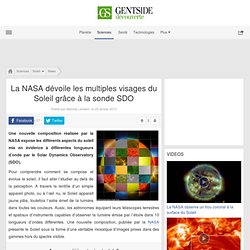
Pour comprendre comment se compose et évolue le soleil, il faut aller l’étudier au delà de la perception. A travers la lentille d’un simple appareil photo, ou à l’œil nu, le Soleil apparaît jaune pâle, toutefois l’astre émet de la lumière dans toutes les couleurs. Aussi, les astronomes équipent leurs télescopes terrestres et spatiaux d’instruments capables d’observer la lumière émise par l’étoile dans 10 longueurs d’ondes différentes. Une nouvelle composition, publiée par la NASA présente le Soleil sous la forme d’une véritable mosaïque d’images prises dans des gammes hors du spectre visible. Solar loop. NASA SDO - Today's Sun; September 11, 2012. Www.solarastronomy.org where the Sun always shines! SDO Data - Solar Dynamics Observatory. Galerie de sdomission. STEREO. SIDC - Solar Influences Data Center. Helioviewer.org - Solar and heliospheric image visualization tool.
Eclipses. Eruptions solaires / CME. Solar Flares: What Does It Take to Be X-Class? Sun Unleashes X6.9 Class Flare. Sun Unleashes X6.9 Class Flare On August 9, 2011 at 3:48 a.m.
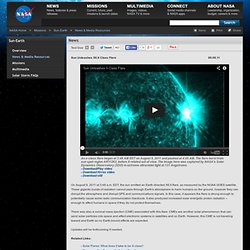
EDT, the sun emitted an Earth-directed X6.9 flare, as measured by the NOAA GOES satellite. These gigantic bursts of radiation cannot pass through Earth's atmosphere to harm humans on the ground, however they can disrupt the atmosphere and disrupt GPS and communications signals. In this case, it appears the flare is strong enough to potentially cause some radio communication blackouts. It also produced increased solar energetic proton radiation -- enough to affect humans in space if they do not protect themselves. There was also a coronal mass ejection (CME) associated with this flare. Updates will be forthcoming if needed. Solar Stormwatch. Space Weather Now. Le Soleil - SpaceWeather live. News and information about meteor showers, solar flares, auroras, and near-Earth asteroids.
SOLARCYCLE 24.com / SolarHam.com / Solar Cycle 24 / Spaceweather / Amateur Radio VHF Aurora Website. iNtegrated Space Weather Analysis System ( iSWA ) : iswa3 : Version 1.9.5 [Prepared Wormhole]
SunCalc - sun position, sunlight phases, sunrise, sunset, dusk and dawn times calculator. 3D Sun for your iPhone and iPod Touch. Sun Moon Scope. Astronomy Picture of the Day. Au travers d’un tunnel du Soleil. Différentes façons de voir le soleil. Amazingly Detailed Photo of the Surface of the Sun. A quoi ressemble le Soleil vu depuis Pluton. En se basant sur des données recueillies par l’ESO (European Southern Observatory), les scientifiques ont réussi à donner une idée (et même une image) de ce à quoi ressemble une belle matinée ensoleillée sur Pluton. Pluton est situé 40 fois plus loin du Soleil que la Terre. Du coup, depuis cette planète naine qui ne représente qu’un cinquième de la Terre, la lumière solaire paraît 1.000 fois plus faible.
De plus, cette planète naine est couverte de plaques de méthane gelé et d’une atmosphère brumeuse dans laquelle flotte le méthane gazeux. Soit des conditions qui diffèrent largement de celles que l'on peut connaitre sur Terre. Mercredis scientifiques @ATLAS Saint-Ouen.