
Vanished Persian army said found in desert - Discovery.com- msnb. The remains of a mighty Persian army said to have drowned in the sands of the western Egyptian desert 2,500 years ago might have been finally located, solving one of archaeology's biggest outstanding mysteries, according to Italian researchers.
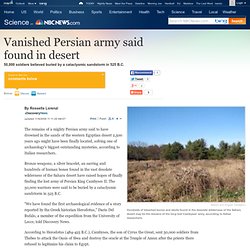
Bronze weapons, a silver bracelet, an earring and hundreds of human bones found in the vast desolate wilderness of the Sahara desert have raised hopes of finally finding the lost army of Persian King Cambyses II. The 50,000 warriors were said to be buried by a cataclysmic sandstorm in 525 B.C. "We have found the first archaeological evidence of a story reported by the Greek historian Herodotus," Dario Del Bufalo, a member of the expedition from the University of Lecce, told Discovery News. According to Herodotus (484-425 B.C.), Cambyses, the son of Cyrus the Great, sent 50,000 soldiers from Thebes to attack the Oasis of Siwa and destroy the oracle at the Temple of Amun after the priests there refused to legitimize his claim to Egypt.
The British Museum: Iraq Crisis. Babylon wrecked by war. Troops from the US-led force in Iraq have caused widespread damage and severe contamination to the remains of the ancient city of Babylon, according to a damning report released today by the British Museum.

John Curtis, keeper of the museum's Ancient Near East department and an authority on Iraq's many archaeological sites, found "substantial damage" on an investigative visit to Babylon last month. The ancient city has been used by US and Polish forces as a military depot for the past two years, despite objections from archaeologists. "This is tantamount to establishing a military camp around the Great Pyramid in Egypt or around Stonehenge in Britain," says the report, which has been seen by the Guardian.
Among the damage found by Mr Curtis, who was invited to Babylon by Iraqi antiquities experts, were cracks and gaps where somebody had tried to gouge out the decorated bricks forming the famous dragons of the Ishtar Gate.