
Lone Sentry: German Visual Communication Between Aircraft and Ground Troops (WWII Tactical and Technical Trends, No. 24, May 6, 1943) Modern warfare puts a heavy premium on successful coordination of all of the various arms.

For that reason, comprehensive and flexible methods of communication must be devised. Liaison between air and ground forces presents special problems, and a German document gives the following outline of methods used to meet some of the difficulties. a. Cooperation Cooperation between army and air force is to be arranged through the respective headquarters, prior to each action. B. Detailed knowledge of friendly aircraft types, pre-arranged signals, and the air situation, distributed down to companies, will facilitate early recognition by the troops. WW2 People's War - RedTape. The Wartime Memories Project - Bletchley Park. An operational Sortie - RAF Coastal Command - World War 2 Talk. RAF Cranfield, Bedfordshire. WW2 People's War - Smugglers or Spies ? WW2 People's War - 58 raids in 49 days. WW2 People's War - No2 Flying Training School - Pt 1.
WW2 People's War - WW2 Memories of an aircraft fitter. WW2 People's War - Beauforts and Spitfires: An Apprentice at large in the Aircraft Industry in Southampton during the early years of WW2. WW2 People's War - You Had A Good War: Part 2. WW2 People's War - Eager For The Air: The Story Of The Air Transport Auxiliary. WW2 People's War - The Huts at Bletchley Park. WW2 People's War - A Classical Scholar at Bletchley Park. WW2 People's War - Drama Productions at Bletchley Park. WW2 People's War - ULTRA secret service. WW2 People's War - Wartime Code Breaking. WW2 People's War - Breaking the Code. WW2 People's War - Commander Travis. WW2 People's War - Memories of Bletchley Park. WW2 People's War - A Year at Bletchley Park.
WW2 People's War - Denis Whelan - His Association with Bletchley Park. WW2 People's War - Wartime - Bletchley Park WAAF 1942 - 47. WW2 People's War - A Wartime Winter Journey with the WAAF to Bletchley Park. WW2 People's War - From School Girl to Code Breaker. WW2 People's War - My years at Bletchley Park – Station X. WW2 People's War - Life at Bletchley Park. WW2 People's War - Children of the Park: Memories of Bletchley Park. WW2 People's War - Children of the Park. WW2 People's War - Yes, Mum, There Really Was a Secret: Bletchley Park. WW2 People's War - The Breaking of the Enigma Code. WW2 People's War - My Father's Secret: Bletchley Park and Beyond.
WW2 People's War - HUT 6, Bletchley Park. WW2 People's War - Memories of a WAAF Teleprinter Operator at Station X (Bletchley Park) WW2 People's War - Breaking the Code: A WAAF at Bletchley. WW2 People's War - Archive List. WW2 People's War - 'Alfriston, My Life in a Country Village' by RA Levett. Military history of the United Kingdom during World War II. Britain, along with most of its dominions, Crown colonies, and British India, declared war on Nazi Germany in 1939.

War with Japan began in 1941, after it attacked British colonies in Asia.[1] The Axis powers were defeated by the Allies in 1945.[2] Pre-war military[edit] Although Britain had increased military spending and funding prior to 1939 in response to the increasing strength of Nazi Germany, its forces were still weak by comparison – especially the British Army. Only the Royal Navy – at the time the largest in the world[3] – was of a greater strength than its German counterpart. The British Army only had nine divisions available for war, whereas Germany had 78 and France 86.[4][page needed] Beginning of the fight[edit] The message sent to ships of the Royal Navy informing them of the outbreak of war.
Western and northern Europe, 1940 and 1941[edit] Norwegian campaign[edit] On 10 May 1940, the Royal Navy occupied Iceland to install naval and air bases on this Atlantic island.[9] De Havilland Mosquito. As a night fighter, from mid-1942, the Mosquito intercepted Luftwaffe raids on the United Kingdom, notably defeating Operation Steinbock in 1944.

Starting in July 1942, Mosquito night-fighter units raided Luftwaffe airfields. As part of 100 Group, it was a night fighter and intruder supporting RAF Bomber Command's heavy bombers and reduced bomber losses during 1944 and 1945.[8][nb 2] As a fighter-bomber in the Second Tactical Air Force, the Mosquito took part in "special raids", such as the attack on Amiens Prison in early 1944, and in precision attacks against Gestapo or German intelligence and security forces.
Cranfield's Airfield - History and information. By Ralph Woodgate [Return to Cranfield Express home page] [Return to Cranfield's Airfield History index page] 51 OTU Cranfield.

OTUs 41 - 63. Operational Training Units No 41 Operational Training Unit Formed from the Training Squadron of No 1 School of Army Co-operation at Old Sarum on 20 September 1941 within No 70 Group to train tactical reconnaissance pilots using Lysanders and Tomahawks.

OTUs 1 - 23. Operational Training Units No 1 (Coastal) Operational Training Unit Formed 1 April 1940 at Silloth within No 17 Group from the Coastal Command Landplane Pilots Pool.

Initially it trained crews for all Coastal Command landplanes and was equipped with Ansons, Hudsons, Blenheims and Beauforts. Chapter Two. Chapter Two.

The Royal Air Force Click on the "thumb-nail" for the full sized picture. Click on the heading to go straight to the section. Radar. --- 51 OTU Cranfield and Twinwood Farm. RAF Commands 1939 - 1945. RAF phonetic alphabet. Following the take-up of radio, the British Royal Air Force (RAF) used a succession of radiotelephony spelling alphabets to aid communication.
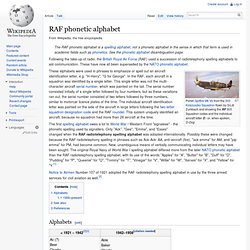
These have now all been superseded by the NATO phonetic alphabet. These alphabets were used in phrases to emphasize or spell out an aircraft identification letter, e.g. "H-Harry", "G for George". NATO phonetic alphabet. The NATO phonetic alphabet, more accurately known as the International Radiotelephony Spelling Alphabet and also called the ICAO phonetic or ICAO spelling alphabet, as well as the ITU phonetic alphabet, is the most widely used spelling alphabet.

Although often called "phonetic alphabets", spelling alphabets are unassociated with such phonetic transcription systems as the International Phonetic Alphabet; instead, the International Civil Aviation Organization (ICAO) alphabet so assigned code words acrophonically to the letters of the English alphabet that critical combinations of letters and numbers can be pronounced and understood despite language barriers or transmission static.
International adoption[edit] NATO[edit] History[edit] The ICAO developed this system in the 1950s in order to account for discrepancies that might arise in communications as a result of multiple alphabet naming systems coexisting in different places and organizations.[4] Lettice Curtis - Lettice Curtis her autobiography. Airfields & Aviation Memorials by Richard Flagg. Women's Royal Naval Service (WRENS). Fleet Air Arm Archive 1939-1945 Contents Page. Wrens fitting smoke floats to a Swordfish aircraft. Women played an active part in the fight against the Axis forces, not more so than the Women's Royal Naval Service (WRENS) and the Air Transport Auxiliary (ATA) women aircraft ferry pilots.This page is dedicated to their dedication and bravery.
Women played an active part in the fight against the Axis forces (see Women At War), not more so than the Women's Royal Naval Service (WRENS). In 1939, there were less than five million women working in . Two million of these were in domestic service yet only a few years later the WRNS reached its peak of 74,620 in 1944. SHORT ARTICLES - based on archive information. Few (if any?)

Surviving RAF Stations can claim longer unbroken service than RAF Henlow. Following the acquisition of 220 acres of land just south of the village of Henlow in mid/south Bedfordshire in 1917, it opened as the first new station under the newly formed RAF service in May 1918. Initially it was an aircraft repair depot servicing squadron and units within the ‘Eastern Area’, and later, after the end of WW1 and restructuring of the service in 1919/20, became the aircraft depot for the ‘Inland Area’ (IAAD). For a brief period between 1925 and 1927 it also became an operational fighter station with Snipes, and later Gamecocks, of no’s 23 and 43 Squadrons. Longer term flying residents were the parachute test section/flight formed in September 1925 which stayed, in various forms, until the end of December 1959.
Battle of Britain. The Battle of Britain (German: Luftschlacht um England, literally "Air battle for England") is the name given to the Second World War air campaign waged by the German Air Force (Luftwaffe) against the United Kingdom during the summer and autumn of 1940. The name is derived from a famous speech delivered by Prime Minister Winston Churchill in the House of Commons: "... the Battle of France is over. I expect that the Battle of Britain is about to begin. "[13] The Battle of Britain was the first major campaign to be fought entirely by air forces,[14] and was also the largest and most sustained aerial bombing campaign to that date. Air Transport Auxiliary (ATA). Fleet Air Arm Archive 1939-1945 Contents Page. Civilian pilots played an active part in the fight against the Axis forces, not more so than the Air Transport Auxiliary (ATA) men and women aircraft ferry pilots.This page is dedicated to their dedication and bravery.
The Air Transport Auxiliary In 1939, the pre-war Civilian Air Guard was reformed under Gerard d'Erlanger as the Air Transport Auxiliary. In September 1939 it consisted of 22 men and women pilots, and eventually built up to 16 Ferry Pools. Diana Barnato Walker. Diana Barnato Walker MBE FRAeS (15 January 1918 – 28 April 2008) was an English aviator and horse rider, the first British woman to break the sound barrier.[1] Biography[edit] Her father was the famous car racing driver Woolf Barnato who was Chairman of Bentley Motors and also a leading member of their racing team. Her mother was Dorothy Maitland Falk of White Plains, New York. Diana Barnato was a 1936 debutante at the age of 18 and was presented to King Edward VIII at Buckingham Palace. From an early age, she became interested in aircraft and at age 20 she decided to become a pilot.
In early 1941 she applied to become one of the first women pilots of the Air Transport Auxiliary (ATA) and successfully took her initial assessment flying test at their headquarters at White Waltham, Berkshire, on 9 March 1941 with the ATA's Chief Flying Instructor, A.R.O. Lettice Curtis. Lettice Curtis (born 1916) is an English woman aviator, flight test engineer, air racing pilot and sportswoman. Curtis was born and brought up in Devon and was educated at Benenden School and St Hilda's College, Oxford, where in addition to studying Mathematics, she was Captain of the University Women's Lawn Tennis and Fencing teams.
She also played Lacrosse for the University. She learned to fly in 1937 at the Yapton Flying Club, Ford, West Sussex. List of aircraft of the Royal Air Force. Bristol Blenheim. Short Stirling. Joan Hughes. Joan Lily Amelia Hughes, MBE (27 April 1918 – 16 August 1993) was a World War II ferry pilot and one of Britain's first female test pilots. Ferry flying. Ferry flying refers to delivery flights for the purpose of returning an aircraft to base, delivering a new aircraft from its place of manufacture to its customer, moving an aircraft from one base of operations to another or moving an aircraft to or from a maintenance facility for repairs, overhaul or other work.[1] An aircraft may need to be moved without passengers from one airport to another at the end of that day's operations in order to satisfy the next day's timetable - these are known as positioning flights, although strictly speaking these are still a type of ferry flight.
[citation needed] Positioning flights may also be necessary following a major weather event or other similar disruption which causes multiple cancellations across an airline's network resulting in many aircraft and crew being 'out of position' for normal operations; the 2010 eruptions of Eyjafjallajökull or the mass evacuation of US airspace following the 9/11 attacks being good examples of this. See also[edit] Amy Johnson. This article is about the British aviator. For the American actor, see Amy Jo Johnson. Amy Johnson in Kalgoorlie, Western Australia, July 1930. Amy Johnson and Jason in Jhansi, India in 1932.
Ann Welch. Ann Courtenay Welch OBE, née Edmonds, (20 May 1917 — 5 December 2002)[1] was a pilot who received the Gold Air Medal from Fédération Aéronautique Internationale (FAI) for her contributions to the development of four air sports - gliding, hang gliding, paragliding and microlight flying.[1] Early life[edit] She was the daughter of a railway engineer and was born in London. As a child, Ann Welch kept a diary listing every aeroplane that flew over the house. She first flew with Alan Cobham in 1930. After she had acquired a motorbike to visit the local aerodrome, she learnt to fly, earning her pilot’s licence in 1934 one month after her seventeenth birthday.[1] From an early age she excelled in drawing and painting, and was a painter of note. Air Transport Auxiliary. Mission[edit] The original intended usage was to transport mail and medical supplies. However the pilots were immediately needed to work with the Royal Air Force (RAF) ferry pools transporting aircraft.[1] By 1 May 1940, they took over transporting all military aircraft from the factories to the Maintenance Units to have guns and accessories installed.
On 1 August 1941, the ATA took over all ferry jobs.[2] This freed the much-needed combat pilot for combat duty. A special ATA Air display Air Pageant was held at White Waltham on 29 September 1945 to raise money for the ATA Benevolent Fund; supported by the aircraft companies served by the ATA, it included comprehensive static displays of Allied and German aircraft (including a V.1), aero engines and even an AA gun and searchlight complete with crew. Women's Auxiliary Air Force. Battle of Britain RAF squadrons. Category:Royal Air Force stations in England.
Cranfield Airport. Cranfield Airport (ICAO: EGTC) is an airfield just outside the village of Cranfield, 7 NM (13 km; 8.1 mi) south-west of Bedford in Bedfordshire, England. It was originally a World War II aerodrome, RAF Cranfield. Cranfield Aerodrome has a CAA Ordinary Licence (Number P803) that allows flights for the public transport of passengers or for flying instruction as authorised by the licensee (Cranfield University)[2] situated next to the site.
In addition to University flights, Cranfield is home to the Met Office research aircraft Facility for Airborne Atmospheric Measurements. Cranfield is also home to the privately owned English Electric Lightning T5 "XS458" which conducts regular demonstration fast taxi and ground runs at selected weekends during the summer months. Cranfield Express - Your village newspaper! History, Pictures, stories and more... Memories of RAF Cranfield. RAF Cranfield. RAF Burials at Cranfield (SS eter and Paul) Churchyard. The Wartime Memories Project - Midlands page 2. The Wartime Memories Project - RAF Cranfield.