
Computer model predicts tomorrow’s nature. Computers’ powers of calculation have developed considerably in recent years – a situation that researchers have used to create complex simulation models of nature.
The new Danish model is a sort of virtual experiment that is based on reality. Therefore the models offer new possibilities of understanding and predicting changes in the future. (Photo: Colourbox) How will nature be affected if we change agricultural subsidies, use other pesticides or build a motorway? So far, researchers have not had usable tools or information for answering such questions without time-consuming and expensive fieldwork. But this will be easier in the future after researchers at Aarhus University have developed an advanced computer model that makes it possible to simulate various future scenarios in nature, based on the real world.
Should we blame the Sun? On the Brink: Planet Near Irreversible Point of Global Warming. We may have already passed the tipping points on global warming, say scientists at the Planet Under Pressure conference.

At the London conference, scientists are giving a bleak view of the future of the planet due to catastrophic damage and growth by humans, saying we are close to the irreversible point of global warming. Will Steffen, executive director of the Australian National University's climate change institute, gave an urgent warning that humanity needs to act radically on climate change. Clouds’ Effect on Climate Change Is Last Bastion for Dissenters. Over time, nearly every one of their arguments has been knocked down by accumulating evidence, and polls say 97 percent of working climate scientists now see global warming as a serious risk.
Yet in recent years, the climate change skeptics have seized on one last argument that cannot be so readily dismissed. Their theory is that clouds will save us. Journal home : Nature Climate Change. Rising Sea Levels a Growing Risk to Coastal U.S., Study Says. If the pace of the rise accelerates as much as expected, researchers found, coastal flooding at levels that were once exceedingly rare could become an every-few-years occurrence by the middle of this century.

By far the most vulnerable state is Florida, the new analysis found, with roughly half of the nation’s at-risk population living near the coast on the porous, low-lying limestone shelf that constitutes much of that state. But Louisiana, California, New York and New Jersey are also particularly vulnerable, researchers found, and virtually the entire American coastline is at some degree of risk. “Sea level rise is like an invisible tsunami, building force while we do almost nothing,” said Benjamin H.
Strauss, an author, with other scientists, of two new papers outlining the research. Antarctica Visitors Unwittingly Bring Invasive Species. The far reaches of Antarctica are no longer visited only by scientists and their support staff.

Adventure tourists and curiosity seekers from Europe, North America and beyond now come by the boatful — and they're bringing some souvenirs from home. Ecologist Steven Chown tells Robert Siegel that visitors unknowingly carry seeds on their clothes and bags. He says they've helped spread dozens of invasive plant species on the continent and risk permanently changing Antarctica's ecology. Copyright © 2012 NPR. For personal, noncommercial use only.
Kiribati: First Nation to be Swallowed Up by the Sea. Climate change makes cod grow. Global warming doesn’t only have negative effects.

A new study shows that the increase in ocean temperatures has caused a sharp increase in the size of North Sea cod. (Photo: Wikimedia Commons) The recent explosive increase in size of the North Sea cod is baffling marine scientists. A new study now claims to have found the cause: global warming. CO2 is confusing fish. A team of researchers has discovered how fish respond to increased levels of CO2 in sea waters.

Global Warming's Terrifying New Math. Greenland Ice Melt, Measured By NASA Satellites, Reaches Unprecedented Level. Unprecedented melting of Greenland's ice sheet this month has stunned NASA scientists and has highlighted broader concerns that the region is losing a remarkable amount of ice overall.
According to a NASA press release, about half of Greenland's surface ice sheet naturally melts during an average summer. But the data from three independent satellites this July, analyzed by NASA and university scientists, showed that in less than a week, the amount of thawed ice sheet surface skyrocketed from 40 percent to 97 percent. How Climate Change Is Changing The Oyster Business : The Salt. Hide captionScientists blame higher levels of carbon dioxide in Pacific Ocean waters caused by global warming for the failure of oyster seeds to thrive in hatcheries.
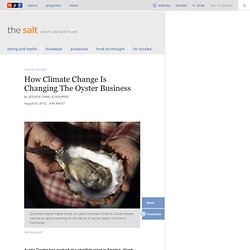
Eric Risberg/AP Scientists blame higher levels of carbon dioxide in Pacific Ocean waters caused by global warming for the failure of oyster seeds to thrive in hatcheries. Austin Docter has worked at a shellfish plant in Shelton, Wash., for 18 years and has a lot of words to describe what he calls the flavor profiles of oysters: Minerally. Metallic-y. Sweet. Less Sea Ice Brings More Snow. ‘Expect the unprecedented’ It's Getting Hot in Here: Understanding the Impact of the "Meteorological March Madness" It's going to take some time for science to catch up with what happened this past winter. For instance, a lot has been made of the "Meteorological March Madness" we just experienced, in which over 15,000 local, all-time warm-weather temperature records were broken across the U.S.
What is particularly significant, and alarming, is the broad context of this weather pattern, which is visualized in this animated video below, courtesy of NOAA’s Environmental Visualization Lab. You can see how over the course of the month, the record warm temperatures were not at all geographically isolated, but actually formed a weather pattern that spanned the entire continental U.S. (Alaska still had a cold one). Watch here (Note: the red dots represent daytime warm temperature records. Oceans' Acidity at Highest Point in 300 Million Years. Rise in sea level can't be stopped: scientists. By Nina Chestney LONDON Sun Jul 1, 2012 10:32pm IST LONDON (Reuters) - Rising sea levels cannot be stopped over the next several hundred years, even if deep emissions cuts lower global average temperatures, but they can be slowed down, climate scientists said in a study on Sunday.

A lot of climate research shows that rising greenhouse gas emissions are responsible for increasing global average surface temperatures by about 0.17 degrees Celsius a decade from 1980-2010 and for a sea level rise of about 2.3mm a year from 2005-2010 as ice caps and glaciers melt. Rising sea levels threaten about a tenth of the world's population who live in low-lying areas and islands which are at risk of flooding, including the Caribbean, Maldives and Asia-Pacific island groups.
Study casts doubt on popular mass extinction theory. Mussels and other species of sea animals died in large numbers at the end of the Triassic geological period. Scientists are trying to understand why. (Photo: Colourbox) About the time, 201 million years ago, that the super-continent Pangaea – the single land mass made up of all the present continents – started to break up, life on Earth was hit by a severe crisis that killed off numerous animal species.
On land, the devastation was not so bad, although many plants did wither and die.