Italian bread. A few weeks ago, in my ninth entry into my bread category, I expressed my desire to take this whole yeast/flour/water/tada!

Thing a step further, and begged for some cookbook guidance. At the end of it, with almost equal votes for Rose Levy Beranbaum’s Bread Bible and Peter Reinhart’s Bread Maker’s Apprentice, I was still torn, changing my mind back and forth until the final seconds of my order, eventually settling on the latter. On the day it arrived, I tore into it, certain that something would jump right off the page, and I’d be up to my elbows in flour, once again, that night. Instead, the opposite happened—I froze with terror. Bigas and poolishes and oh my god, all of these steps and seriously, are there any breads you can make in just a few hours and really, it was very humbling. So, at 10 p.m. Italian bread, eh? BigaThe Bread Baker’s Apprentice, Peter Reinhart From Reinhart: In Italy nearly every pre-ferment, including wild yeast or sourdough, is called a biga. Wholemeal flour - Is it really whole wheat flour? For beaming, bewitching breads.
For months now, my obsession with bread making has snowballed, leaving me eager buy a bread-specific cookbook to further fill our apartment, and my idle hours, with kneaded deliciousness.

I believe I’ve mentioned this before, but I’m extraordinarily conservative about the cookbooks I buy. On one hand, it’s a space issue — isn’t it always? — but considering that this hasn’t kept me from buying a pasta-cranker, too many baking pans and, most insanely, six varieties of flours, it’s hard argue that an stuffed apartment is truly a deterrent. More accurately, I find it impossible to make decisions. Berebaum’s Bread Bible? But it doesn’t mean I’m twiddling my thumbs until new inspiration brings itself home. Still, as I work my way through recipe after recipe, I can’t help but cringe at the well-intentioned but often lacking directions. Months ago, I bundled some haphazard bread making advice for you over two posts from notes scribbled in the margins of recipes from my ICE bread-baking class.
Cheddar, beer and mustard pull-apart bread. You might have created a monster.
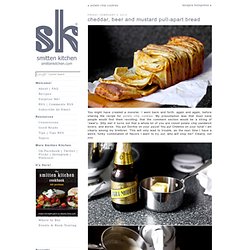
I went back and forth, again and again, before sharing the recipe for potato chip cookies. My presumption was that most sane people would find them revolting; that the comment section would be a string of “eww”s. Silly me! It turns out that a whole lot of you are closet potato chip sandwich lovers, and worse. You put Doritos on your pizza! Like this. In my kitchen, with nobody there to stop me, I mashed the two up. Alas, it was time for preschool pick-up and so, as usual these days, I behaved like an adult. Breaking The Baking Code. If cooking is an art, baking is a science.

A lot of even seasoned chefs can get intimidated by the simplest baking recipes, because it comes down to knowing the exact ratios for baking. That doesn't mean there's no room for experimentation. Far from it. Once you understand how the ratios of baking work in doughs and batters, there's very little you can't do with your baked goods.
For instance, pie dough is a ratio of three, two, one: three parts flour, two parts fat (such as butter), and one part water. It's all explained by Michael Ruhlman, a classically trained chef, in his book, "Ratio: The Simple Codes Behind the Craft of Everyday Cooking. " Ruhlman visited The Early Show Thursday to go through the basics of making great breads, cookies, and everything from the oven -- all you need to know about dough! According to Ruhlman: The only way to measure these ratios is by weight. Some basic measurements that might also help as you begin to incorporate ratios in your recipes: Copyright 2009 CBS. Baking tips: Bread Troubleshooting.