
Students Learn by Arguing in Science Labs. Published Online: October 8, 2013 Published in Print: October 9, 2013, as Students Learn by Arguing in New-Style Science Labs Includes correction(s): November 1, 2013 Studies suggest deeper learning may result Washington Teaching students to argue, question, and communicate more like real scientists may also help them understand scientific concepts more deeply, according to several ongoing research projects highlighted at the Society for Research in Educational Effectiveness conference held here last month.

Scientific argument and inquiry skills—as separate from basic science-concept knowledge—are gaining a higher profile in science classes, as schools work to align their instruction with common content standards. Infographic: How, When & Where Tornadoes Form. On iTunes U - NSDL. Take NSDL With You Wherever You Go NSDL provides access to audio, video, and other multimedia resources for science and math education through Apple's iTunes Store. iTunes U is a free service that gives users of iTunes access to audio and video from leading educational institutions.
Digging for Rare Earths: The Mines Where iPhones Are Born. MOUNTAIN PASS, Calif. -- About 60 miles southwest of Las Vegas, in a mine some 500 feet deep, the beginnings of an iPhone come to life.
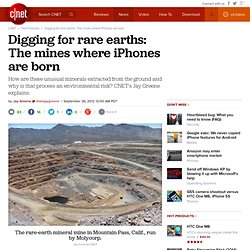
But the sleek, shiny iPhone is far, far removed from the rocks pulled out of this giant hole, which looks like a deep crater on the moon. A very deep crater. The ground is covered with rust-colored boulders, rocks, and pebbles. The walls etched with striations in varying shades of black, are notched, every 75 feet or so, creating steps that only a giant could use to climb out of the pit. Cell Command. In Cell Command, students embark on a series of exciting missions aboard a microscopic "cell ship.

" At the outset, students operate a single station (e.g., the "ribosome station"), but eventually command all the ship's functions (e.g., duplication, membrane, mitochondria, golgi complex) simultaneously. Successfully completing missions (e.g., mitigating the "cellular crises" that emerge when wounds need healing or muscles need flexing) earns "cell experience" that allows students to upgrade their cell ship, their skills as commander, and the skills of their crew. Weekend Website #93: 24 Third Grade Websites on Landforms.
The Scale of the Universe 2. Science Songs: Teaching Science with Educational Music for Biology, Chemistry, and More! Periodic Table - Song with Free Worksheets and Activities. This song for teaching the periodic table of elements offers basic information about the first eighteen elements with names.

Students will learn names, atomic symbols, and numbers as well as general information about elements and how they are organized. For students wondering how to memorize the periodic table of elements, this song is the perfect start. The accompanying detailed, printable periodic table worksheets and games enhance the learning experience. Teaching With Cartoons: 6th, 7th, & 8th Grade Science Curriculum. Teach With Cartoons is a middle school program covering 6th, 7th and 8th grade science.

The science program is aligned with national standards, and covers a realm of learning abilities and multiple intelligences. SmartBoardSmarty - Science. Next Generation Science Standards. Science Education on the Edge · About. Would You Eat That? The Game of Naming What's in What You Eat Getting the most out of what you eat takes knowing what's in your food.
While packaged and prepared food can save time, it takes a lot of chemistry to keep those items edible on the long trip from the factory to your face. Search, Collect, and Share. Math in Daily Life. When you buy a car, follow a recipe, or decorate your home, you're using math principles.
People have been using these same principles for thousands of years, across countries and continents. Whether you're sailing a boat off the coast of Japan or building a house in Peru, you're using math to get things done. How can math be so universal? First, human beings didn't invent math concepts; we discovered them. Unseen Titanic. The wreck sleeps in darkness, a puzzlement of corroded steel strewn across a thousand acres of the North Atlantic seabed.
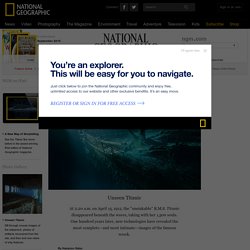
Fungi feed on it. Weird colorless life-forms, unfazed by the crushing pressure, prowl its jagged ramparts. From time to time, beginning with the discovery of the wreck in 1985 by Explorer-in-Residence Robert Ballard and Jean-Louis Michel, a robot or a manned submersible has swept over Titanic’s gloomy facets, pinged a sonar beam in its direction, taken some images—and left. Frozen Planet: Explore the polar regions. Click on the image below to start exploring the Arctic and Antarctic.
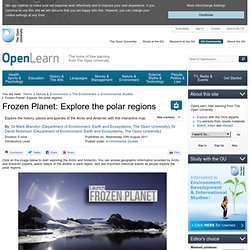
You can access geographic information provided by Arctic and Antarctic experts, watch videos of the wildlife in each region, and see important historical events as people explore the polar regions. Copyrighted image Credit: The Open University Launch Frozen Planet 9 Special thanks to British Antarctic Survey 10 for their assistance in developing this interactive map. Science Teacher Network Group News. Science writing is more technical in nature than other subjects. The major difference between science writing and other subjects is the importance placed on certain stylistic elements. When students write about science events, observations, reports, etc.; they must use more descriptive wording to avoid confusion and ambiguity.
When students write about science, they spend time writing reports about laboratory investigations using a format provided by their teacher. Although teachers tend to use laboratory report formats they favor, the information contained within all reports are same. These reports present data and/or ideas with the level of detail that allows the reader to evaluate the validity of results and conclusions based on facts presented in the report. Scientific reports or articles for a science newsletter typically follow a chain of logic used to draw conclusions from the data using the following key elements: Making the Science Writing Objective Active Versus Passive Voice. Windows to the Universe. NSTA Learning Center. Assessment Tools. The Global Climate Change Educator Professional Development Network. Chemistry. The periodic table of the elements with metallic elements colored in green, nonmetallic in orange and metalloids in blue.
Click on image for full size L.Gardiner/Windows to the Universe. Home. Latest Science News. Multimedia Gallery. News Story. We have all sat in classes in which a teacher made a difficult or abstract concept understandable by using an analogy. Science classes are full of abstract or challenging concepts that are easier to understand if they are related to something from our everyday experiences. Analogies can be useful instructional tools in each phase of the 5E instructional model. AGPA P-16 Professional Development Resources. Analogies and metaphors - The Dayside. Computer simulations in science education. Science Teacher Network Group News. There is a lot of information known about planet earth; however, every day new and astonishing little known facts are discovered. These facts are the result of research by scientists who spend their time investigating phenomena, acquiring new knowledge, or correcting and integrating prior knowledge into theories and facts that explain how the earth works.
The study of earth and its related sciences is called earth science. Investigations in earth science have produced a wealth of new knowledge and little known facts that are derived from the five major disciplines. Pete's Power Point Station - A Collection of FREE Presentations in PowerPoint format for K-12 Teachers and Students.
SCIENCE INDEX - FREE presentations in PowerPoint format, interactive activities, lessons for K-12. The art on our website was created by Phillip Martin. Some of this art may be freely used on your website. Please review our restrictions prior to use. Science - Home. Mission Center. Build a Solar System Model.
Virtual Microscopy: Magnification. Refraction of Light, Interactive Java Tutorial. Measuring With Shadows - Interactive Java Tutorial. Newton's Prism Experiment - Interactive Java Tutorial. The Physics Classroom Shockwave Physics Studios. The Shockwave Physics Studios consists of a collection of pages which feature interactive Shockwave files that simulate a physical situation. Balancing Chemical Equations. Danny Nicholson Presentations. Think Bank - Colour Mixing. The Scale of the Universe. Earth Science. SMARTBoard Science. 32 Science Websites for Fifth Graders. Welcome to the Cassiopeia Project. Welcome to the Cassiopeia Project. Science - News for Your Neurons. Online Science Teaching Resources & Instruction - NSTA Overview. Engineering Interact - Interactive science & engineering for 9-11 year olds.
DESIGN SQUAD NATION . Home. National Science Teachers Association - Science & Education Resource. Learn how Everything Works!". PeriodicTable.