
Pattern. A pattern, apart from the term's use to mean "Template",[a] is a discernible regularity in the world or in a manmade design.

As such, the elements of a pattern repeat in a predictable manner. A geometric pattern is a kind of pattern formed of geometric shapes and typically repeating like a wallpaper. Any of the five senses may directly observe patterns. Conversely, abstract patterns in science, mathematics, or language may be observable only by analysis. Direct observation in practice means seeing visual patterns, which are widespread in nature and in art.
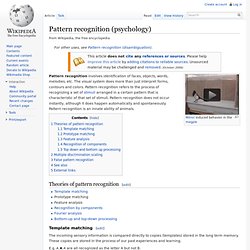
Nature[edit] Nature provides examples of many kinds of pattern, including symmetries, trees and other structures with a fractal dimension, spirals, meanders, waves, foams, tilings, cracks and stripes.[2] Symmetry[edit] Symmetry is widespread in living things. Spirals[edit] Pattern recognition (psychology) The incoming sensory information is compared directly to copies (templates) stored in the long term memory.
These copies are stored in the process of our past experiences and learning. E.g. Ten Virtues for the Modern Age. The Virtues Project comes as a response to the wave of discussion and feedback that followed the publication of my book, Religion for Atheists, and a growing sense that being virtuous has become a strange and depressing notion, while wickedness and evil bask in a peculiar kind of glamour.
My ultimate aim for the project is that it ignites a vital conversation around moral character to increase public interest in becoming more virtuous and connected as a society. In the modern world, the idea of trying to be a ‘good person’ conjures up all sorts of negative associations: of piety, solemnity, bloodlessness and sexual renunciation, as if goodness were something one would try to embrace only when other more difficult but more fulfilling avenues had been exhausted. Throughout history, societies have been interested in fostering virtues, in training us to be more virtuous, but we're one of the first generations to have zero public interest in this. 1. Resilience. 2. 3. 4. 5. Category mistake. A category mistake, or category error, is a semantic or ontological error in which "things of one kind are presented as if they belonged to another",[1] or, alternatively, a property is ascribed to a thing that could not possibly have that property.

Thomas Szasz argued that minds are not the sort of things that can be said to be diseased or ill because they belong to the wrong category and that "illness" is a term that can only be ascribed to things like the body; saying that the mind is ill is a misuse of words. Another example is the metaphor "time crawled", which if taken literally is not just false but a category mistake. To show that a category mistake has been committed one must typically show that once the phenomenon in question is properly understood, it becomes clear that the claim being made about it could not possibly be true. Gilbert Ryle[edit] The phrase is introduced in the first chapter.[2] The first example is of a visitor to Oxford. See also[edit] References[edit] Notes. Redirect with Timothy Wilson. Joshua Foer: Feats of memory anyone can do. Bruce Schneier: The security mirage.
Mental Models Website. Elementary Worldly Wisdom. A Lesson on Elementary, Worldly Wisdom As It Relates To Investment Management & Business Charles Munger, USC Business School, 1994 I'm going to play a minor trick on you today because the subject of my talk is the art of stock picking as a subdivision of the art of worldly wisdom.
That enables me to start talking about worldly wisdom—a much broader topic that interests me because I think all too little of it is delivered by modern educational systems, at least in an effective way. And therefore, the talk is sort of along the lines that some behaviorist psychologists call Grandma's rule after the wisdom of Grandma when she said that you have to eat the carrots before you get the dessert. Insight. If we eliminate system one, system two isn't going to get the job done because you can't live by system two.

There are people who try, there are people who have had various kinds of brain lesions that create disconnects between their emotions and their decision-making process. Damasio has written about them. It can take them 30 minutes to figure out what restaurant they want to go to. Their performance on intelligence tests isn't impaired, but their performance in living their lives is greatly impaired; they can't function well, and their lives go downhill. So we know that trying to do everything purely rationally, just following Bayesian statistics or anything like that isn't going to work.
Too often it's treated as a real dichotomy, and too many organizations that I study try to encourage people to just follow procedures, just follow the steps, and to be afraid to make any mistakes. Rather than perform standard research and manipulate variables, we said, "Let's talk to the experts. " An overview of the recognition primed decision making model. What is it?

In 1985 Gary Klein and others began to develop the recognition primed decision making model. They were studying decision making in the army and were examining how fire fighting chiefs make decisions. They realized that these expert decision-makers were not comparing lists of options. They were not even comparing two options.
So they ended up revising the whole research project and came up with a model of how people actually make decisions. This description they called the recognition primed decision making model. How it works In a given situation, the decision maker will pick up cues and indicators that let them recognise patterns. Klein and Co. wondered how people could assess this single option if they were not comparing it to something else. The mental simulation was based on mental models that the decision maker had developed through experience. Moving forward If the decision maker considers the action script will achieve the outcome, they go ahead.
Expertise and patterns. List of thought processes. Nature of thought[edit] Thought (or thinking) can be described as all of the following: An activity taking place in a: brain – organ that serves as the center of the nervous system in all vertebrate and most invertebrate animals (only a few invertebrates such as sponges, jellyfish, adult sea squirts and starfish do not have a brain).
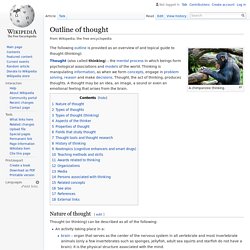
It is the physical structure associated with the mind. mind – abstract entity with the cognitive faculties of consciousness, perception, thinking, judgement, and memory.