
How the Internet powers German small businesses. In Germany, we’ve long believed that the Internet helps create innovative new small businesses - and that SMEs that go online, grow faster, export more and create more jobs than their offline competitors.
But to prove it, we needed solid evidence. So we commissioned the Institute of the German Economy in Cologne (IW Cologne) to find out how the Internet has benefited SMEs - and the German economy. The findings, released this week, are startling. Since 2007, they estimate that German entrepreneurs have founded 28,000 new businesses using online services from Google and other web companies. These new businesses have created nearly 100,000 new jobs and in 2010 generated EUR 8.6 billion in sales. As part of the research, the consultants more than 11,000 Google customers in Germany. The new study suggests that online business is particularly effective for small companies with up to nine employees. Small, Internet-savvy businesses are also more innovative than the German average.
Reconciling social computing with the enterprise. Umair Haque wrote an impressive tract on his Harvard Business blog late last week about Twitter and how it changes the rules of innovation.
SLIDES: Social Media Basics For Executives. China's Internet obsession - McKinsey Quarterly - Marketing - Di. Just how big (or small) a market would Google leave behind were it to pull out of China today?
In January, China Internet Network Information Center, the country’s official domain registry and research organization, reported that by the end of 2009, the number of Internet users in China had touched 384 million, more than the entire population of the United States. That’s an increase of around 50 percent over 2008. Moreover, 233 million Chinese—twice as many as in the previous year—accessed the Net on handheld devices, partly because China’s cellular providers started offering 3G services widely last year. The Chinese are obsessed with the Internet. People in the 60 largest cities in China spend around 70 percent of their leisure time on the Internet, according to a survey we conducted in 2009. BuzzParadise // Blogger community - Influence marketing - Buzz m. Inside the War Against China's Blogs.
Vengeful bloggers?
Flaming posts? PR firms help global brands navigate the country's perilous Web. How Web 2.0 is changing the way we work Andrew McAfee - McKinsey. Andrew McAfee on Enterprise 2.0. Blog : Andrew McAfee’s Blog. Just a quick note to let Washingtonians know about two happenings in their city this week.
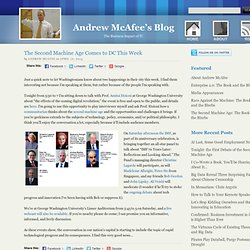
I find them interesting not because I’m speaking at them, but rather because of the people I’m speaking with. Tonight from 5:30 to 7 I’m sitting down to talk with Prof. Amitai Etzioni at George Washington University about “the effects of the coming digital revolution;” the event is free and open to the public, and details are here. I’m going to use this opportunity to play interviewer myself and ask Prof. Etzioni how a communitarian thinks about the second machine age and the opportunities and challenges it brings. On Saturday afternoon the IMF, as part of its anniversary celebration, is bringing together an all-star panel to talk about “IMF 70 Years Later: Reflections and Looking Ahead.” How companies are benefiting from Web 2.0 - McKinsey Quarterly - Over the past three years, we have tracked the rising adoption of Web 2.0 technologies, as well as the ways organizations are using them.
This year, we sought to get a clear idea of whether companies are deriving measurable business benefits from their investments in the Web. Our findings indicate that they are. Podcast How companies are benefiting from Web 2.0: McKinsey Global Survey results. 35+ Examples of Corporate Social Media in Action. We’ve discussed some tactics to get your company better engaged with social media.
Lest you think there’s a limit to how you can connect with business and customer facing audiences, we’ve assembled this list of more than 35 companies who are experimenting with social media in a host of different ways. This list is by no means exhaustive, and it represents a wide variety of businesses, industries and social media tools. As you can see, engagement takes many forms. Some are likely to generate more discussions with the company while others might result better connections between customers. Some will fade away over the next 6-12 months while others will continue to grow and evolve. There are no rules to what form your engagement has to take. If you have other examples of corporate social media engagement, please share them in the comments. Marriott on the Move - Bill Marriott's Blog. When I visit our hotels, I always like to go to the kitchen.
A clean, well-run kitchen usually means the rest of the hotel is also clean and well run. In the hotel business, we call it "the heart of the house. " The kitchen is pretty close to my heart too, because that's where I got my start 55 years ago. I was working in my parents' Hot Shoppes restaurant in Salt Lake City. Not many people get to go behind the scenes of a Marriott kitchen, but now you can thanks to a new game we launched on our Jobs and Careers Facebook page.